
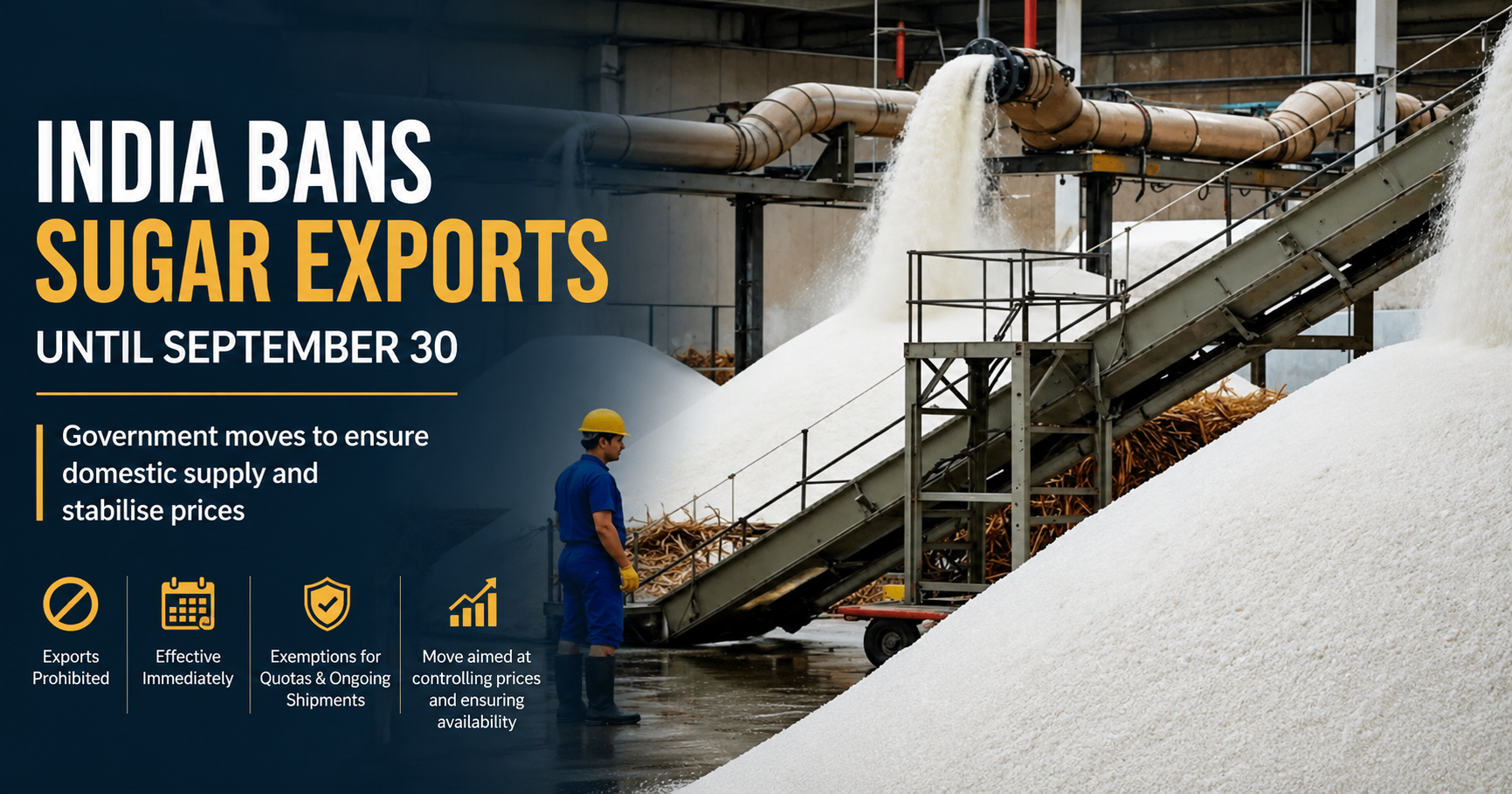
Government shifts export policy from “restricted” to “prohibited” for most sugar categories amid concerns over lower production and rising domestic demand
The Indian government has imposed an immediate ban on the export of raw, white, and refined sugar in an effort to maintain domestic availability and control rising prices in the local market.
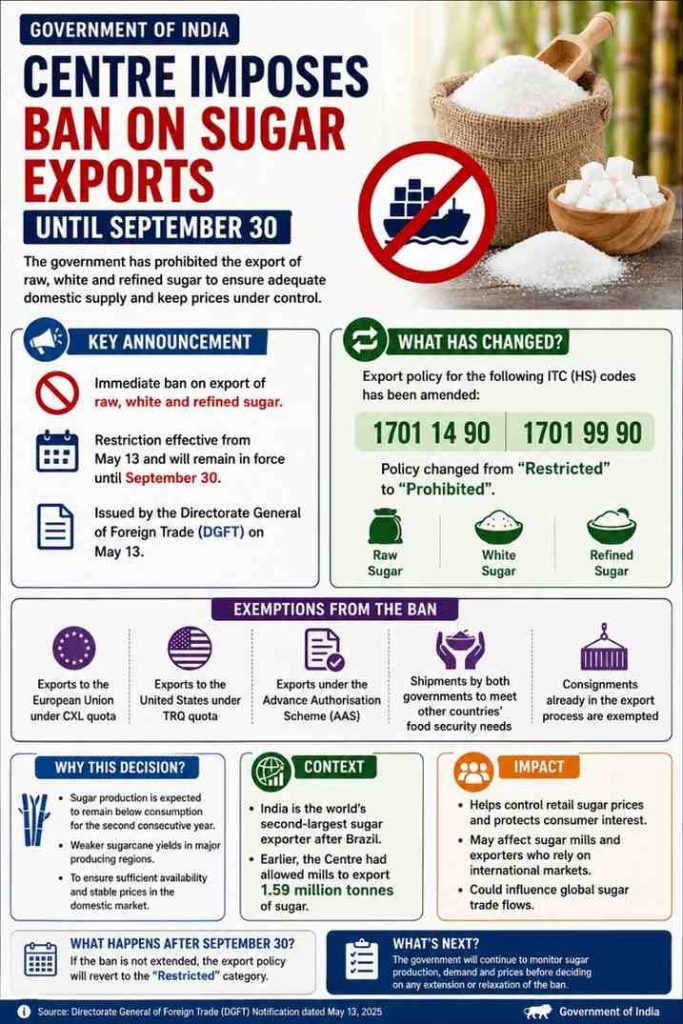
The decision was announced through a notification issued by the Directorate General of Foreign Trade late on May 13. The restriction will remain in force until September 30 unless extended further.
Key Announcements / Highlights
The Centre has prohibited exports of most sugar varieties until September 30.
The export policy for key sugar categories has been changed from “restricted” to “prohibited.”
Certain quota-based exports and ongoing shipments have been exempted from the ban.
What the Government Notification Says
According to the DGFT notification, exports under specific sugar categories classified under ITC (HS) codes 1701 14 90 and 1701 99 90 will no longer be permitted during the restriction period.
The move covers raw sugar, white sugar, and refined sugar exports. However, the government clarified that shipments under special international quota arrangements and select authorised schemes would continue.
Exports to the European Union and the United States under CXL and Tariff Rate Quota (TRQ) arrangements have been exempted. Shipments made under the Advance Authorisation Scheme (AAS) and exports linked to humanitarian or food-security assistance by governments are also excluded from the restriction.
Additionally, consignments already in the export process before the notification was issued will not be affected.
Why the Ban Was Introduced
Officials and market analysts say the decision comes amid concerns over domestic sugar availability and lower-than-expected sugarcane output in major producing states.
India is expected to witness sugar production remaining below domestic consumption levels for the second consecutive year, largely due to weaker sugarcane yields in key agricultural regions.
Higher global demand and tighter domestic supply conditions had also increased concerns over price volatility in the local market.
Context / Background
India is one of the world’s largest sugar producers and exporters, ranking second globally after Brazil in sugar exports.
In recent years, the government has frequently adjusted sugar export policies to balance farmer interests, mill revenues, and domestic consumer prices. Earlier, authorities had allowed sugar mills to export around 1.59 million tonnes of sugar under controlled conditions.
Public Impact
The export restriction is expected to help stabilise sugar prices for consumers and food manufacturers within India.
However, the move may impact sugar mills and exporters who rely on international sales, especially during periods of strong global prices.
The policy could also influence global sugar trade flows, given India’s significant role in the international market.
Conclusion and Outlook
The government indicated that the export policy may return to the “restricted” category after September if market conditions improve.
Officials are expected to continue monitoring domestic sugar production, demand, and price trends before deciding on any extension or relaxation of the export ban.
Key Insights
- India’s export ban reflects growing concern over domestic food inflation and lower sugar production in major cane-producing states.
- As one of the world’s largest sugar exporters, India’s decision could influence global sugar prices and international trade flows.
- The temporary restriction suggests the government is closely monitoring monsoon conditions, domestic demand, and future sugarcane output before reviewing the policy again after September.
- The move may help stabilise local sugar prices for consumers, but it could affect sugar mills and exporters that benefit from overseas demand.
- The policy also highlights the balancing act between maintaining domestic supply and supporting India’s ethanol-blending and biofuel goals.
Input & Images : Hindusthan Samachar
Add outlooknews.in as preferred source on google – click here
Also read – CBO Estimates Trump’s “Golden Dome” Missile Shield Could Cost $1.2 Trillion Over 20 Years
Last Updated on: Thursday, May 14, 2026 4:44 pm by Monisha Angara | Published by: Monisha Angara on Thursday, May 14, 2026 4:40 pm | News Categories: Business
About The Author