

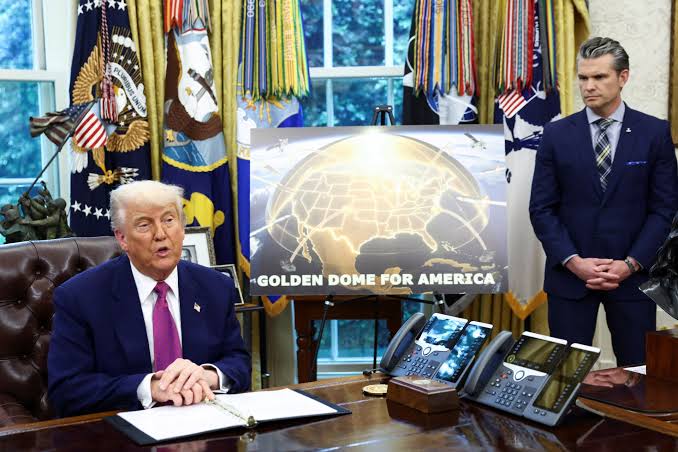
Congressional Budget Office projects costs far above White House estimates, with space-based defence systems driving most of the expense
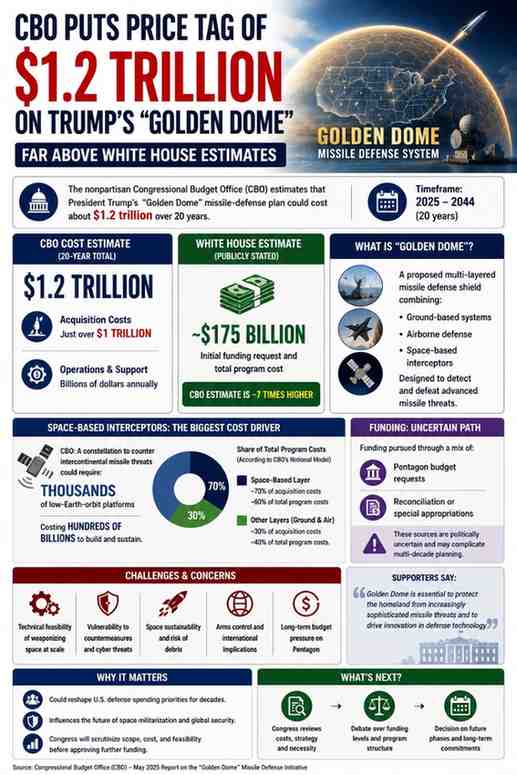
The Congressional Budget Office has estimated that former US President Donald Trump’s proposed “Golden Dome” missile-defence initiative could cost around $1.2 trillion over two decades, significantly higher than the administration’s earlier public estimates.
The nonpartisan budget office said the projected cost includes development, deployment, and long-term operational expenses tied to the proposed multi-layered defence system.
Key Announcements / Highlights
The CBO estimated total program costs at approximately $1.2 trillion over 20 years.
Space-based interceptor systems were identified as the most expensive component.
The estimate is substantially higher than the administration’s previously cited figure of about $175 billion.
What Is the “Golden Dome” Project?
The “Golden Dome” initiative was introduced by Donald Trump in early 2025 as a large-scale missile-defence programme designed to protect the United States against advanced aerial and missile threats.
According to public descriptions from administration officials, the system would combine ground-based, airborne, and space-based defence layers capable of detecting and intercepting incoming missiles.
The proposal has been compared by some analysts to earlier missile-defence concepts that relied heavily on integrated surveillance and interception technology.
Why the Cost Estimate Is So High
The CBO report stated that space-based interceptors account for the majority of projected spending.
The office estimated that deploying a satellite network capable of responding to intercontinental missile threats could require thousands of low-Earth-orbit platforms, resulting in hundreds of billions of dollars in acquisition and maintenance costs.
According to the analysis, the space-based layer alone could represent roughly 70 percent of total acquisition expenses.
In addition to deployment costs, the report projected significant annual operational and support expenses, raising concerns about long-term budgetary pressure on US defence spending.
Official and Expert Reactions
Supporters of the project argue that the programme is intended to strengthen homeland defence capabilities amid evolving missile threats from rival nations.
Administration allies have also said the initiative could accelerate technological innovation in missile-warning and defence systems.
However, defence analysts and policy experts have raised concerns about the technical feasibility, long-term sustainability, and strategic implications of deploying large-scale weapon systems in space.
Some experts also warned about the risks of orbital debris, countermeasures by adversaries, and the broader impact on international arms-control discussions.
Context / Background
The United States has invested in missile-defence programmes for decades, including ground-based interceptors and regional defence systems.
The proposed Golden Dome project represents a far broader and more technologically ambitious concept, particularly due to its planned reliance on space-based interception capabilities.
The latest CBO findings are expected to influence congressional debate over future funding and the programme’s overall scope.
Public Impact
Large-scale defence spending proposals can affect federal budget priorities and influence broader debates over national security, infrastructure, healthcare, and other public expenditures.
The report may also shape public discussion around military modernisation and the growing militarisation of space technologies.
Conclusion and Outlook
Congress is expected to examine the programme’s projected costs, feasibility, and strategic value as lawmakers consider future defence appropriations.
The CBO’s estimate has added new scrutiny to the Golden Dome proposal, particularly regarding whether the project can realistically be funded and implemented on the scale envisioned by its supporters.
Input & Images : Hindusthan Samachar
Add outlooknews.in as preferred source on google – click here
Also read – Indian Stock Market Falls for Second Straight Session as Sensex Drops Over 760 Points
Last Updated on: Wednesday, May 13, 2026 11:32 am by Monisha Angara | Published by: Monisha Angara on Wednesday, May 13, 2026 11:32 am | News Categories: News
About The Author