


Global financial markets delivered a mixed performance on Wednesday as investors balanced optimism surrounding technology stocks against growing geopolitical concerns and uncertainty over the global economic outlook.
While major U.S. indices managed to close in positive territory after a volatile trading session, Asian markets displayed a more fragmented picture, reflecting varying regional responses to risk sentiment, economic expectations, and geopolitical developments. European equities also extended recent gains, underscoring the uneven nature of current global market conditions.
The latest trading activity suggests investors remain willing to pursue opportunities in growth sectors but are increasingly cautious about risks linked to international conflicts, energy prices, and monetary policy trajectories.
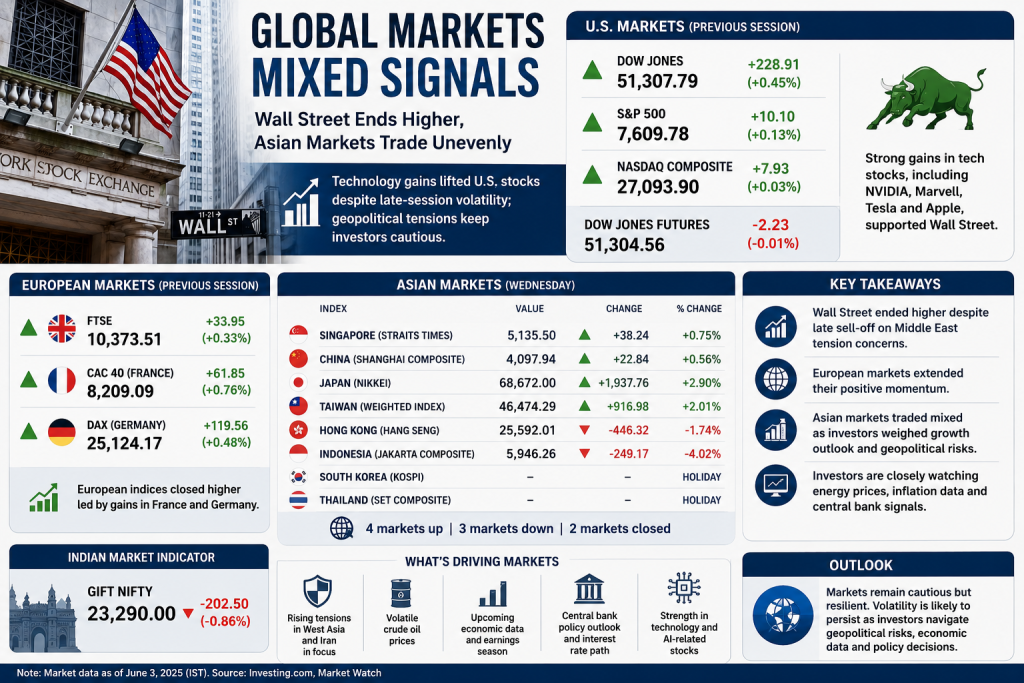
Wall Street Ends Higher Despite Volatile Session
U.S. markets experienced significant intraday swings as strong gains in technology shares initially drove major indices sharply higher before geopolitical headlines triggered a bout of late-session selling.
Investor enthusiasm was fueled by continued strength in artificial intelligence-related stocks and large-cap technology companies. Market leaders in semiconductors, cloud computing, and electric vehicles remained key drivers of sentiment, helping offset concerns emerging from international developments.
Despite profit-taking later in the session, the broader market maintained enough momentum to finish higher. The performance reinforced the influential role that technology stocks continue to play in supporting U.S. equity valuations, even as investors become increasingly sensitive to external risks.
Market analysts note that the resilience of growth-oriented stocks reflects ongoing confidence in long-term earnings potential, particularly among companies benefiting from advances in artificial intelligence, automation, and digital infrastructure.
Geopolitical Risks Remain in Focus
A major theme influencing market behavior remains the evolving geopolitical situation in West Asia.
Recent reports of rising tensions involving Iran have heightened concerns about regional stability and the potential impact on global energy supplies. Financial markets remain particularly sensitive to developments that could affect crude oil production or disrupt key shipping routes.
Historically, periods of geopolitical uncertainty tend to increase volatility across equities, commodities, and currency markets. Investors often respond by reducing exposure to riskier assets and shifting capital toward perceived safe-haven investments.
Although recent market reactions have remained relatively measured, analysts caution that any significant escalation could alter investor sentiment quickly and create additional pressure on global markets.
European Markets Extend Positive Momentum
European equities also finished higher, supported by improving corporate sentiment and continued investor interest in cyclical sectors.
Major regional indices recorded gains despite broader geopolitical concerns. Market participants have been encouraged by signs of economic stabilization across parts of Europe, although questions remain regarding inflation trends, consumer demand, and future central bank policy decisions.
Financial institutions, industrial companies, and select technology stocks contributed to gains across several major European exchanges.
Investors continue to assess whether economic growth across the euro area can remain resilient amid a challenging global backdrop marked by slower trade growth and ongoing geopolitical risks.
Asian Markets Reflect Diverging Sentiment
Trading across Asia presented a more varied picture, highlighting differences in regional market drivers.
Several markets advanced on the back of strong global technology sentiment and optimism surrounding export-oriented sectors. Japan emerged as one of the strongest performers, benefiting from renewed investor confidence and strength in technology-linked stocks.
Chinese equities also posted gains as investors assessed domestic policy measures aimed at supporting economic activity. Meanwhile, other regional markets faced pressure due to concerns over external demand, geopolitical uncertainty, and profit-taking after recent rallies.
The uneven performance illustrates how regional markets are responding differently to a combination of domestic economic factors and international developments.
Energy Prices and Central Banks Remain Key Variables
Beyond geopolitical concerns, investors continue to monitor energy markets and central bank signals.
Fluctuations in oil prices remain particularly important because of their potential impact on inflation. Higher energy costs can influence transportation expenses, manufacturing activity, and consumer prices, creating challenges for policymakers attempting to maintain economic stability.
At the same time, traders are closely watching upcoming economic indicators for clues regarding interest-rate policy across major economies. Central bank decisions over the coming months are expected to play a significant role in determining market direction, particularly as investors weigh growth prospects against inflation risks.
Investors Navigate a Complex Global Environment
The current market environment reflects a delicate balance between optimism and caution.
On one side, strong corporate earnings, technological innovation, and resilient economic activity continue to support investor confidence. On the other, geopolitical tensions, energy-market uncertainty, and shifting monetary policy expectations remain significant sources of risk.
As markets digest new economic data and monitor international developments, volatility is likely to remain elevated. Investors are expected to continue focusing on sectors with strong earnings visibility while remaining attentive to global events that could influence sentiment.
For now, global markets remain broadly resilient, but the mixed performance across regions suggests investors are becoming increasingly selective as they navigate a rapidly changing economic and geopolitical landscape.
Key Highlights:
- Wall Street closed higher despite late-session volatility driven by geopolitical concerns.
- Technology stocks, including major AI and growth companies, helped support U.S. markets.
- European indices ended in positive territory, led by gains in France and Germany.
- Asian markets traded mixed, with strong rallies in Japan and Taiwan offset by declines in Hong Kong and Indonesia.
- Investors remain focused on West Asia tensions and their potential impact on global energy markets.
- Oil prices, inflation risks, and upcoming economic data continue to influence market sentiment.
- Gift Nifty traded lower, indicating cautious sentiment among Indian investors.
- Market participants are closely watching central bank signals and global growth indicators for future direction.
Input & Images : Hindusthan Samachar
Add outlooknews.in as preferred source on google – click here
Also read – Australia Fight Back to Level ODI Series as Nathan Ellis Leads Dominant Win Over Pakistan
Last Updated on: Wednesday, June 3, 2026 6:33 pm by Monisha Angara | Published by: Monisha Angara on Wednesday, June 3, 2026 6:26 pm | News Categories: Business
About The Author