
Businesses dependent on commercial cooking gas will face higher operating costs from June 1 after oil marketing companies revised prices of commercial LPG cylinders upward across major cities. The increase comes alongside a separate policy move by the central government to reduce export duties on petroleum products, highlighting a contrasting approach toward domestic energy pricing and export competitiveness.
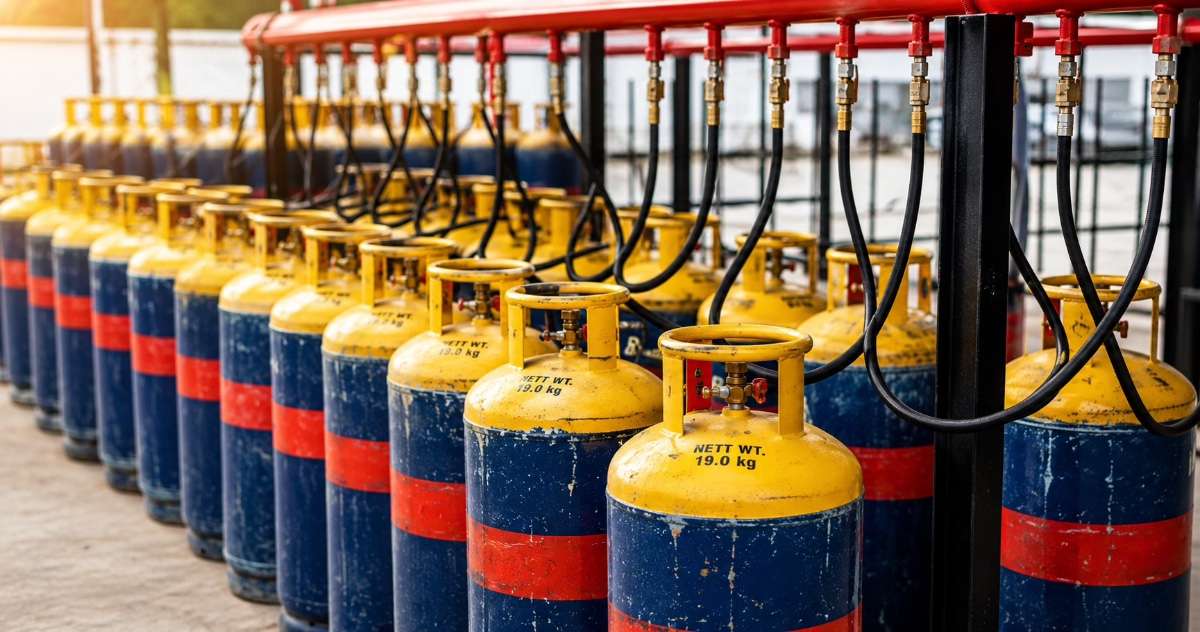
The latest revision affects 19-kilogram commercial LPG cylinders commonly used by restaurants, hotels, catering services, and small businesses. In contrast, household consumers have been spared any immediate impact, as prices of the standard 14.2-kg domestic cooking gas cylinder remain unchanged.
The dual announcements underscore the government’s ongoing effort to balance fiscal priorities, global energy market conditions, and domestic inflation concerns while maintaining stability in consumer fuel prices.
Commercial Users Face Fresh Cost Pressures
The increase in commercial LPG prices is expected to be felt most directly by food-service businesses and small enterprises that rely heavily on gas-based operations.
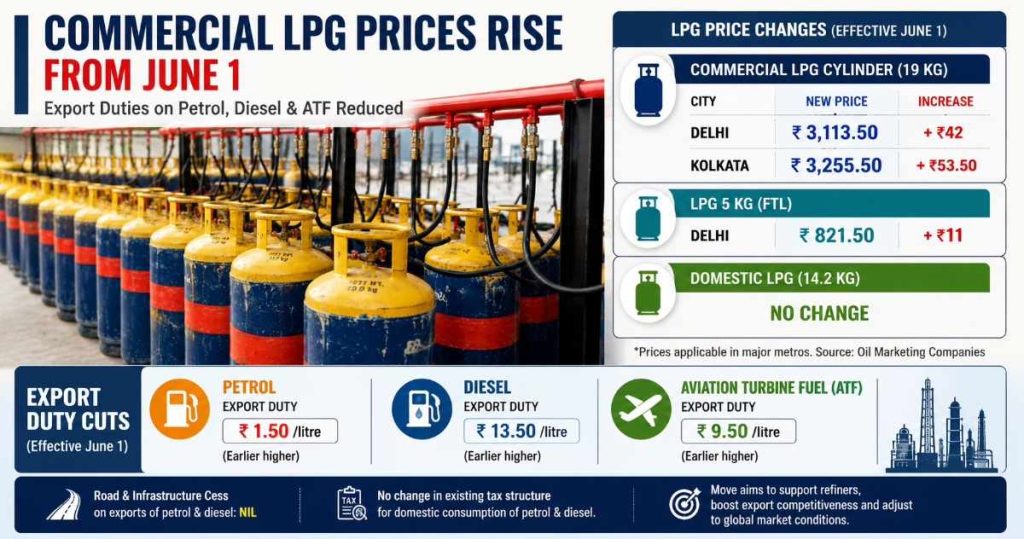
In Delhi, the price of a 19-kg commercial cylinder has risen by ₹42, while other metropolitan markets have also recorded increases. The price revision follows periodic adjustments linked to international energy benchmarks, currency movements, and procurement costs.
Industry observers note that commercial LPG pricing remains significantly more sensitive to global market fluctuations than subsidized or politically sensitive household fuel categories. As a result, restaurants and commercial establishments often absorb the impact of energy price changes more frequently than residential consumers.
For many small businesses already navigating elevated input costs, the latest hike could place additional pressure on margins, particularly in sectors where passing higher costs on to customers remains difficult.
Domestic Consumers Largely Protected
Despite the increase in commercial rates, domestic LPG users have received temporary relief.
The price of the widely used 14.2-kg household cylinder has not been revised, allowing millions of families to avoid additional fuel expenses. Maintaining stable domestic cooking gas prices has remained an important policy consideration given the broader impact of household energy costs on inflation and consumer spending.
Economists frequently point out that cooking fuel prices carry both economic and political significance because they directly influence household budgets across urban and rural India.
By leaving domestic LPG rates unchanged, policymakers appear to be attempting to limit inflationary pressures while allowing market-linked adjustments in the commercial segment.
Government Cuts Export Duties on Petroleum Products
While LPG users face higher commercial costs, refiners and exporters have received a measure of relief through reductions in export duties on petrol, diesel, and aviation turbine fuel (ATF).
The government has lowered the windfall tax burden on these products, reducing export levies across key fuel categories. Such taxes were originally introduced during periods of exceptionally high global crude oil prices, when energy companies benefited from elevated refining margins and export earnings.
As international energy markets have gradually stabilized compared with the extreme volatility witnessed in previous years, authorities have repeatedly recalibrated the tax structure to reflect changing market conditions.
Energy analysts suggest that lower export duties may improve profitability for refiners and enhance the competitiveness of Indian petroleum exports in global markets.
What the Policy Changes Mean
The simultaneous increase in commercial LPG prices and reduction in export duties reflects two distinct policy objectives.
On one hand, LPG pricing continues to follow cost-linked revisions influenced by global energy trends. On the other, export duty reductions indicate an effort to support India’s refining sector and maintain export competitiveness amid evolving international demand patterns.
India remains one of the world’s largest consumers and importers of energy products, making fuel taxation and pricing decisions closely watched indicators of broader economic policy.
For businesses, the immediate impact will likely be higher operational expenses associated with commercial LPG usage. For fuel exporters and refiners, reduced duties may offer greater flexibility and improved margins in overseas markets.
Energy Policy Balancing Act Continues
The latest changes highlight the complexity of managing energy policy in a large and rapidly growing economy.
Governments must simultaneously address inflation concerns, fiscal requirements, consumer affordability, industrial competitiveness, and global market developments. Adjustments to fuel prices and export taxes are often part of that balancing exercise.
As international crude oil prices, refining margins, and energy demand continue to evolve, further revisions to fuel-related taxes and LPG pricing cannot be ruled out. For now, commercial users face higher costs, domestic consumers remain shielded from immediate increases, and exporters gain modest relief through a lighter tax burden.
The developments reinforce a broader reality of India’s energy landscape: pricing decisions increasingly reflect a mix of market forces and policy objectives rather than a single economic consideration.
Key Highlights
- Commercial 19-kg LPG cylinder prices increased from June 1 across major cities.
- Delhi commercial LPG cylinder price rises by ₹42 to ₹3,113.50.
- Kolkata sees a sharper increase of ₹53.50, taking the price to ₹3,255.50.
- 5-kg Free Trade LPG (FTL) cylinder becomes costlier by ₹11.
- No change in the price of the 14.2-kg domestic cooking gas cylinder.
- Central government cuts export duties on petrol, diesel, and aviation turbine fuel (ATF).
- Petrol export duty reduced to ₹1.50 per litre.
- Diesel export duty lowered to ₹13.50 per litre.
- ATF export duty cut to ₹9.50 per litre.
- Existing tax structure for domestic petrol and diesel consumption remains unchanged.
Input & Images : Hindusthan Samachar
Add outlooknews.in as preferred source on google – click here
Also read – IPO Market Gears Up for Busy Week as Five New Issues Open and Four SME Listings Approach
Last Updated on: Monday, June 1, 2026 11:31 am by Monisha Angara | Published by: Monisha Angara on Monday, June 1, 2026 11:30 am | News Categories: India
About The Author