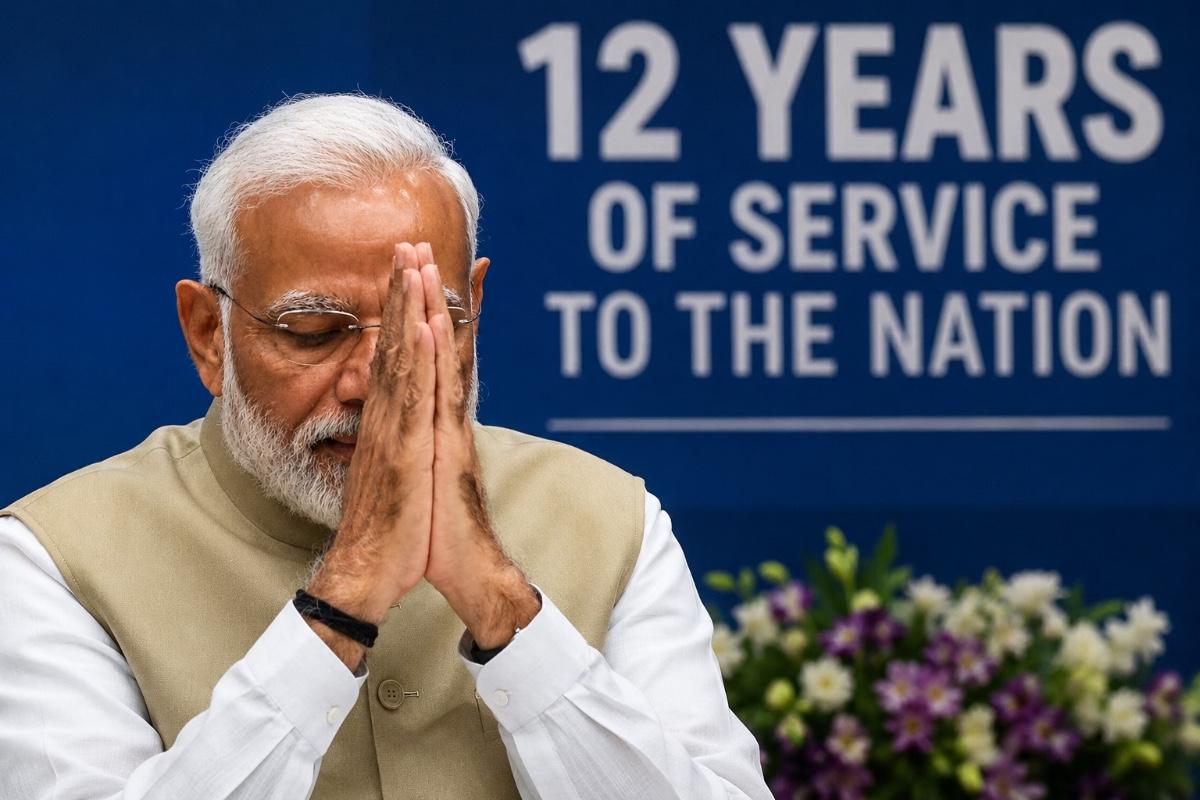

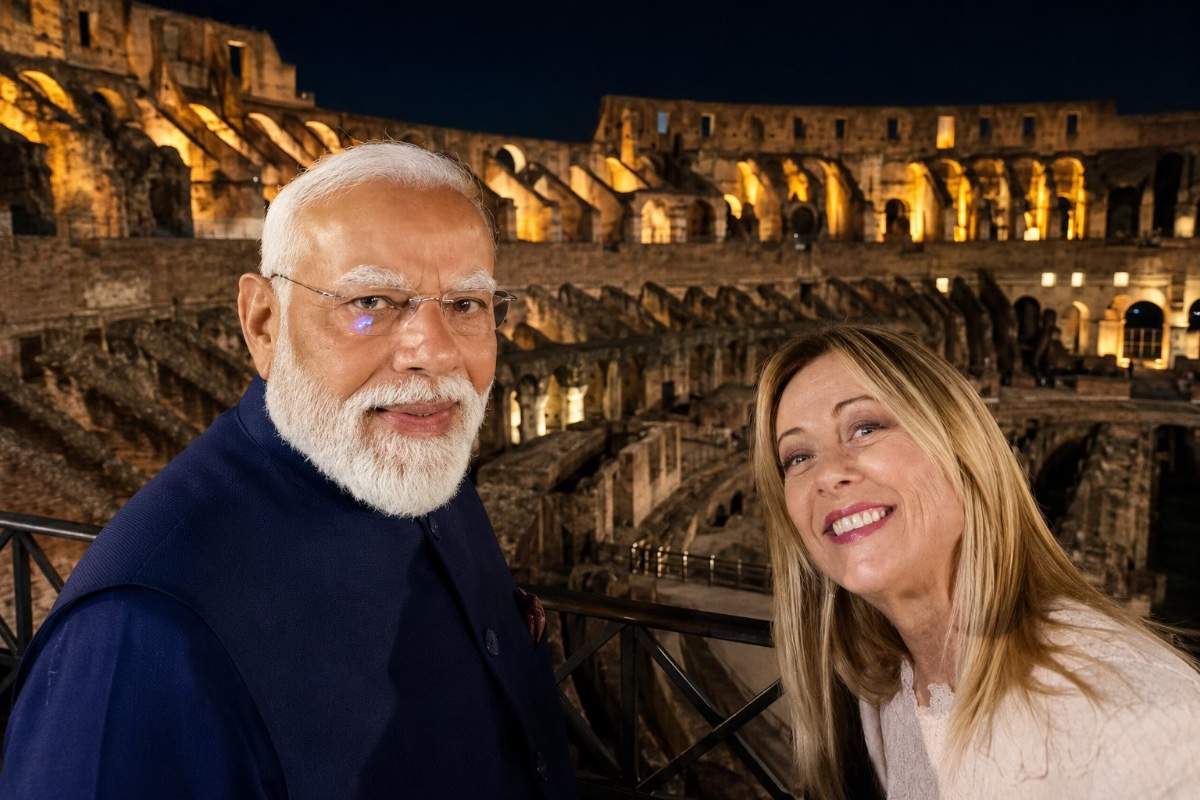
Prime Minister Narendra Modi arrived in Rome on Tuesday for the final leg of his multi-nation diplomatic tour, signaling the growing strategic importance of India’s partnership with Italy at a time when New Delhi is expanding its political, economic and technological engagement across Europe.
Italian Prime Minister Giorgia Meloni welcomed Modi with a warm public message on social media, posting a photograph alongside the Indian leader and writing, “Welcome to Rome, my friend!” The gesture reflected not only personal diplomatic chemistry between the two leaders, but also the increasingly visible alignment between India and Italy on trade, technology, energy transition and geopolitical cooperation.
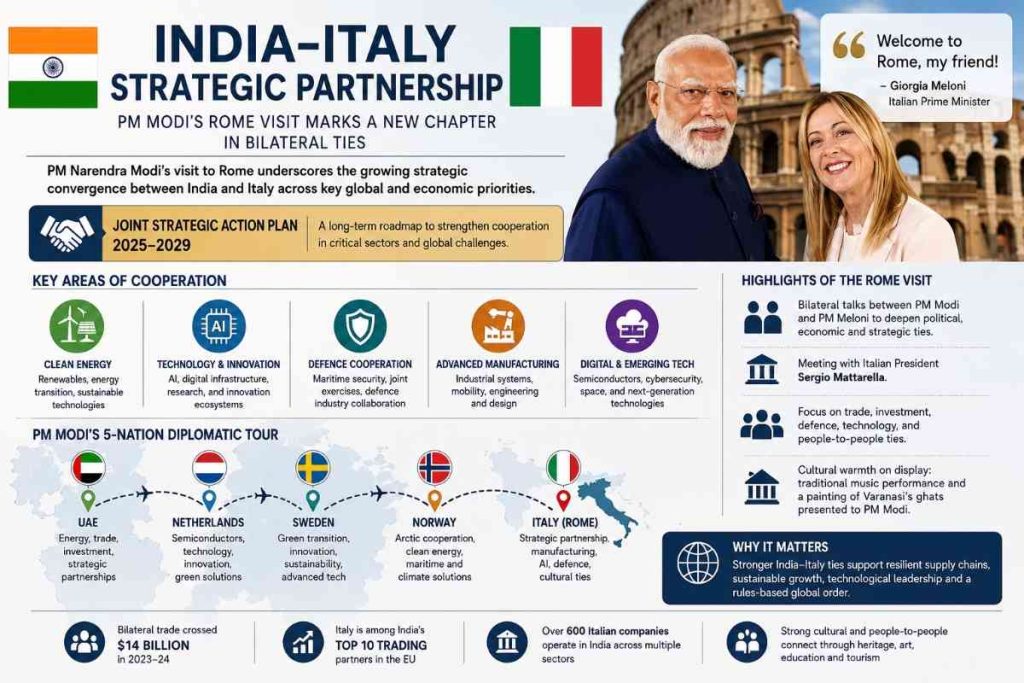
The visit comes as both countries push forward with the India-Italy Joint Strategic Action Plan 2025–2029, a long-term framework designed to strengthen bilateral cooperation across sectors ranging from advanced manufacturing and artificial intelligence to clean energy, mobility and scientific research.
India-Italy Relations Move Beyond Traditional Diplomacy
Relations between India and Italy have undergone a notable transformation in recent years after a period of diplomatic strain earlier in the last decade. Policymakers in both capitals now increasingly view the partnership through a strategic lens shaped by supply-chain diversification, Indo-Pacific engagement, industrial collaboration and energy security concerns.
Italy, Europe’s third-largest economy in the eurozone, has been seeking stronger engagement with fast-growing Asian markets as European governments reassess economic dependencies and global manufacturing vulnerabilities.
India, meanwhile, is intensifying outreach to technologically advanced European nations capable of contributing to its infrastructure expansion, clean-energy ambitions and industrial modernization goals.
Diplomatic analysts say the Rome visit reflects a broader trend in India-Europe relations, where partnerships are increasingly driven by economic resilience, strategic autonomy and emerging technologies rather than purely ceremonial diplomacy.
Strategic Cooperation Expanding Across Multiple Sectors
Talks between Modi and Meloni are expected to focus heavily on trade, defence cooperation, renewable energy, semiconductors, innovation ecosystems and digital infrastructure.
Both countries have shown growing interest in collaboration on green technologies and sustainable manufacturing as governments worldwide accelerate energy-transition policies and climate-focused industrial investments.
India’s rapidly expanding renewable-energy market and large-scale infrastructure projects are increasingly attracting European strategic interest, while Italy’s expertise in industrial engineering, mobility systems, advanced manufacturing and design-based industries offers potential areas for deeper collaboration.
Artificial intelligence, cybersecurity and scientific research are also expected to remain central areas of discussion as India positions itself as a major technology and innovation hub.
Officials from both countries have repeatedly emphasized that future cooperation is expected to move beyond conventional trade relationships toward long-term industrial and research partnerships.
Cultural Diplomacy Shapes the Visit
Beyond the political and economic agenda, Modi’s arrival in Rome also carried a strong cultural dimension.
The Indian Prime Minister received a ceremonial welcome featuring a musical performance inspired by Raga Hamsadhwani, reflecting the growing visibility of Indian cultural traditions within Europe’s artistic and academic circles.
Artists involved in the performance described the composition as a tribute to India’s civilizational heritage and a symbol of increasing cultural exchange between the two countries.
Modi was also presented with a painting depicting the ghats of Varanasi one of India’s oldest spiritual and cultural centers highlighting how cultural symbolism continues to play an important role in India’s global diplomatic outreach.
India has increasingly incorporated soft-power diplomacy, diaspora engagement and cultural heritage promotion into its international strategy, particularly across Europe and the Gulf region.
Europe Emerging as a Major Pillar of India’s Foreign Policy
The Rome visit follows Modi’s participation in the India-Nordic Summit in Oslo, where discussions focused on climate technology, Arctic cooperation, sustainable development and innovation partnerships with Nordic nations.
Earlier stops during the tour included engagements in the United Arab Emirates, the Netherlands and Sweden, underscoring India’s attempt to strengthen interconnected relationships across energy, trade, technology and strategic sectors.
Foreign-policy observers increasingly describe India’s current diplomatic approach as “multi-alignment” — maintaining simultaneous partnerships with Western economies, Gulf nations, Indo-Pacific allies and emerging global blocs while preserving independent strategic positioning.
Europe has become a particularly important component of that strategy as both India and European governments seek to diversify economic relationships amid geopolitical fragmentation and global supply-chain restructuring.
India’s growing engagement with Italy, the Nordic countries and the European Union reflects New Delhi’s effort to deepen access to investment, innovation and advanced industrial ecosystems.
Economic and Geopolitical Context Behind the Visit
The strengthening India-Italy relationship also comes against the backdrop of shifting geopolitical dynamics across Europe and the Indo-Pacific.
European governments are increasingly reassessing economic dependencies following disruptions caused by the pandemic, the Russia-Ukraine conflict and global trade tensions. India, with its expanding manufacturing base, digital economy and large consumer market, has emerged as a strategically attractive partner.
For India, deeper European engagement provides access to technology transfer, industrial expertise and diversified investment channels necessary for long-term economic transformation.
At the same time, both countries have shown greater willingness to cooperate on maritime security, global governance reforms, climate commitments and strategic connectivity initiatives.
Analysts note that the growing warmth between Modi and Meloni also reflects broader political convergence on issues such as economic nationalism, supply-chain resilience and balancing globalization with domestic industrial priorities.
Focus Now Shifts to Implementation
While diplomatic symbolism and public messaging have generated visibility around the visit, the long-term significance of India-Italy relations will depend on execution.
Trade facilitation, industrial investments, research collaboration and technology partnerships are likely to determine whether the momentum translates into durable economic outcomes.
Still, the Rome visit highlights a larger reality shaping global diplomacy: India’s engagement with Europe is no longer limited to traditional political relations. It is increasingly centered on technology, industrial cooperation, sustainability and strategic coordination in an uncertain international environment.
As geopolitical and economic systems continue to evolve, partnerships like the one emerging between India and Italy are expected to play a growing role in shaping the next phase of India’s global engagement.
Key Highlights
- Prime Minister Narendra Modi arrived in Rome for the final leg of his five-nation diplomatic tour, receiving a warm public welcome from Italian Prime Minister Giorgia Meloni.
- India and Italy are expected to deepen cooperation under the Joint Strategic Action Plan 2025–2029, focusing on clean energy, advanced manufacturing, AI, digital innovation and defence collaboration.
- Modi’s Rome visit reflects India’s broader push to strengthen strategic and economic partnerships with major European economies amid shifting global trade and geopolitical dynamics.
- Bilateral talks are expected to focus on technology partnerships, energy transition, industrial investment and innovation-driven economic cooperation.
- The visit also highlighted cultural diplomacy, with Modi receiving a ceremonial welcome featuring a musical performance inspired by Indian classical traditions and a painting of Varanasi’s ghats.
- The Rome engagement follows Modi’s participation in the India-Nordic Summit, underscoring India’s expanding diplomatic outreach across Europe on sustainability, technology and global coordination.
- Analysts view the strengthening India-Italy relationship as part of New Delhi’s wider “multi-alignment” strategy aimed at building diversified partnerships across Europe, the Gulf and the Indo-Pacific.
Input & Images : Hindusthan Samachar
Add outlooknews.in as preferred source on google – click here
Also read – Cuba-US Tensions Rise as Havana Warns Against ‘Incalculable Consequences’ Amid Drone Concerns
Last Updated on: Wednesday, May 20, 2026 11:19 am by Monisha Angara | Published by: Monisha Angara on Wednesday, May 20, 2026 11:16 am | News Categories: Politics, India
About The Author