

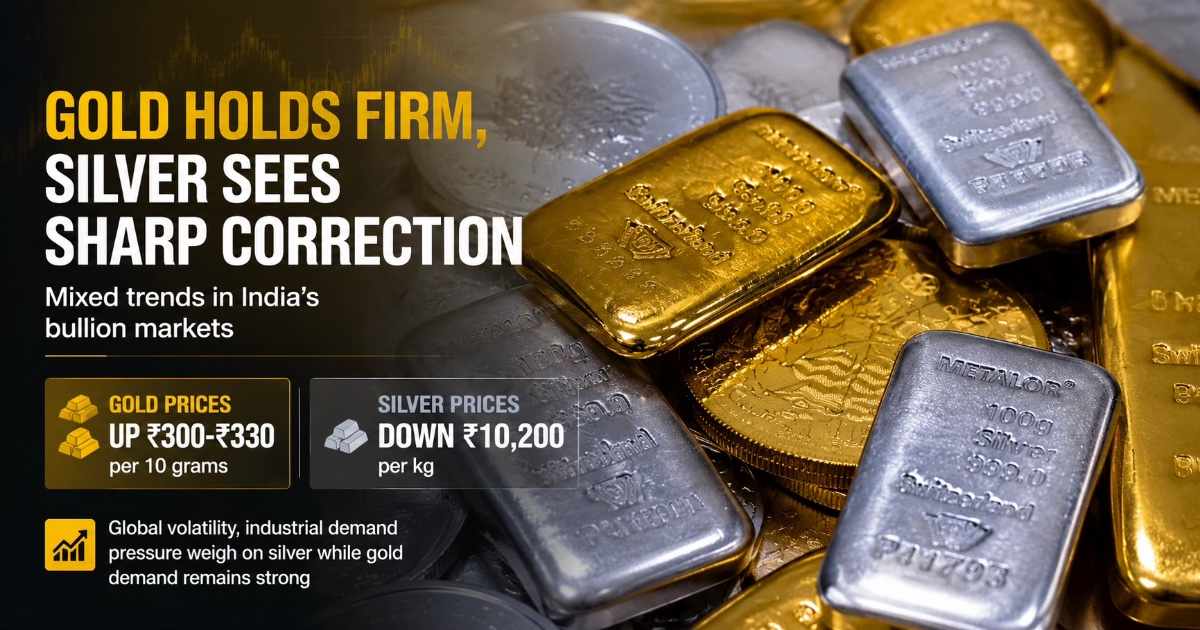
India’s bullion markets witnessed a mixed trading session on Friday, with gold prices continuing their upward movement across major jewellery centres even as silver recorded one of its steepest single-day declines in recent weeks. The divergence reflects growing uncertainty in global commodity markets, shifting investor sentiment, and changing demand dynamics ahead of the festive and wedding-buying season.
Retail gold prices rose by roughly ₹300–₹330 per 10 grams in several cities during early trade, supported by resilient domestic demand and elevated spot prices. Silver, however, came under significant pressure, falling by as much as ₹10,200 per kilogram in some wholesale markets, highlighting heightened volatility in industrial and investment demand for the metal.
Gold Remains Strong Despite Global Pullback
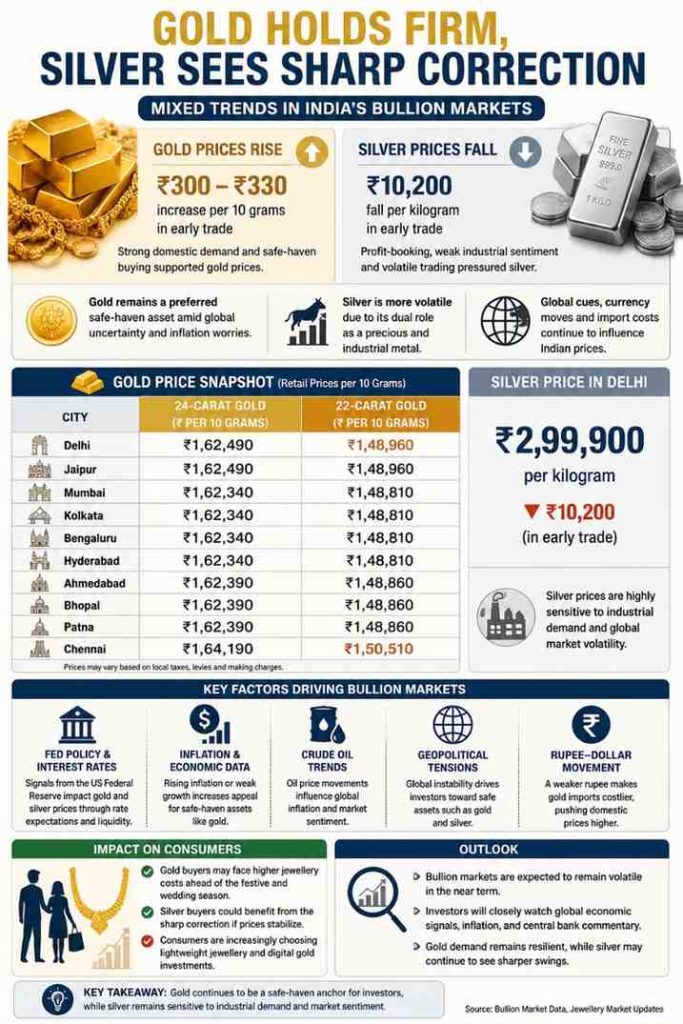
In Delhi’s bullion market, 24-carat gold was quoted around ₹1,62,490 per 10 grams, while 22-carat gold traded near ₹1,48,960. Similar price trends were recorded across Mumbai, Ahmedabad, Kolkata, Bengaluru, Hyderabad and Bhubaneswar, with southern markets such as Chennai witnessing slightly higher retail rates due to local levies and transportation costs.
The rise in domestic prices came even as international spot gold eased modestly during overseas trading. Analysts say Indian bullion rates are currently being influenced not only by global price movements but also by rupee-dollar fluctuations, import costs, and strong local purchasing interest.
Gold continues to attract buyers as a traditional safe-haven asset amid persistent geopolitical uncertainty, inflation concerns in several economies, and cautious central bank policies worldwide. Market participants note that investors often move toward gold during periods of financial instability or currency weakness, helping support prices even when global benchmarks cool temporarily.
Why Silver Prices Fell Sharply
Unlike gold, silver witnessed heavy selling pressure. In Delhi, silver prices dropped to nearly ₹2,99,900 per kilogram after a steep correction in early trading. Traders attributed the decline to profit-booking, weaker industrial sentiment in overseas markets, and short-term volatility in speculative commodity positions.
Silver typically reacts more sharply than gold because of its dual role as both a precious and industrial metal. Demand from sectors such as electronics, solar manufacturing, electric vehicles, and industrial equipment heavily influences price movement. Any signs of slowing industrial activity or weaker manufacturing sentiment can quickly impact silver valuations.
Commodity analysts also point out that silver has witnessed unusually high volatility globally over the past several months due to fluctuating expectations around interest rates and industrial demand recovery. Sudden corrections after rapid rallies are therefore becoming increasingly common in bullion markets.
Price Snapshot Across Major Indian Cities
Gold prices remained largely consistent across leading jewellery hubs:
- Delhi and Jaipur recorded 24-carat gold near ₹1,62,490 per 10 grams.
- Mumbai, Kolkata, Bengaluru and Hyderabad saw prices around ₹1,62,340.
- Chennai remained among the costliest markets, with 24-carat gold trading near ₹1,64,190.
- Ahmedabad, Patna and Bhopal hovered close to ₹1,62,390.
For 22-carat gold, prices generally ranged between ₹1,48,810 and ₹1,50,510 per 10 grams depending on the region.
Jewellers say demand from wedding buyers and long-term investors continues to support the market despite elevated rates. However, some retail consumers are increasingly opting for lightweight jewellery and digital gold investments due to affordability concerns.
Global Factors Driving Bullion Volatility
International bullion markets remain highly sensitive to macroeconomic developments. Traders are closely monitoring US Federal Reserve policy signals, global inflation data, crude oil trends, and geopolitical tensions that could affect investor appetite for safe-haven assets.
A stronger US dollar and rising bond yields often pressure precious metals because they reduce the attractiveness of non-yielding assets such as gold and silver. Conversely, uncertainty surrounding economic growth or financial markets tends to strengthen bullion demand.
Currency movement also plays a crucial role in India. Since the country imports a large portion of its gold requirement, any depreciation in the rupee can push domestic prices higher even when international rates soften.
Consumer Impact and Market Outlook
For consumers, the latest price movement presents a mixed picture. Gold buyers may face higher jewellery costs ahead of the festive and marriage season, while silver buyers could benefit from the sudden correction if prices stabilize.
Industry experts believe bullion markets may continue to witness sharp day-to-day swings in the near term as global economic signals remain uneven. Much will depend on central bank commentary, inflation trajectories, and investor confidence across international markets.
Despite short-term volatility, gold’s long-standing role in Indian households as both an investment and cultural asset continues to keep demand resilient. Silver, meanwhile, is expected to remain more sensitive to industrial demand cycles and speculative trading patterns in the months ahead.
Key Highlights
- Gold prices rose across major Indian jewellery markets, with 24-carat rates increasing by around ₹300–₹330 per 10 grams during Friday’s early trade.
- Silver recorded a sharp correction, falling by as much as ₹10,200 per kilogram in some markets amid volatility in global commodity and industrial demand trends.
- In Delhi, 24-carat gold traded near ₹1,62,490 per 10 grams, while silver prices slipped to around ₹2,99,900 per kilogram.
- Analysts attributed gold’s resilience to strong domestic demand, rupee-dollar fluctuations, geopolitical uncertainty, and continued investor preference for safe-haven assets.
- Silver remained under pressure due to weaker industrial sentiment, profit-booking, and fluctuations linked to sectors such as electronics, solar manufacturing, and electric vehicles.
- Bullion markets are expected to remain volatile as traders monitor US Federal Reserve policy signals, inflation trends, bond yields, crude oil prices, and global economic conditions.
- Jewellers reported continued demand from wedding-season buyers and long-term investors, though high prices are pushing some consumers toward lightweight jewellery and digital gold options.
Input & Images : Hindusthan Samachar
Add outlooknews.in as preferred source on google – click here
Also read – PM Modi Meets BRICS Foreign Ministers as India Hosts Strategic Talks in New Delhi
Last Updated on: Friday, May 15, 2026 11:36 pm by Monisha Angara | Published by: Monisha Angara on Friday, May 15, 2026 10:08 pm | News Categories: Business
About The Author