

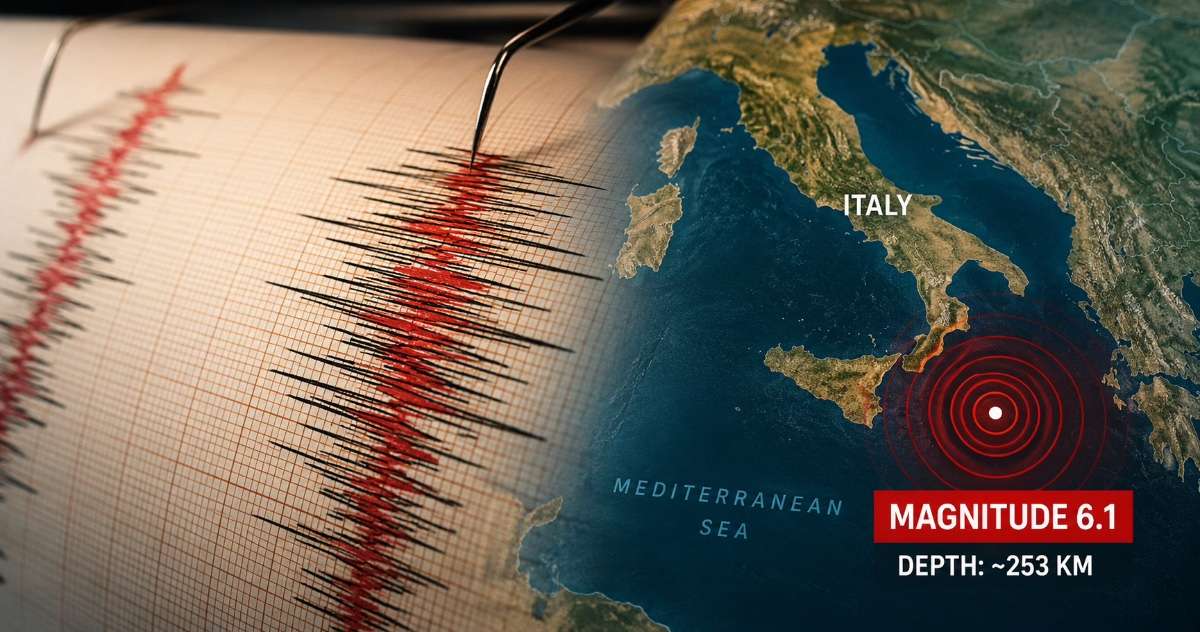
A powerful earthquake struck beneath the Mediterranean Sea near southern Italy early Tuesday, sending tremors across parts of the country and prompting authorities to assess potential impacts. While the quake was strong enough to be felt over a wide area, officials reported no immediate signs of major damage or casualties.
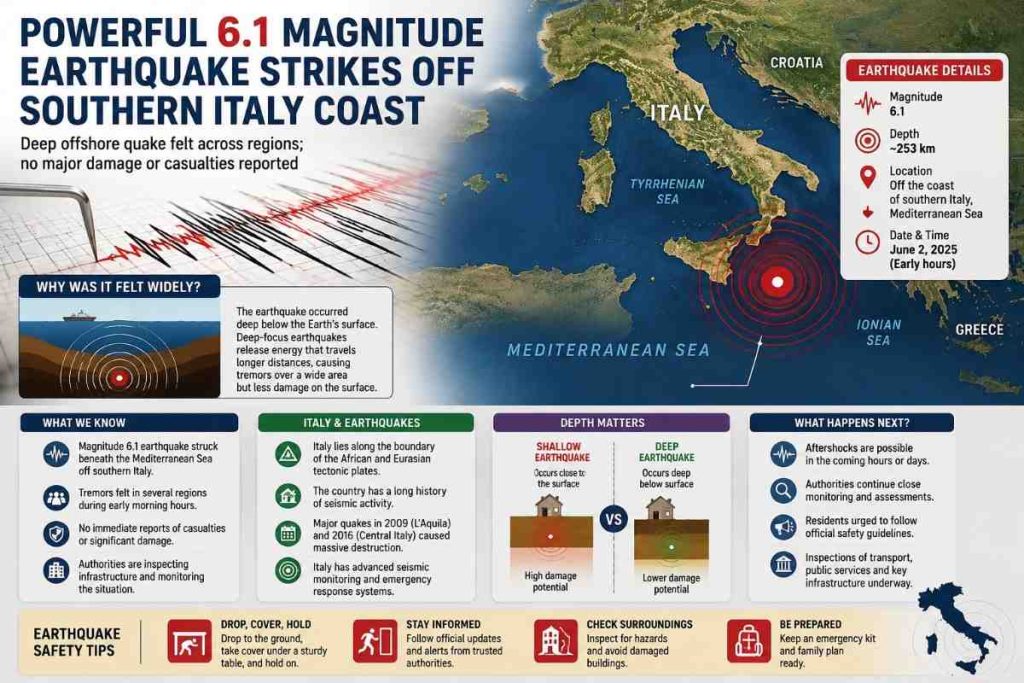
According to seismic monitoring agencies, the earthquake registered a magnitude of 6.1 and originated deep below the Earth’s surface. Experts noted that the event occurred at a depth of more than 250 kilometers, a factor that likely reduced its destructive potential despite its considerable strength.
Residents in several southern Italian regions reported feeling brief shaking during the early morning hours. Emergency services and local authorities began precautionary monitoring efforts shortly after the quake, while infrastructure inspections were expected in areas where the tremors were most noticeable.
Why the Quake Was Felt Widely
Earthquakes occurring at significant depths behave differently from those that originate closer to the surface.
While shallow earthquakes often cause severe localized damage, deep-focus earthquakes can transmit seismic waves across larger geographical areas. As a result, people hundreds of kilometers away may feel shaking even when the earthquake’s epicenter is located far offshore.
Seismologists explained that the depth of the latest earthquake helped disperse energy before it reached the surface, reducing the likelihood of widespread structural damage. Nevertheless, earthquakes of this magnitude remain closely monitored because of the possibility of aftershocks and their potential impact on vulnerable infrastructure.
The event serves as a reminder that earthquake intensity alone does not determine the level of damage. Factors such as depth, distance from populated areas, local geology, and building resilience all play crucial roles in shaping outcomes.
Italy’s Long History With Seismic Activity
Italy ranks among Europe’s most earthquake-prone countries due to its location along the complex tectonic boundary where the African and Eurasian plates interact.
The constant movement of these plates generates stress within the Earth’s crust, periodically releasing energy through earthquakes. The country’s geography has been shaped by millions of years of tectonic activity, resulting in both its dramatic landscapes and its ongoing seismic vulnerability.
Several major earthquakes have left lasting marks on Italy’s modern history. The 2009 L’Aquila earthquake caused extensive destruction and claimed more than 300 lives, while the 2016 Central Italy earthquake devastated multiple communities and triggered a lengthy reconstruction effort.
Because of this history, Italian authorities maintain one of Europe’s most advanced seismic monitoring and emergency response systems.
Authorities Continue Monitoring for Aftershocks
Although no major incidents were immediately reported, civil protection agencies continue to monitor the affected region closely.
Aftershocks are a common feature of significant seismic events and can occur hours, days, or even weeks after the main quake. While most aftershocks are weaker than the initial event, they can occasionally create additional risks, particularly for already weakened structures.
Emergency officials have encouraged residents to remain informed through official channels and to follow established earthquake safety procedures if further tremors occur.
Local governments and infrastructure operators are also expected to conduct inspections of transportation networks, public facilities, and essential services as a precautionary measure.
Lessons in Preparedness
The earthquake highlights the importance of preparedness in countries located along active tectonic zones.
Over the past two decades, Italy has invested heavily in seismic risk reduction through updated building codes, public awareness campaigns, and improvements in emergency management capabilities. Experts argue that preparedness measures remain one of the most effective tools for reducing casualties and economic losses when earthquakes occur.
As authorities continue evaluating the effects of the latest tremor, the event underscores a broader reality facing many Mediterranean nations: seismic activity remains a constant feature of life in the region.
For now, the absence of major damage offers reassurance, but the earthquake serves as another reminder of the need for vigilance in one of Europe’s most geologically active areas.
Key Highlights:
- Magnitude 6.1 earthquake strikes off southern Italy’s coast.
- Quake occurred at a depth of approximately 253 km beneath the Mediterranean Sea.
- Tremors felt across parts of southern Italy; no immediate casualties reported.
- Significant depth likely reduced surface damage despite strong magnitude.
- Authorities monitoring for aftershocks and conducting precautionary inspections.
- Italy remains one of Europe’s most seismically active countries due to tectonic plate activity.
Input & Images : Hindusthan Samachar
Add outlooknews.in as preferred source on google – click here
Also read – Trump Signals Possible Iran Breakthrough as Talks Focus on Ceasefire and Strait of Hormuz Security
Last Updated on: Tuesday, June 2, 2026 11:51 am by Monisha Angara | Published by: Monisha Angara on Tuesday, June 2, 2026 11:51 am | News Categories: News
About The Author