

Spanish health authorities have intensified medical monitoring after confirming a hantavirus infection in a passenger linked to a cruise ship outbreak that prompted international health surveillance earlier this month. The case, connected to an expedition voyage that travelled through remote South Atlantic regions, has renewed attention on rare zoonotic diseases and the challenges of managing infectious risks during international travel.
The infected traveller has been placed in a specialised high-isolation facility in Madrid, where doctors are continuing close observation and treatment. Officials from Spain’s Ministry of Health said the patient remains under controlled medical supervision and emphasized that the situation does not currently pose a broader public-health threat.
Authorities also stressed that existing containment measures remain effective and that there is no evidence of widespread community transmission associated with the case.
Expedition Cruise at Centre of International Health Monitoring
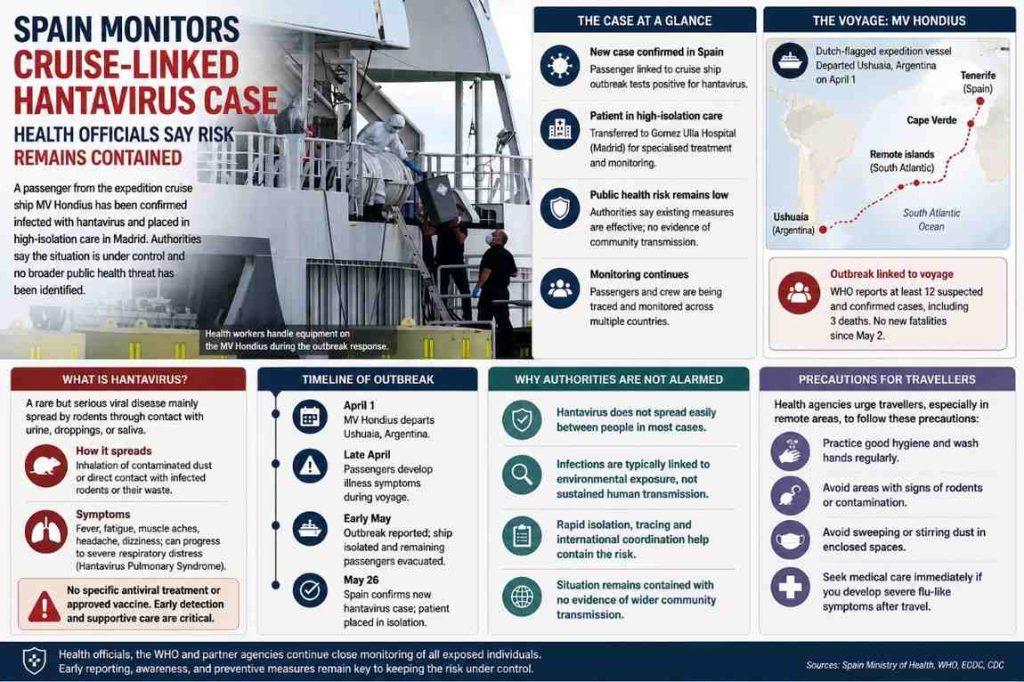
The confirmed infection is linked to passengers travelling aboard the Dutch-flagged expedition vessel MV Hondius, which departed from Ushuaia, Argentina, in early April and later sailed through isolated South Atlantic regions before heading toward Europe.
The voyage reportedly included stops near remote islands and environmentally sensitive areas where exposure to rodent-borne diseases may occur under certain conditions. Concerns emerged after multiple passengers began showing symptoms consistent with hantavirus infection, triggering quarantine measures and coordinated monitoring efforts involving several countries.
The World Health Organization has previously acknowledged multiple suspected and confirmed cases connected to the outbreak, including fatalities reported earlier during the incident. Health officials indicated that no additional deaths have been recorded in recent weeks, suggesting that containment efforts may be limiting further spread among identified contacts.
Public-health agencies across Europe and Latin America continue tracing and monitoring individuals who may have had prolonged exposure during the voyage.
Understanding Hantavirus and Why It Draws Concern
Hantavirus infections remain relatively rare but are closely watched by infectious disease specialists because severe cases can rapidly become life-threatening.
The virus is generally transmitted through exposure to rodents or contact with particles contaminated by rodent urine, saliva or droppings. Infection often occurs when contaminated dust is inhaled in enclosed or poorly ventilated spaces.
Medical experts explain that symptoms typically begin with flu-like illness, including fever, fatigue, headaches and muscle pain, before potentially progressing to serious respiratory complications known as Hantavirus Pulmonary Syndrome (HPS).
In severe cases, patients may experience breathing difficulties, low blood pressure and fluid accumulation in the lungs requiring intensive medical support.
Currently, there is no approved vaccine or specific antiviral treatment for hantavirus, making early diagnosis and supportive hospital care especially important.
Health Authorities Seek to Prevent Public Panic
Spanish officials have attempted to balance transparency with reassurance as public attention around the case grows.
Authorities emphasized that hantavirus does not spread as easily as many respiratory viruses and that person-to-person transmission remains uncommon in most known hantavirus strains. Most infections worldwide continue to be linked directly to environmental exposure involving infected rodents rather than sustained human transmission.
Epidemiologists note that heightened awareness following the COVID-19 pandemic has increased public sensitivity toward infectious disease outbreaks, even when risks to the wider population remain limited.
For this reason, health agencies are focusing on targeted containment measures rather than broad public restrictions.
Experts say rapid isolation protocols, passenger tracing and cross-border coordination are now standard procedures whenever unusual infectious clusters emerge during international travel operations.
Cruise Industry Faces Renewed Focus on Health Preparedness
The outbreak has also drawn renewed scrutiny toward expedition-style cruise travel, which has grown rapidly in recent years.
Unlike conventional cruises operating between major urban ports, expedition voyages often travel through remote ecosystems with limited medical infrastructure and increased environmental exposure risks.
Industry analysts say cruise operators have significantly strengthened onboard medical preparedness and sanitation protocols since the pandemic era. However, remote expeditions continue to present unique logistical challenges when serious illness emerges far from advanced healthcare facilities.
Health specialists note that rodent-borne diseases are not typically associated with mainstream cruise tourism, making the incident relatively unusual within the sector.
Still, the case highlights how global tourism, environmental exposure and infectious disease monitoring are becoming increasingly interconnected.
Scientists Continue Studying Emerging Zoonotic Risks
Researchers have long warned that human interaction with remote ecosystems and wildlife habitats may increase opportunities for zoonotic disease transmission infections that pass from animals to humans.
Climate change, ecological disruption and expanding tourism into isolated environments are all being studied as factors that could influence disease exposure patterns in future decades.
Although hantavirus outbreaks remain infrequent compared to more common infectious diseases, public-health experts say vigilance remains essential because of the virus’s potentially high mortality rate in severe cases.
International health agencies are expected to continue monitoring the cruise-linked outbreak closely until all potentially exposed passengers and crew members complete observation periods.
Situation Remains Under Control, Officials Say
Spanish authorities maintain that the current case remains isolated and manageable under existing public-health protocols.
Medical teams continue monitoring the infected passenger while health agencies maintain contact with individuals connected to the voyage. Officials have also advised travellers to follow standard hygiene precautions and avoid direct exposure to rodent-infested environments, particularly in rural or remote areas where hantavirus infections are more commonly detected.
For now, the incident serves less as a sign of a broader outbreak and more as a reminder of the continuing importance of international disease surveillance in an era of expanding global travel and environmental exposure.
Key Highlights:
- Spain confirms new hantavirus case linked to outbreak aboard expedition cruise ship MV Hondius
- Infected passenger transferred to high-isolation unit at Madrid’s Gomez Ulla Hospital
- WHO-linked outbreak has resulted in at least 12 suspected and confirmed cases, including three deaths
- Spanish authorities say public health risk remains low and situation is under control
- Cruise travelled from Argentina through remote South Atlantic regions before reaching Spain
- Hantavirus spreads mainly through exposure to infected rodents or contaminated environments
- No approved vaccine or specific antiviral treatment currently exists for hantavirus
- Officials continue monitoring passengers and crew while maintaining quarantine precautions
- Health experts stress importance of early detection and supportive medical care in severe cases
- Incident highlights growing focus on infectious disease surveillance in global travel and expedition tourism
Input & Images : Hindusthan Samachar
Add outlooknews.in as preferred source on google – click here
Also read – U.S. Conducts Defensive Strikes on Iranian Military Targets Amid Fragile Diplomatic Efforts
Last Updated on: Tuesday, May 26, 2026 12:43 pm by Monisha Angara | Published by: Monisha Angara on Tuesday, May 26, 2026 12:41 pm | News Categories: World
About The Author