
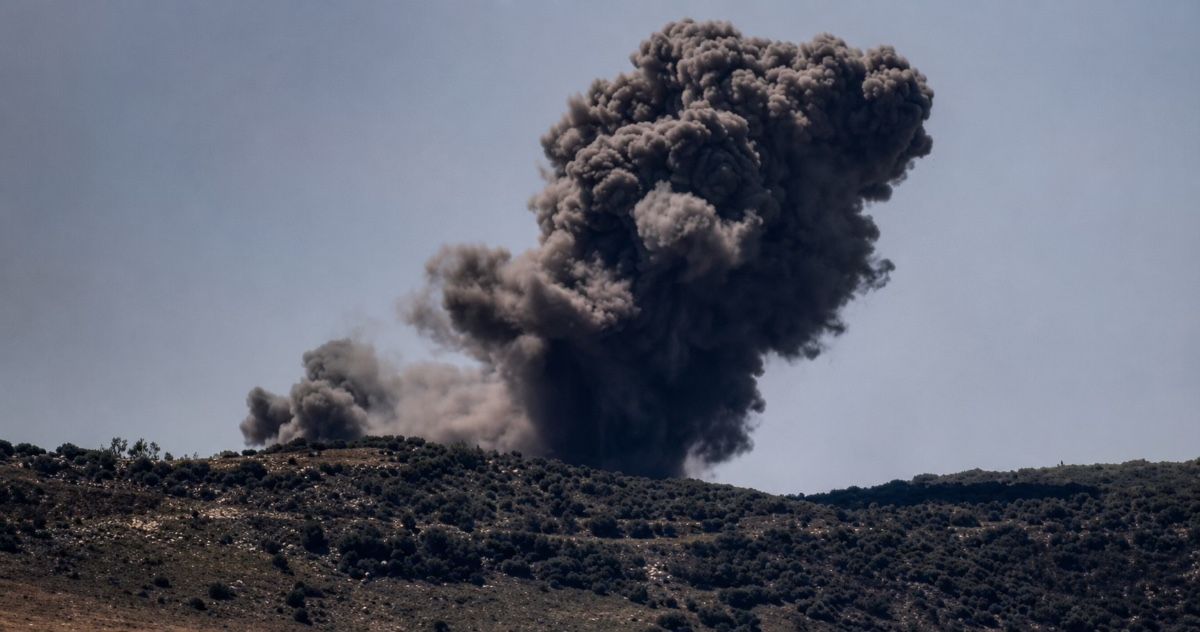
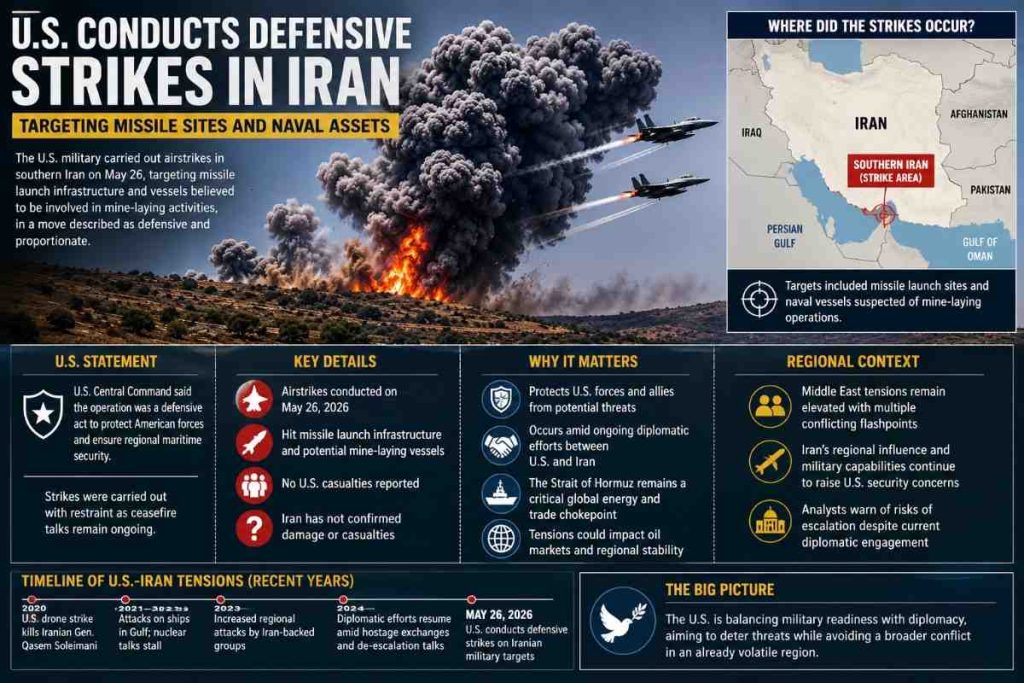
The United States military carried out targeted airstrikes in southern Iran on Monday, striking missile launch infrastructure and naval assets that American officials said posed a potential threat to U.S. personnel and regional maritime security. The operation marks another escalation in already tense U.S.-Iran relations, even as diplomatic channels between the two countries remain active behind the scenes.
According to U.S. Central Command, the strikes were intended as “defensive and proportionate actions” aimed at preventing imminent risks to American forces operating in the region. U.S. officials said the targets included missile launch positions and vessels believed to be involved in mine-laying activities near strategically sensitive waterways.
No American casualties were reported, while Iranian authorities had not publicly disclosed the full extent of the damage or potential casualties at the time of reporting.
The development underscores the fragile balance currently shaping U.S.-Iran relations a situation in which military deterrence and diplomatic engagement are unfolding simultaneously amid wider instability across the Middle East.
Pentagon Frames Operation as Force Protection Measure
American military officials emphasized that the strikes were not designed as a broader offensive campaign against Iran, but rather as a limited response intended to protect U.S. personnel and safeguard regional navigation routes.
Central Command indicated that intelligence assessments had identified what officials described as “credible threats” involving missile systems and maritime activities linked to Iranian military units operating in southern Iran.
The waters surrounding the Persian Gulf and Strait of Hormuz remain among the world’s most strategically critical maritime corridors, carrying a significant share of global oil shipments and commercial shipping traffic. Any disruption in the region has the potential to impact energy markets, shipping costs and broader geopolitical stability.
U.S. officials have repeatedly stated in recent months that Washington would respond rapidly to actions perceived as threats to American troops, allied assets or international maritime security.
Diplomatic Talks Continue Despite Military Escalation
What makes the latest operation particularly significant is its timing.
The strikes occurred while diplomatic discussions involving U.S. and Iranian representatives reportedly continue through indirect channels aimed at reducing regional tensions and exploring broader understandings on security and de-escalation.
Analysts note that Washington appears to be attempting a dual-track strategy: maintaining military deterrence while avoiding a full-scale confrontation that could derail diplomatic engagement altogether.
The Biden administration like several previous U.S. administrations has faced the challenge of balancing regional security commitments with efforts to prevent direct conflict escalation with Tehran.
Iranian officials have historically reacted sharply to U.S. military actions, especially strikes occurring on Iranian territory. However, the absence of immediate retaliatory announcements suggested both sides may still be seeking to avoid uncontrolled escalation.
Regional Tensions Remain Elevated
The latest strikes come during a period of heightened instability across the Middle East, where multiple flashpoints continue to intersect.
Iran’s regional influence through allied militias and proxy groups has remained a central concern for Washington and several Gulf allies. U.S. military bases and naval operations across the region have periodically faced threats from drone attacks, missile launches and maritime disruptions linked to Iran-backed actors.
Security experts say southern Iran’s coastal military infrastructure plays an important role in Tehran’s strategic posture in the Gulf. Missile systems, fast-attack naval craft and maritime surveillance capabilities in the region are viewed by Iran as essential deterrence tools against external military pressure.
At the same time, U.S. naval deployments in nearby waters have increased in recent years amid repeated concerns over commercial shipping safety and regional escalation risks.
Oil Markets and Global Trade Watching Closely
Financial markets and energy traders are expected to monitor developments closely, particularly because of the region’s importance to global energy supplies.
Even limited military confrontations involving Iran can trigger concerns over crude oil prices, shipping insurance costs and broader market volatility. The Strait of Hormuz remains one of the most strategically sensitive energy chokepoints in the world.
While there were no immediate reports of disruptions to commercial shipping following the strikes, analysts warned that prolonged instability could heighten economic uncertainty at a time when global markets are already sensitive to geopolitical risk.
Several countries in the Gulf region are also likely to intensify diplomatic engagement to prevent a wider deterioration in regional security conditions.
Iran’s Likely Response Under Scrutiny
Iranian leadership now faces a complex strategic decision.
Historically, Tehran has sought to project strength following U.S. military actions while calibrating its responses carefully to avoid triggering overwhelming escalation. Responses have ranged from rhetorical condemnation and diplomatic pressure to indirect regional actions through allied groups.
Military analysts caution that even limited retaliatory actions including maritime incidents or proxy-group activity could rapidly increase tensions if miscalculations occur.
At the same time, Iran is dealing with internal economic pressure, sanctions-related constraints and broader regional challenges, factors that may influence how aggressively it chooses to respond.
Wider Implications for Regional Stability
The latest operation illustrates how quickly tensions between Washington and Tehran can resurface despite ongoing diplomatic engagement.
For years, U.S.-Iran relations have been shaped by cycles of confrontation, negotiation and temporary de-escalation. Issues involving nuclear policy, regional military influence, sanctions and maritime security continue to remain deeply interconnected.
Diplomatic observers say the coming days will be critical in determining whether the current situation stabilizes or develops into a broader confrontation.
Much may depend on whether both governments continue prioritizing controlled signaling over direct escalation.
For now, the strikes serve as another reminder that the Middle East’s security landscape remains highly volatile where diplomacy and military pressure increasingly operate side by side in an environment shaped by mistrust, strategic competition and fragile regional balances.
Key Highlights:
- U.S. military launched targeted airstrikes on missile sites and naval assets in southern Iran.
- Pentagon described the operation as a “defensive” action aimed at protecting American forces and maritime security.
- Targets reportedly included missile launch infrastructure and vessels suspected of mine-laying activities.
- U.S. Central Command said the strikes were carried out with restraint amid ongoing ceasefire and diplomatic discussions.
- No U.S. casualties were reported following the operation.
- Iranian authorities had not officially confirmed the extent of damage or casualties at the time of reporting.
- The strikes come during heightened tensions across the Middle East and fragile U.S.-Iran diplomatic engagement.
- Analysts say the operation highlights Washington’s dual-track strategy of military deterrence and continued diplomacy.
- The Strait of Hormuz and Gulf shipping routes remain key global security and energy concerns.
- Global markets and regional governments are closely monitoring the risk of further escalation between Washington and Tehran.
Input & Images : Hindusthan Samachar
Add outlooknews.in as preferred source on google – click here
Also read – Delhi Capitals Finish IPL 2026 Campaign with Dominant Win Over Kolkata Knight Riders
Last Updated on: Tuesday, May 26, 2026 11:34 am by Monisha Angara | Published by: Monisha Angara on Tuesday, May 26, 2026 11:24 am | News Categories: World
About The Author