
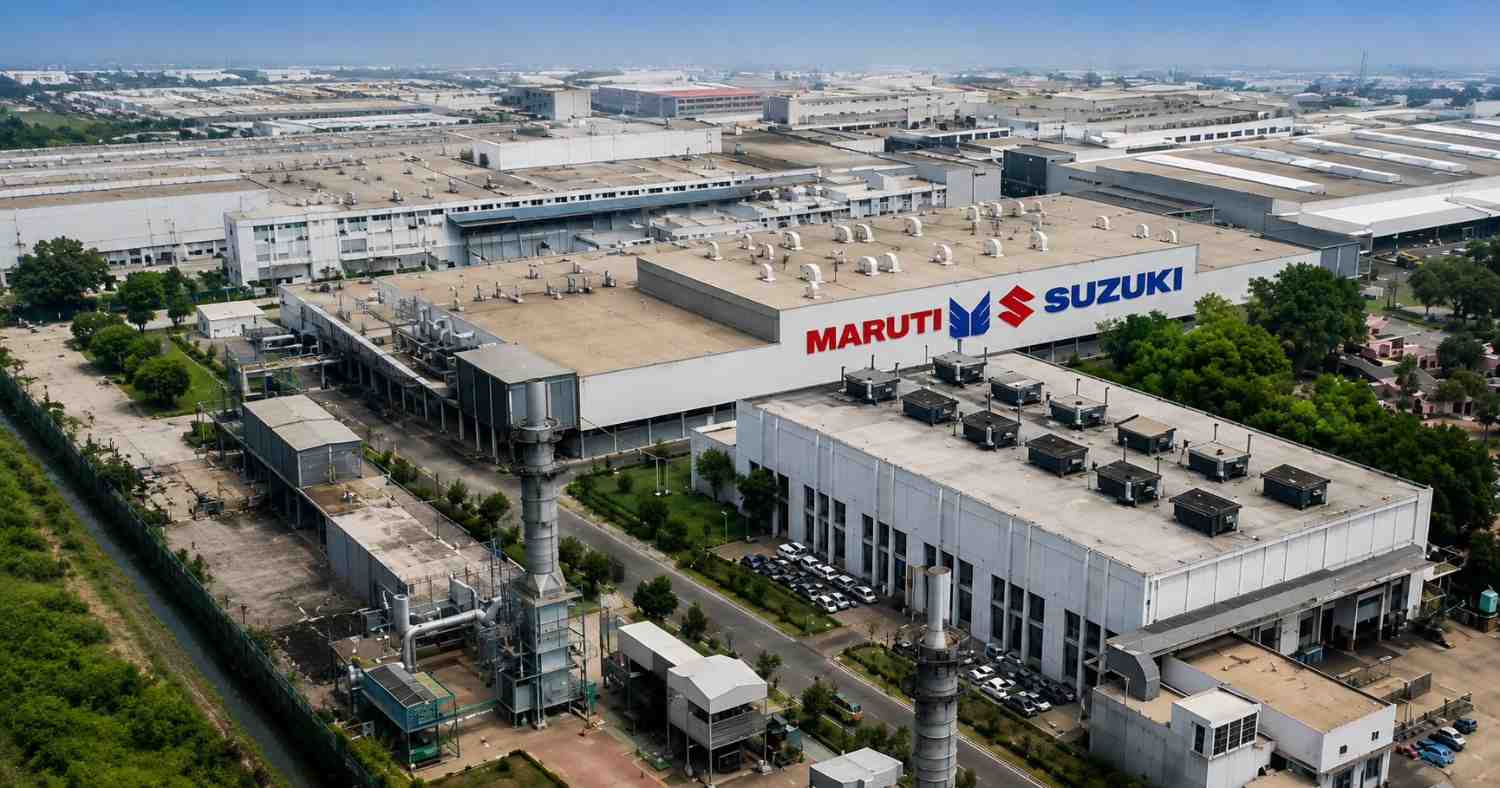
Maruti Suzuki India has started commercial production at the second manufacturing unit of its Kharkhoda facility in Haryana, significantly expanding the company’s production capacity at a time when India’s passenger vehicle market continues to evolve toward SUVs, exports and large-scale manufacturing investments.
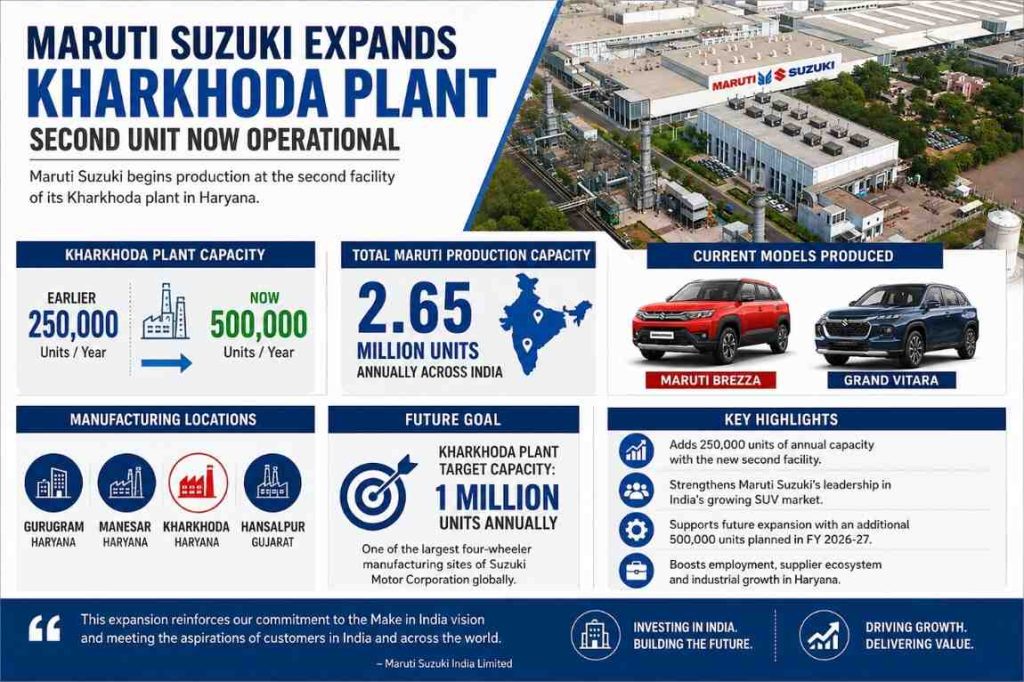
The newly operational unit adds an annual capacity of 250,000 vehicles, taking the total capacity at the Kharkhoda complex to 500,000 units per year. With this expansion, Maruti Suzuki’s combined manufacturing capacity across India has risen to approximately 2.65 million vehicles annually.
The development marks another major step in the company’s long-term strategy to strengthen production infrastructure, defend market leadership and prepare for rising domestic and international demand in the coming years.
Kharkhoda Emerging as a Strategic Manufacturing Hub
The Kharkhoda facility, located in Haryana’s Sonipat district, has become central to Maruti Suzuki’s next phase of expansion.
The company has indicated that the site is expected to eventually reach a production capacity of one million vehicles annually once all planned phases are completed. If achieved, the facility would become one of the largest automobile manufacturing hubs operated globally by parent company Suzuki Motor Corporation.
Industry analysts view the scale of the investment as a reflection of India’s growing importance within Suzuki’s worldwide production and export network.
The expansion also comes amid increasing competition in India’s passenger vehicle market, where automakers are investing aggressively in manufacturing scale, electric mobility, supply-chain resilience and SUV production capabilities.
SUV Demand Driving Capacity Expansion
Currently, the Kharkhoda plant is manufacturing the Maruti Suzuki Brezza and the Grand Vitara two models that operate in India’s highly competitive SUV segment.
The emphasis on SUVs reflects a major structural shift in Indian consumer preferences over the past several years. Compact and mid-size SUVs have become among the fastest-growing categories in the domestic automobile market, prompting manufacturers to expand production lines and introduce multiple new models.
Maruti Suzuki, historically dominant in hatchbacks and small cars, has increasingly repositioned itself to capture a larger share of the SUV market as rivals such as Hyundai, Tata Motors, Mahindra and Kia intensify competition.
Expanding SUV production capacity is therefore strategically important not only for sales growth but also for maintaining long-term market share leadership.
Manufacturing Expansion Signals Confidence in Indian Auto Market
The production increase comes despite broader uncertainty in global automotive markets caused by inflationary pressures, supply-chain disruptions and uneven consumer demand in several international economies.
India, however, continues to remain one of the world’s fastest-growing major automobile markets, supported by rising urbanization, infrastructure development and increasing middle-class consumption.
Automobile manufacturers have increasingly treated India as both a major domestic market and an export-oriented manufacturing base.
Maruti Suzuki’s latest capacity expansion suggests continued confidence in medium- and long-term demand growth, particularly in utility vehicles and premium compact segments.
Haryana Remains Central to Maruti’s Production Ecosystem
The expansion also reinforces Haryana’s long-standing role as the backbone of Maruti Suzuki’s manufacturing operations.
The company already operates major facilities in Gurugram and Manesar, while its Gujarat operations in Hansalpur serve both domestic and export markets.
Together, these manufacturing ecosystems support extensive vendor networks, logistics infrastructure and employment generation across northern and western India.
Industrial experts note that large-scale automobile facilities often create multiplier effects through ancillary industries including auto components, transport services, warehousing, tooling and engineering support businesses.
The continued expansion of the Kharkhoda site is therefore likely to have broader regional economic implications beyond vehicle production alone.
Push Toward Larger Production Targets
Maruti Suzuki has already announced plans to add another 500,000 units of production capacity during the 2026–27 financial year, indicating that the current expansion is part of a wider long-term scaling strategy.
The company has also been accelerating investments in hybrid technology, cleaner mobility solutions and export competitiveness as regulatory and market expectations evolve.
While electric vehicle adoption in India is still developing gradually compared to some global markets, manufacturers are preparing for future transition pressures involving emissions standards, fuel efficiency and alternative propulsion technologies.
Production flexibility is expected to become increasingly important as companies adapt to changing demand patterns.
Competitive Pressure Intensifying Across Industry
The expansion at Kharkhoda comes during a period of intense transformation within India’s automotive sector.
Domestic manufacturers and global brands alike are competing aggressively across pricing, technology, safety features and product diversification.
At the same time, government policy initiatives promoting domestic manufacturing and supply-chain localization have encouraged companies to deepen investment in Indian production infrastructure.
For Maruti Suzuki, retaining scale advantages remains crucial as newer competitors continue gaining ground in premium segments.
Why the Expansion Matters
The operational launch of the second Kharkhoda unit is more than a routine manufacturing update it signals the growing industrial scale of India’s automobile sector and the country’s expanding role within global automotive supply chains.
For consumers, increased production capacity could help improve vehicle availability and support future product expansion.
For the broader industry, the move highlights how India’s automotive market continues shifting toward higher-capacity manufacturing, SUV-led demand and long-term industrial investment.
As competition intensifies and mobility technologies evolve, manufacturing scale and operational efficiency are likely to become even more important in shaping the next phase of India’s auto industry growth.
Key Highlights
- Maruti Suzuki has started commercial production at the second unit of its Kharkhoda plant in Haryana, adding annual capacity for 250,000 vehicles.
- The expansion increases total production capacity at the Kharkhoda facility to 500,000 units per year.
- Maruti Suzuki’s combined manufacturing capacity across Haryana and Gujarat has now risen to 2.65 million vehicles annually.
- The company plans to eventually scale the Kharkhoda site to one million vehicles annually, potentially making it one of Suzuki Motor Corporation’s largest global manufacturing hubs.
- The facility is currently producing the Maruti Suzuki Brezza and Grand Vitara, reflecting the company’s increasing focus on India’s fast-growing SUV segment.
- The expansion comes as automakers continue investing heavily in India amid rising domestic demand, supply-chain diversification and growing competition in the passenger vehicle market.
- Maruti Suzuki has also announced plans to add another 500,000 units of production capacity during FY2026–27 as part of its long-term growth strategy.
Input & Images : Hindusthan Samachar
Add outlooknews.in as preferred source on google – click here
Also read – Punjab Kings Deny Injury Concerns Around Arshdeep Singh Amid Mounting Pressure in IPL 2026 Campaign
Last Updated on: Tuesday, May 19, 2026 12:54 pm by Monisha Angara | Published by: Monisha Angara on Monday, May 18, 2026 9:48 pm | News Categories: Business
About The Author