

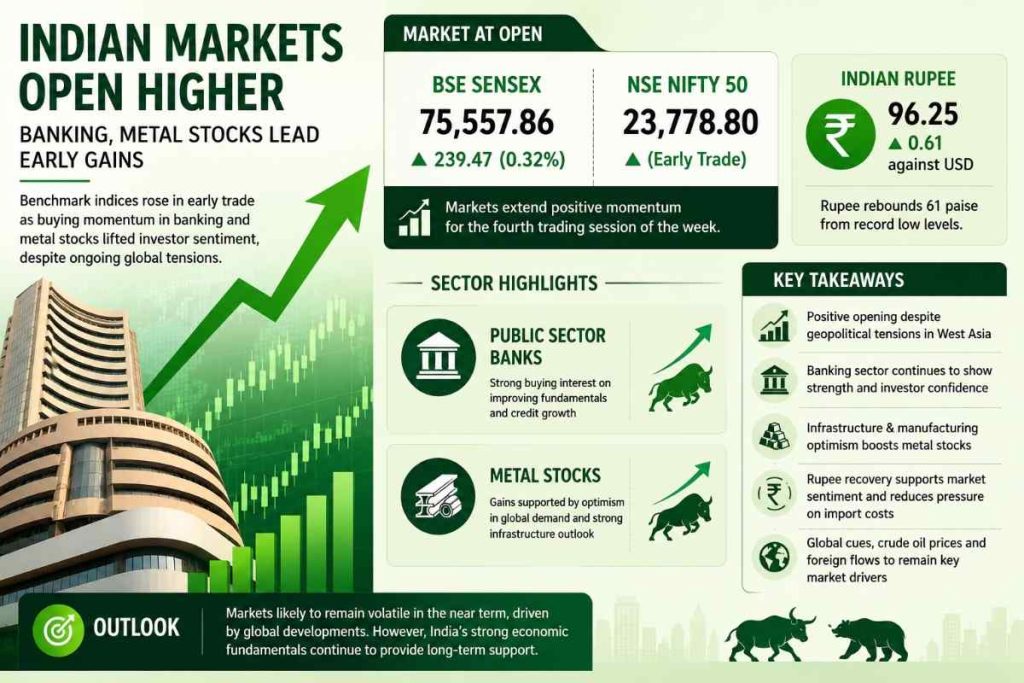
India’s benchmark equity indices opened higher on Thursday, extending recent market momentum even as investors continued to monitor geopolitical tensions in West Asia and shifting global risk sentiment. Early gains in banking and metal stocks helped lift domestic markets, while a recovery in the Indian rupee added to positive investor sentiment during opening trade.
The BSE Sensex rose more than 230 points in early trading, while the NSE Nifty moved closer to the 23,800 mark, reflecting sustained buying interest across key sectors. Market participants appeared encouraged by resilient domestic fundamentals, stable institutional inflows and expectations that India’s growth trajectory remains comparatively strong despite global uncertainties.
Banking and Metal Stocks Drive Early Momentum
Public sector banks and metal companies emerged among the strongest performers during the opening session.
Analysts noted that banking stocks continue to benefit from improving balance sheets, healthy credit growth and expectations that India’s financial sector could remain one of the primary drivers of domestic economic expansion. Public sector banks, in particular, have seen renewed investor interest over the past year as asset quality improved and profitability strengthened.
Metal stocks also attracted buying support amid hopes of stabilizing global commodity demand and expectations of continued infrastructure spending both domestically and internationally. Investors are increasingly viewing infrastructure-linked sectors as long-term beneficiaries of India’s public investment push and manufacturing expansion initiatives.
The broader market tone suggested that traders were focusing more on domestic earnings resilience and economic indicators rather than short-term geopolitical volatility.
Rupee Recovery Offers Additional Support
The Indian rupee also recovered sharply in early trade after recently touching record low levels against the U.S. dollar.
Currency traders attributed part of the rebound to easing pressure from crude oil prices and improved risk appetite in emerging markets. A stronger rupee often supports investor confidence by reducing imported inflation risks and improving perceptions of macroeconomic stability.
Foreign exchange markets have remained sensitive to global interest-rate expectations, crude oil movements and geopolitical developments, particularly given India’s dependence on imported energy supplies.
Even so, economists note that the rupee’s trajectory will continue to depend heavily on external conditions, including U.S. Federal Reserve policy signals and global capital flows toward emerging economies.
Domestic Resilience Continues to Support Markets
Indian equities have shown notable resilience in recent months compared to several global markets facing economic slowdown concerns and geopolitical disruptions.
Strong domestic consumption, government-led infrastructure spending and relatively stable corporate earnings have helped sustain investor confidence. Institutional investors also continue to view India as one of the faster-growing major economies at a time when growth forecasts in several developed markets remain subdued.
Market strategists say domestic investors are increasingly focusing on long-term structural themes such as manufacturing expansion, digital infrastructure, renewable energy, banking growth and capital expenditure cycles.
The continued rise in retail investor participation has also contributed to market stability, cushioning volatility triggered by global events.
Global Risks Still Remain in Focus
Despite the positive opening, analysts cautioned that geopolitical tensions in West Asia and broader global uncertainties could continue influencing market sentiment in the coming sessions.
Any sharp movement in crude oil prices remains particularly important for India, which imports a large portion of its energy requirements. Sustained increases in oil prices could affect inflation, currency stability and corporate profitability.
Investors are also closely tracking developments related to global interest rates, trade flows and economic data from the United States, China and Europe, all of which continue to shape risk appetite across international markets.
Still, early trading trends suggested that domestic investors currently remain focused on India’s comparatively stable macroeconomic outlook and expectations of continued earnings growth.
Market Attention Shifts Toward Economic Signals
As the trading week progresses, market participants are expected to closely monitor sectoral performance, foreign institutional investor activity and upcoming macroeconomic indicators.
Analysts believe volatility may persist due to external geopolitical developments, but India’s domestic growth narrative continues to provide underlying support for equities.
For now, the opening session reinforced a broader pattern seen in recent months: Indian markets remain sensitive to global developments, but domestic economic momentum and sector-specific strength continue to attract investor confidence.
Key Highlights:
- Sensex rises over 239 points in opening trade
- Nifty gains momentum, trades above 23,770
- PSU banking and metal stocks lead market rally
- Indian rupee strengthens 61 paise against US dollar
- Positive domestic sentiment offsets West Asia concerns
- Investors continue buying in banking and infrastructure-linked sectors
- Markets extend previous session’s upward trend
- Strong domestic economic outlook supports equities
- Global crude oil prices and geopolitical tensions remain under watch
- Early trade reflects sustained investor confidence in Indian markets
Input & Images : Hindusthan Samachar
Add outlooknews.in as preferred source on google – click here
Also read – Kartik Tyagi’s Late-Season Surge Adds New Twist to IPL 2026 Purple Cap Race
Last Updated on: Thursday, May 21, 2026 5:53 pm by Monisha Angara | Published by: Monisha Angara on Thursday, May 21, 2026 5:48 pm | News Categories: Business
About The Author