
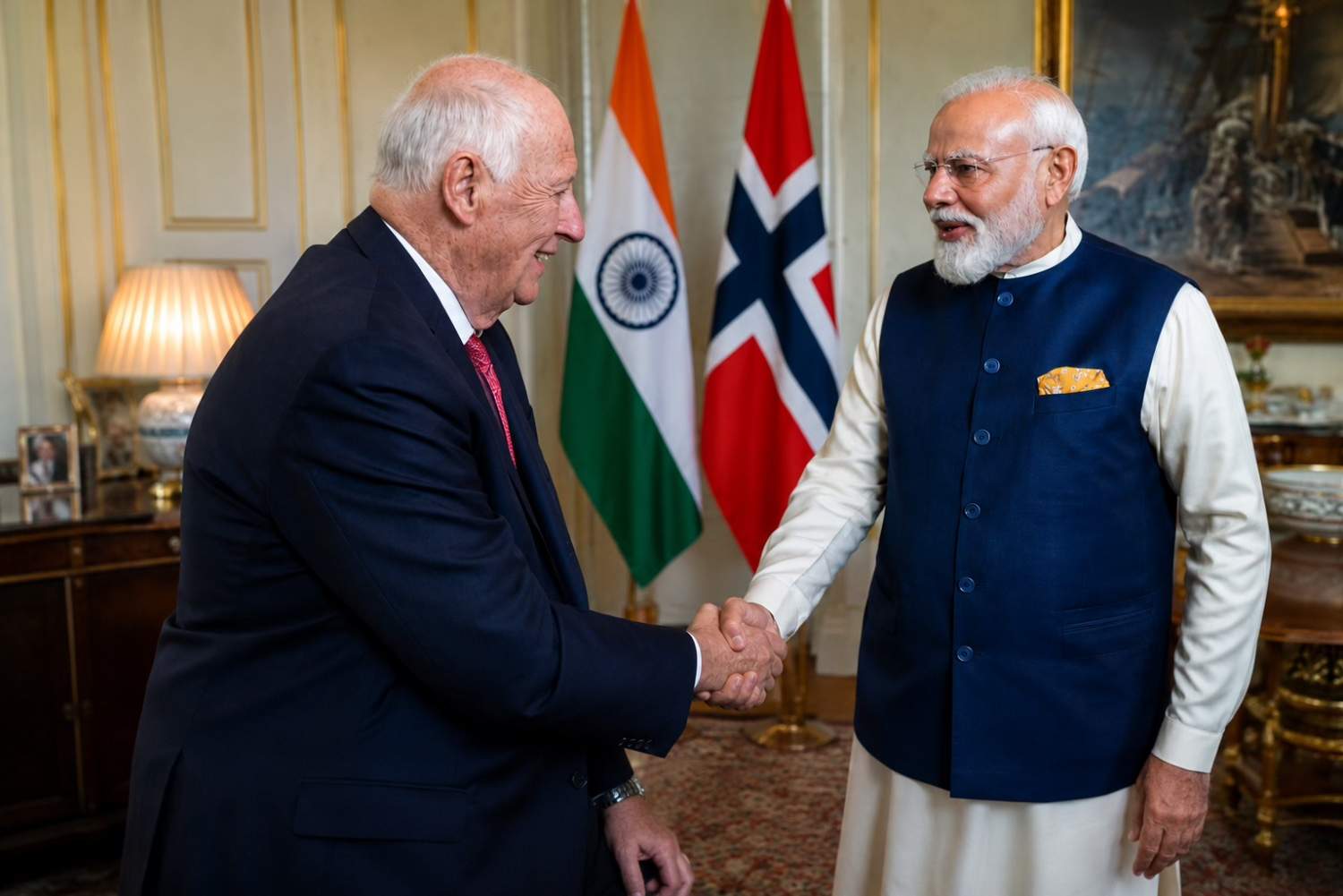
Prime Minister Narendra Modi’s visit to Norway on Monday marked a significant step in India’s rapidly evolving engagement with Northern Europe, with New Delhi and Oslo agreeing to elevate bilateral relations into a “Green Strategic Partnership” focused on clean energy, technology, maritime cooperation and sustainable economic growth.
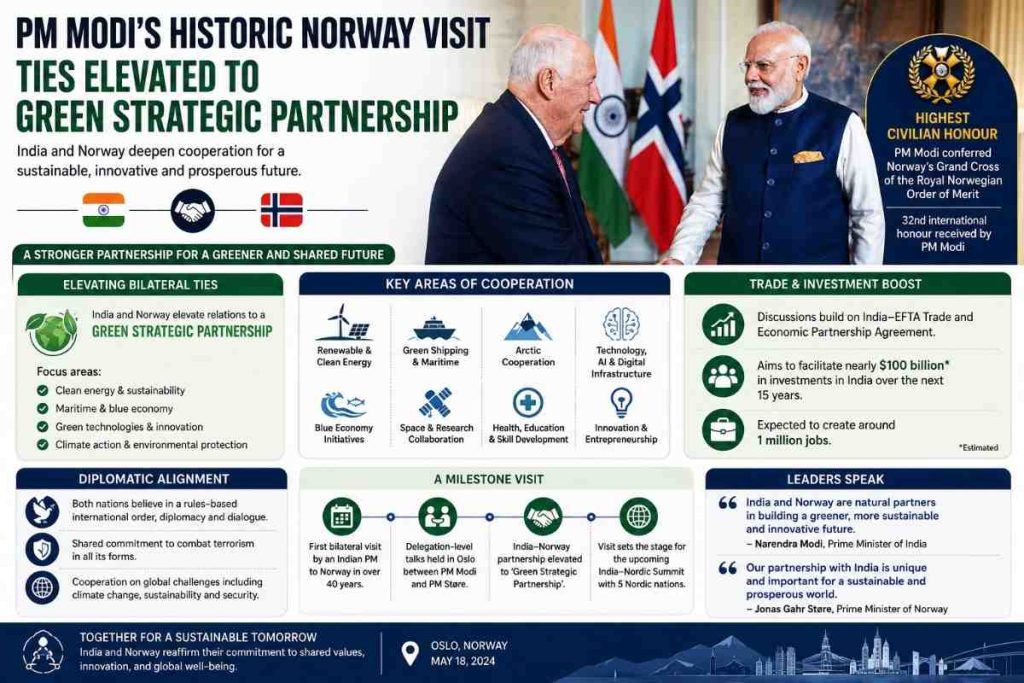
The visit, widely viewed as one of the most consequential India-Norway diplomatic engagements in decades, also saw Modi receive Norway’s highest civilian honour the Grand Cross of the Royal Norwegian Order of Merit in recognition of his role in strengthening international partnerships and deepening bilateral ties.
The developments come at a time when India is intensifying its outreach to technologically advanced European economies while Europe simultaneously seeks stronger strategic and economic partnerships in the Indo-Pacific amid growing geopolitical uncertainty and supply-chain realignments.
India-Norway Relations Enter a New Phase
Talks between Prime Minister Modi and Norwegian Prime Minister Jonas Gahr Støre in Oslo centered on expanding cooperation across renewable energy, green shipping, climate technology, digital infrastructure, Arctic research and maritime industries.
The decision to formally establish a “Green Strategic Partnership” reflects the growing convergence between India’s industrial and energy-transition ambitions and Norway’s expertise in sustainability-focused technologies and maritime innovation.
While India has emerged as one of the world’s fastest-growing major economies with large-scale infrastructure and energy demands, Norway has increasingly positioned itself as a global leader in clean technologies, offshore energy systems, shipping innovation and environmental governance.
Officials from both countries indicated that future collaboration could extend across hydrogen energy, carbon reduction technologies, offshore wind systems, electric mobility ecosystems and climate-resilient infrastructure.
The agreement also underlines India’s broader strategy of building issue-based strategic partnerships beyond traditional defence and geopolitical frameworks.
A Symbolically Important International Honour
During the visit, Norway conferred its prestigious Royal Norwegian Order of Merit on Prime Minister Modi — one of the country’s highest recognitions for distinguished contribution to international cooperation and bilateral relations.
The award adds to a growing list of international honours received by Modi during his tenure and reflects India’s expanding diplomatic visibility in Europe and beyond.
The recognition came shortly after Modi received another major honour in Sweden during the Nordic leg of his diplomatic outreach, underscoring the increasing importance Nordic nations place on their relationships with India.
Diplomatic analysts note that honours of this nature often carry symbolic significance beyond ceremony, signaling political goodwill, long-term strategic alignment and recognition of expanding bilateral influence.
Trade and Investment Take Center Stage
Economic cooperation formed a major pillar of the discussions in Oslo.
India and Norway emphasized the opportunities emerging from the India-European Free Trade Association (EFTA) Trade and Economic Partnership Agreement, which includes Norway, Switzerland, Iceland and Liechtenstein.
The agreement is expected to facilitate significant long-term investment flows into India while strengthening cooperation in advanced manufacturing, digital infrastructure, logistics, research and industrial innovation.
Indian officials have increasingly highlighted Europe as a key investment and technology partner as global businesses diversify supply chains away from concentrated manufacturing dependencies.
Norwegian companies are also expected to explore opportunities in India’s expanding renewable energy sector, smart infrastructure projects, healthcare systems, clean mobility initiatives and digital economy.
Prime Minister Modi, while addressing business leaders during the India-Norway Business and Research Summit, emphasized India’s scale, infrastructure expansion and growing innovation ecosystem as attractive opportunities for international investors.
Norwegian Prime Minister Store described the economic partnership with India as strategically important, particularly in the context of future-oriented industries and sustainable growth.
Maritime, Arctic and Blue Economy Cooperation Gain Importance
Among the most strategically important discussions were those surrounding maritime cooperation and Arctic engagement.
Norway’s global expertise in shipping, offshore industries and Arctic governance aligns closely with India’s growing interest in maritime security, port modernization and polar research.
India has steadily expanded its Arctic policy engagement in recent years, recognizing the region’s importance for climate science, shipping routes, energy resources and long-term geopolitical strategy.
The two countries also discussed collaboration in the “blue economy” a sector covering sustainable ocean resources, marine technology, fisheries, coastal infrastructure and maritime sustainability.
As climate change increasingly impacts global trade, shipping and energy systems, experts say such partnerships are becoming strategically important for both economic and environmental reasons.
Strategic Context Behind the Visit
The Norway visit forms part of India’s broader diplomatic recalibration toward Europe at a time of major geopolitical transition.
Europe’s approach toward India has evolved significantly in recent years as governments across the continent seek to reduce economic vulnerabilities, diversify strategic partnerships and strengthen engagement in the Indo-Pacific region.
For India, partnerships with technologically advanced but relatively flexible European economies offer access to innovation, investment and sustainability expertise without the rigid bloc-based alignments often associated with major power competition.
Foreign policy experts increasingly describe India’s approach as “multi-alignment diplomacy” maintaining partnerships simultaneously with Western economies, Gulf states, Indo-Pacific partners and emerging global groupings while preserving strategic autonomy.
Modi’s recent visits across Europe and the Gulf reflect that broader diplomatic balancing strategy.
India-Nordic Cooperation Expanding Beyond Diplomacy
The Oslo visit also precedes the upcoming India-Nordic Summit, where leaders from Norway, Sweden, Finland, Denmark and Iceland are expected to discuss cooperation across climate policy, digital transformation, Arctic research, energy transition and regional security.
Over the past decade, Nordic countries have emerged as important partners for India in sectors such as clean technology, urban sustainability, advanced manufacturing, education and innovation ecosystems.
India’s large consumer market, digital infrastructure growth and renewable energy ambitions have increased its attractiveness to Nordic investors and research institutions.
At the same time, Nordic governments increasingly view India as a strategically important democratic and economic partner in an increasingly fragmented global order.
Beyond Symbolism, Focus Shifts to Execution
While the visit produced strong diplomatic symbolism and broad strategic announcements, the long-term significance of the India-Norway partnership will ultimately depend on implementation.
Trade facilitation, industrial investments, research collaborations and technology-transfer mechanisms will determine whether the momentum generated during the visit translates into durable economic and strategic outcomes.
Still, the visit reflects a clear trend: India’s engagement with Europe is moving beyond traditional diplomacy toward deeper cooperation in technology, sustainability, manufacturing and geopolitical coordination.
As global economic and political systems continue to shift, partnerships like the one emerging between India and Norway are increasingly likely to play a larger role in shaping the next phase of international cooperation.
Key Highlights
- Prime Minister Narendra Modi and Norwegian Prime Minister Jonas Gahr Støre elevated bilateral ties to a new “Green Strategic Partnership” focused on clean energy, sustainability and advanced technology cooperation.
- Norway conferred its highest civilian honour the Grand Cross of the Royal Norwegian Order of Merit on PM Modi for strengthening bilateral relations and international cooperation.
- The visit comes amid India’s broader push to deepen economic and strategic engagement with Europe, particularly in technology, energy transition and supply-chain partnerships.
- India and Norway expanded discussions on renewable energy, green shipping, maritime industries, Arctic cooperation, artificial intelligence and digital infrastructure.
- Trade and investment cooperation gained fresh momentum following the India-EFTA trade agreement framework involving Norway, Switzerland, Iceland and Liechtenstein.
- PM Modi emphasized diplomacy, dialogue and a rules-based global order while addressing ongoing international conflicts and counter-terrorism cooperation.
- The visit also highlighted India’s growing engagement with Nordic countries ahead of the upcoming India-Nordic Summit focused on climate policy, innovation and regional security cooperation.
Input & Images : Hindusthan Samachar
Add outlooknews.in as preferred source on google – click here
Also read – Maruti Suzuki Expands Haryana Manufacturing Footprint as Kharkhoda Plant Begins Second-Unit Production
Last Updated on: Tuesday, May 19, 2026 12:26 pm by Monisha Angara | Published by: Monisha Angara on Tuesday, May 19, 2026 11:57 am | News Categories: India
About The Author