
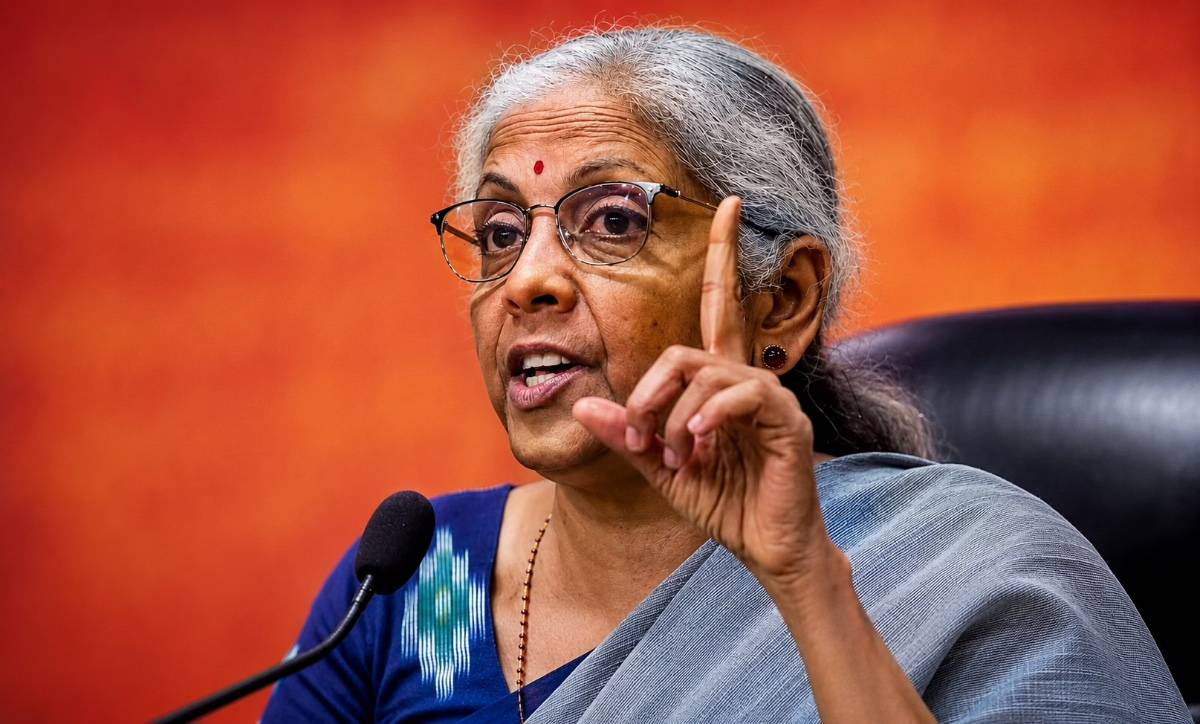
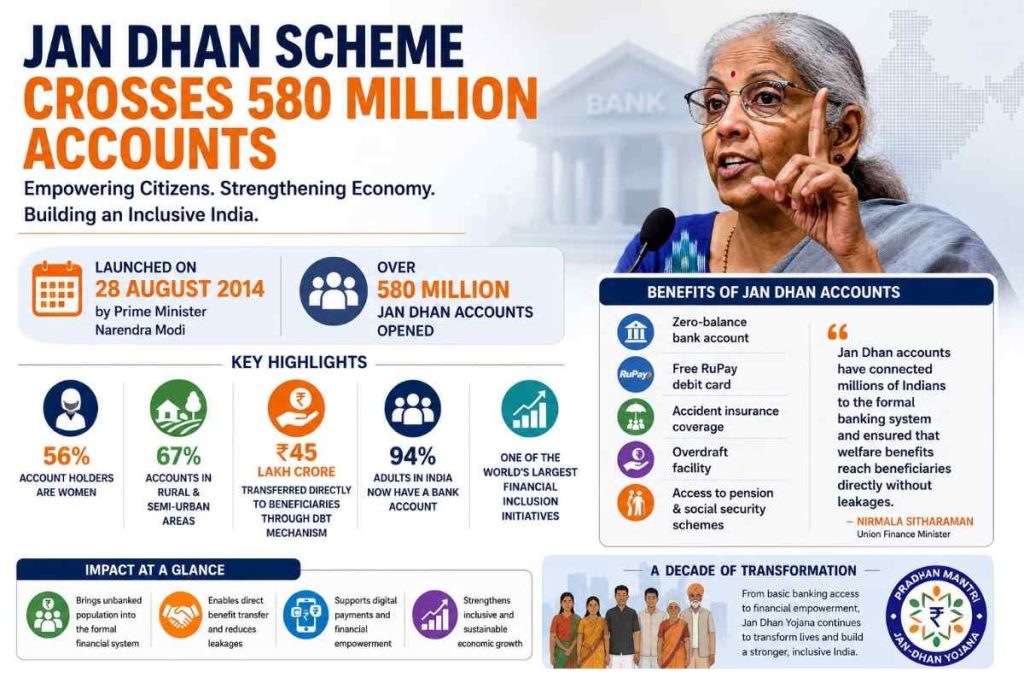
More than a decade after its launch, the Pradhan Mantri Jan Dhan Yojana (PMJDY) has emerged as one of the most significant financial inclusion initiatives in the world, with the number of accounts opened under the scheme surpassing 580 million, according to Union Finance Minister Nirmala Sitharaman.
The milestone highlights the scale of India’s effort to bring previously unbanked citizens into the formal financial system and reflects the government’s broader push toward digital governance, direct benefit transfers, and inclusive economic participation.
Speaking about the scheme’s progress, Sitharaman said Jan Dhan accounts have helped millions gain access to banking services while enabling welfare benefits, pensions, insurance coverage, and other government assistance programs to reach beneficiaries directly.
A Decade of Expanding Financial Access
Launched in August 2014, the Pradhan Mantri Jan Dhan Yojana was designed to address one of India’s longstanding development challenges: limited access to formal banking among low-income households, rural communities, and marginalized populations.
Before the scheme’s introduction, a significant portion of the population relied on informal financial channels, limiting access to savings products, credit facilities, insurance, and government welfare schemes.
The initiative sought to bridge that gap by enabling citizens to open basic bank accounts with minimal documentation requirements and no mandatory minimum balance. Over time, the scheme evolved into a broader financial inclusion platform linked with digital payments, social welfare delivery, and financial security programs.
The latest figures suggest that banking penetration has expanded dramatically, with government data indicating that approximately 94 percent of India’s adult population now has access to a bank account.
Direct Benefit Transfers Reshape Welfare Delivery
One of the most consequential outcomes of the Jan Dhan ecosystem has been its integration with the Direct Benefit Transfer (DBT) framework.
Under this model, government subsidies, pensions, scholarships, and welfare payments are transferred directly into beneficiaries’ bank accounts, reducing dependence on intermediaries and minimizing leakages in the distribution process.
According to official figures, nearly ₹45 lakh crore has been transferred through the DBT mechanism over the years. Policymakers argue that the system has improved transparency, strengthened accountability, and accelerated the delivery of public benefits.
Economists note that direct transfers can significantly reduce administrative inefficiencies while ensuring that support reaches intended recipients more quickly and accurately.
Women and Rural India Drive Growth
The composition of Jan Dhan account holders reveals the scheme’s broader social impact.
Government data shows that women account for more than half of all Jan Dhan beneficiaries, highlighting the program’s role in expanding financial access among female citizens. Increased participation in formal banking is often associated with greater economic independence, improved savings behavior, and stronger financial decision-making at the household level.
The scheme has also made significant inroads into rural and semi-urban India, where roughly two-thirds of all accounts have been opened.
Financial inclusion experts frequently point out that access to banking services can support rural development by enabling savings, facilitating government transfers, and improving access to formal financial products.
Beyond Banking: Insurance, Credit and Digital Payments
Jan Dhan accounts provide more than basic banking access.
Eligible account holders receive benefits such as RuPay debit cards, accident insurance coverage, overdraft facilities, and access to pension and social security programs. These features are intended to encourage long-term participation in the formal financial system while providing a financial safety net for vulnerable households.
The scheme has also played a supporting role in India’s rapid expansion of digital payments. By linking bank accounts with mobile technology and digital payment infrastructure, policymakers have sought to increase financial participation while reducing dependence on cash-based transactions.
This integration has become particularly important as India continues to promote digital public infrastructure and financial technology innovation.
Financial Inclusion as an Economic Strategy
Financial inclusion is increasingly viewed not only as a social objective but also as an economic growth strategy.
A larger formal banking network improves savings mobilization, expands the customer base for financial institutions, and supports the efficient distribution of credit and government assistance. It can also strengthen economic resilience by giving households greater access to secure financial services.
International institutions have frequently cited financial inclusion as a key factor in reducing poverty, improving economic participation, and supporting sustainable development.
India’s experience with Jan Dhan has attracted global attention because of the scale at which financial access has been expanded within a relatively short period.
Looking Ahead
While the growth in account ownership represents a major achievement, experts note that the next phase of financial inclusion will depend on increasing account usage, improving financial literacy, and expanding access to formal credit, insurance, and investment products.
As digital banking continues to evolve and government services become increasingly technology-driven, policymakers are expected to focus on ensuring that newly banked citizens remain active participants in the financial system.
With more than 580 million accounts now opened and banking access reaching most adults, the Jan Dhan program has become a central pillar of India’s financial architecture, illustrating how large-scale public policy initiatives can reshape economic participation and welfare delivery across a diverse and rapidly growing population.
Key Highlights
- Over 580 million Jan Dhan accounts have been opened since the scheme’s launch in 2014.
- Finance Minister Nirmala Sitharaman said the initiative has connected millions to the formal banking system.
- Nearly ₹45 lakh crore has been transferred directly to beneficiaries through the Direct Benefit Transfer (DBT)mechanism.
- Women account for 56% of all Jan Dhan account holders.
- Around 67% of accounts are located in rural and semi-urban areas.
- India now has an estimated 94% adult banking penetration.
- Jan Dhan accounts provide benefits including zero-balance banking, RuPay cards, accident insurance, overdraft facilities, and pension access.
- The scheme has become one of the world’s largest financial inclusion programs.
- Government says the initiative has reduced leakages in welfare distribution and strengthened financial inclusion.
- Jan Dhan continues to support India’s broader goals of digital payments, financial empowerment, and inclusive economic growth.
Input & Images : Hindusthan Samachar
Add outlooknews.in as preferred source on google – click here
Also read – India Moves to Make Government Bonds More Attractive With Tax-Free Returns for Foreign Investors
Last Updated on: Monday, June 8, 2026 11:11 pm by Monisha Angara | Published by: Monisha Angara on Monday, June 8, 2026 11:06 pm | News Categories: Business
About The Author