
India’s fuel transition is entering a new phase. After achieving nationwide rollout of E20 petrol (20% ethanol blend), the government is now preparing to move towards higher ethanol blends such as E85 and even E100, marking a major shift in the country’s automotive and energy landscape.
Policy push: What the government has announced
The Ministry of Road Transport and Highways has proposed changes to vehicle regulations to formally allow E85 (85% ethanol) and E100 (nearly pure ethanol) fuels.
These draft rules are currently open for consultation, and once finalised, they will enable automakers to produce vehicles that can legally operate on higher ethanol blends.
The move follows India’s early achievement of its E20 target and is aimed at reducing dependence on crude oil imports and promoting cleaner fuels.
What are E85 and E100 fuels?
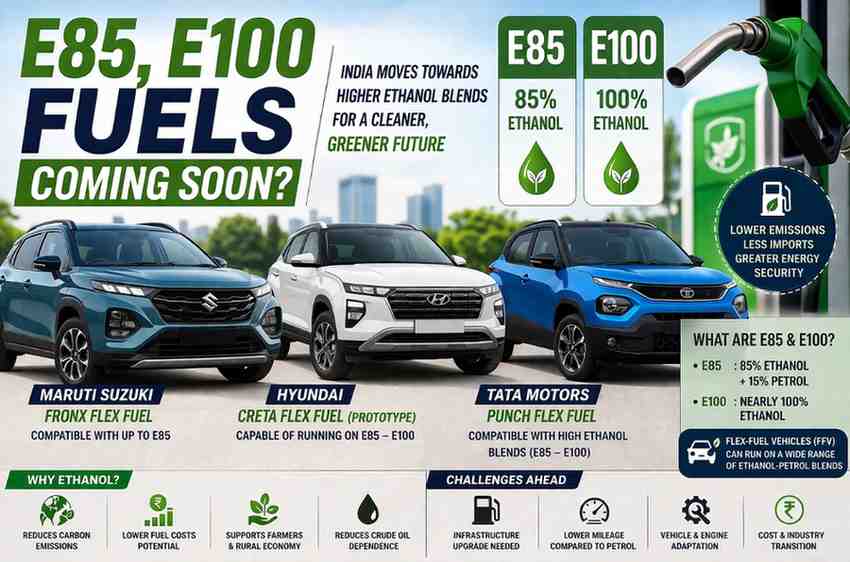
- E85: A blend of 85% ethanol and 15% petrol
- E100: Nearly 100% ethanol fuel
Unlike current petrol cars, these fuels require flex-fuel vehicles (FFVs) engines specifically designed to run on a wide range of ethanol-petrol blends.
Most existing petrol vehicles in India are engineered for E20 or lower blends, meaning higher ethanol fuels need dedicated engine modifications.
Cars from Maruti, Hyundai, Tata: Which models are compatible?
While a mass-market rollout is still pending, several automakers have already showcased or developed flex-fuel-compatible models.
Maruti Suzuki
- Maruti Fronx Flex Fuel (concept/expected launch)
- Can run on up to E85 ethanol blend
- Showcased globally and expected to enter India around 2026
- Flex-fuel variants of models like Brezza have also been displayed at auto expos as part of future plans
Hyundai
- Hyundai Creta Flex Fuel (prototype)
- Demonstrated with capability to run on up to E100 ethanol
- Uses a modified turbo-petrol engine adapted for high ethanol blends
Hyundai has been among the early adopters showcasing real-world FFV prototypes in India.
Tata Motors
- Tata Punch Flex Fuel (showcased)
- Demonstrated compatibility with high ethanol blends (up to E85–E100 range at concept level)
Tata Motors is actively working on flex-fuel technology as part of its broader clean mobility strategy.
Other notable developments
- Toyota Innova Hycross FFV
- India’s first commercially introduced flex-fuel car capable of running on up to E100 ethanol
- Hyundai, Maruti, Tata, Mahindra SUVs
- Multiple prototypes showcased at the Bharat Mobility Expo capable of E85–E100 operation
Why India is pushing ethanol fuels
The shift toward E85 and E100 is driven by multiple strategic goals:
- Energy security: Reduce dependence on imported crude oil
- Lower emissions: Ethanol burns cleaner than petrol
- Support agriculture: Ethanol is produced from crops like sugarcane and maize
- Cost advantage: Ethanol is generally cheaper than petrol
India is also planning phased availability of higher ethanol blends in key agricultural regions before nationwide expansion.
Challenges ahead
Despite strong policy momentum, the transition faces several hurdles:
- Vehicle compatibility: Most existing cars cannot use E85 or E100
- Infrastructure readiness: Fuel stations need upgrades
- Mileage concerns: Ethanol has lower energy density, leading to reduced fuel efficiency
- Industry adaptation: Automakers need time and investment to scale FFVs
Automobile companies have already raised concerns about the cost and technical adjustments required for this transition.
What it means for car buyers
For now, there is no immediate impact on existing car owners. E20 remains the standard fuel across India.
However, in the coming years:
- New cars may increasingly be flex-fuel compatible
- Buyers may get the option to use multiple fuel types (petrol + ethanol blends)
- Running costs could reduce, depending on ethanol pricing
The bottom line
India’s move towards E85 and E100 fuels signals a long-term transformation of the automotive ecosystem, rather than an overnight shift.
With companies like Maruti Suzuki, Hyundai, and Tata Motors already testing compatible vehicles, the groundwork is being laid for a future where cars can run on cleaner, domestically produced fuels.
The transition, however, will depend on how quickly infrastructure, regulations, and vehicle technology align making the next few years critical for India’s ethanol mobility ambitions.
Input & Images : Hindusthan Samachar
Add outlooknews.in as preferred source on google – click here
Also read – Best gaming phones in India under ₹30,000: From iQOO Neo 10R to Poco X7 Pro — full list and analysis
Last Updated on: Wednesday, April 29, 2026 4:39 pm by Monisha Angara | Published by: Monisha Angara on Wednesday, April 29, 2026 4:39 pm | News Categories: Automobile
About The Author