

Central Bank Faces Balancing Act Between Growth Support and Rising Global Uncertainties
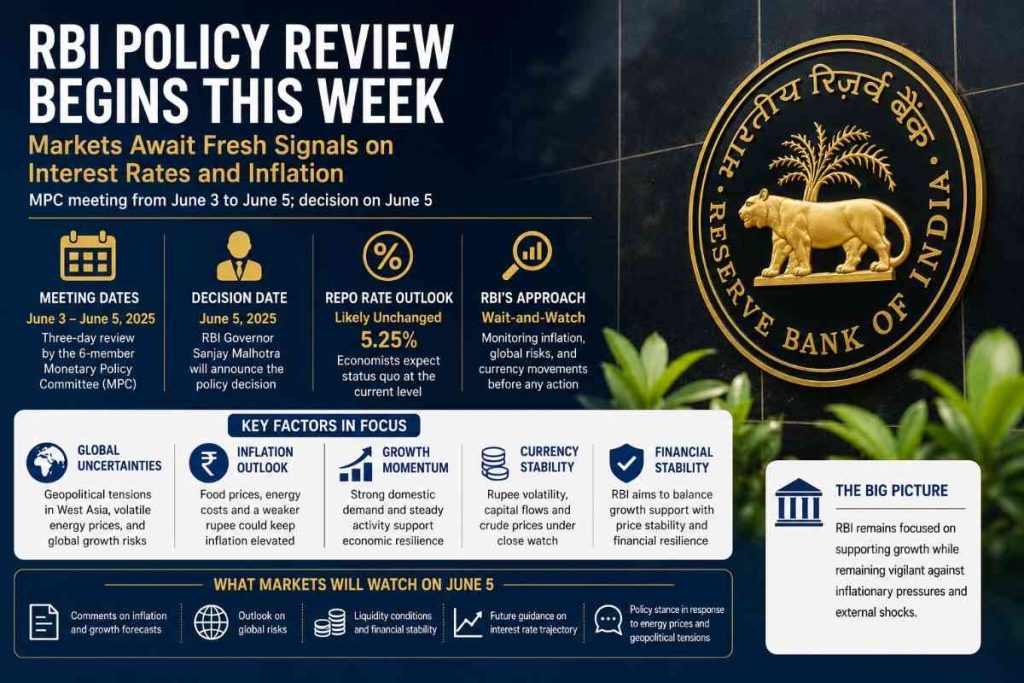
The Reserve Bank of India (RBI) is set to begin its latest monetary policy review on June 3, with financial markets, businesses, and borrowers closely watching for signals on interest rates, inflation, and the broader economic outlook. The three-day meeting of the Monetary Policy Committee (MPC) comes at a time when policymakers are navigating a complex mix of domestic resilience and mounting global risks.
The six-member MPC, chaired by RBI Governor Sanjay Malhotra, will deliberate on monetary policy settings before announcing its decision on June 5. While market participants remain attentive to every policy review, this meeting carries added significance due to ongoing geopolitical tensions, volatile energy markets, and uncertainties surrounding global growth.
Most economists expect the central bank to leave the benchmark repo rate unchanged at 5.25%, extending its cautious approach as it evaluates evolving inflation and financial stability risks.
Global Risks Continue to Shape Policy Outlook
The RBI enters the review amid heightened geopolitical uncertainty. Ongoing tensions in West Asia have raised concerns about potential disruptions to global energy supplies, a development that could influence crude oil prices and, consequently, inflation in energy-importing economies such as India.
Higher energy costs typically affect transportation, manufacturing, and household expenses, creating broader inflationary pressures. Policymakers are therefore likely to closely assess how global commodity markets evolve over the coming months before considering any major adjustment to interest rates.
At the same time, central banks across major economies remain cautious about easing monetary conditions too quickly, adding another layer of uncertainty to the global financial environment.
Inflation Remains a Key Consideration
Although India’s inflation trajectory has moderated compared with the peaks seen in previous years, policymakers continue to monitor several factors that could reignite price pressures.
Food inflation remains vulnerable to weather-related disruptions, while imported inflation risks have increased amid fluctuations in energy prices and currency markets. A weaker rupee can raise the cost of imports, potentially feeding into domestic prices across multiple sectors.
For the RBI, maintaining price stability remains a core priority. Any signs that inflation could move persistently above the central bank’s comfort zone may reinforce the case for keeping policy rates unchanged.
Analysts note that while inflation has become more manageable, it has not yet reached a stage where policymakers can comfortably shift toward a significantly more accommodative stance.
Growth Momentum Offers Support
India’s economy continues to demonstrate relative strength compared with many major economies, supported by government infrastructure spending, resilient domestic demand, and steady activity across manufacturing and services sectors.
Strong economic growth provides policymakers with greater flexibility to prioritize inflation control when necessary. Unlike periods of weak economic activity, the current environment does not create immediate pressure for aggressive rate cuts aimed at stimulating growth.
The central bank is therefore expected to maintain its focus on balancing growth support with financial stability and inflation management.
Currency Stability Under Focus
The performance of the Indian rupee is likely to feature prominently in policy discussions.
Global capital flows, crude oil prices, and interest-rate expectations in advanced economies continue to influence currency movements. A stable rupee helps contain imported inflation and supports investor confidence, making exchange-rate developments an important consideration for the MPC.
While the RBI does not target a specific exchange rate, it closely monitors excessive volatility that could disrupt financial markets or economic stability.
What Markets Will Watch on June 5
Beyond the interest-rate decision itself, investors will closely examine the RBI’s commentary on inflation forecasts, growth projections, liquidity conditions, and external risks.
Financial markets often react as much to the central bank’s future guidance as to the policy decision itself. Any indication regarding the likely trajectory of rates over the coming quarters could influence bond yields, equity markets, borrowing costs, and investor sentiment.
Particular attention will also be paid to whether the RBI revises its inflation outlook in response to higher energy prices and global uncertainties.
A Wait-and-Watch Approach Likely to Continue
The consensus among economists is that the RBI is likely to maintain its cautious stance while gathering additional evidence on inflation trends and global developments.
With geopolitical risks, energy prices, and currency movements continuing to create uncertainty, policymakers may prefer stability over aggressive policy action. Such an approach would allow the central bank to preserve flexibility while monitoring how domestic and international conditions evolve.
As the MPC begins its deliberations, the broader message expected from the RBI is one of vigilance: supporting economic momentum while remaining prepared to respond to inflationary pressures and external shocks if required.
Key Highlights
- RBI Monetary Policy Committee meeting scheduled from June 3–5.
- Policy decision to be announced by Governor Sanjay Malhotra on June 5.
- Markets widely expect the repo rate to remain unchanged at 5.25%.
- Rising oil prices, geopolitical tensions, and rupee weakness remain key concerns.
- Inflation outlook and RBI guidance will be closely watched by investors.
- Any revisions to growth and inflation forecasts could influence market sentiment.
Input & Images : Hindusthan Samachar
Add outlooknews.in as preferred source on google – click here
Also read – Commercial LPG Prices Rise as Government Eases Fuel Export Levies
Last Updated on: Monday, June 1, 2026 9:46 pm by Monisha Angara | Published by: Monisha Angara on Monday, June 1, 2026 9:46 pm | News Categories: Business
About The Author