
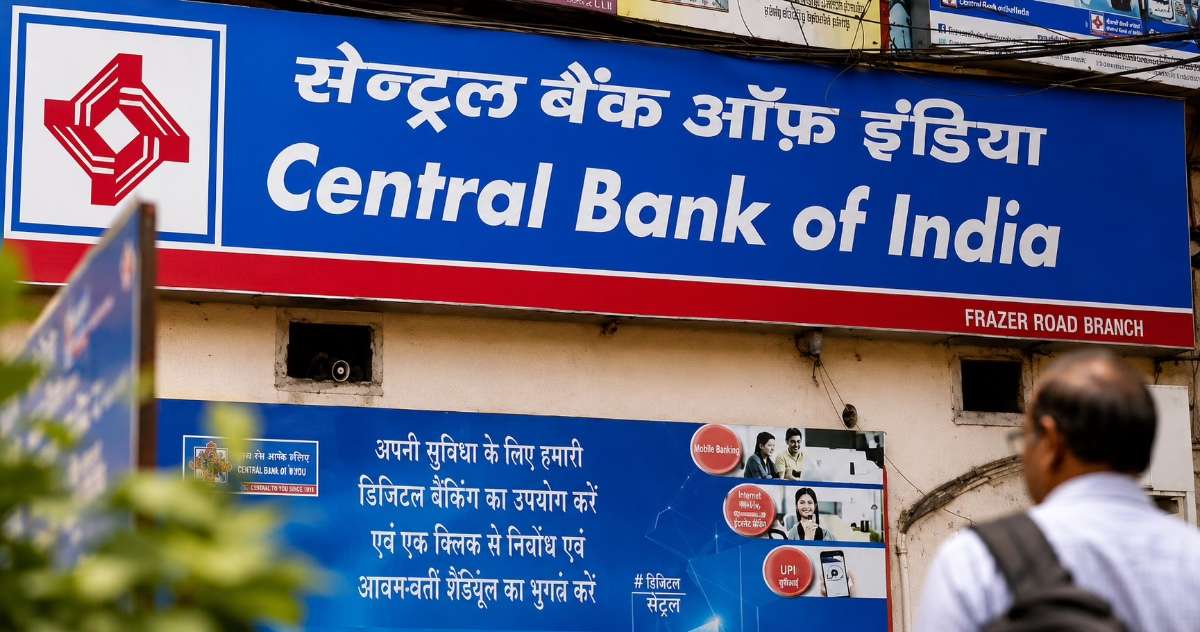
The Indian government has initiated a fresh stake sale in state-run Central Bank of India, continuing its broader strategy of reducing holdings in public sector banks while moving closer to regulatory shareholding norms mandated by market authorities.
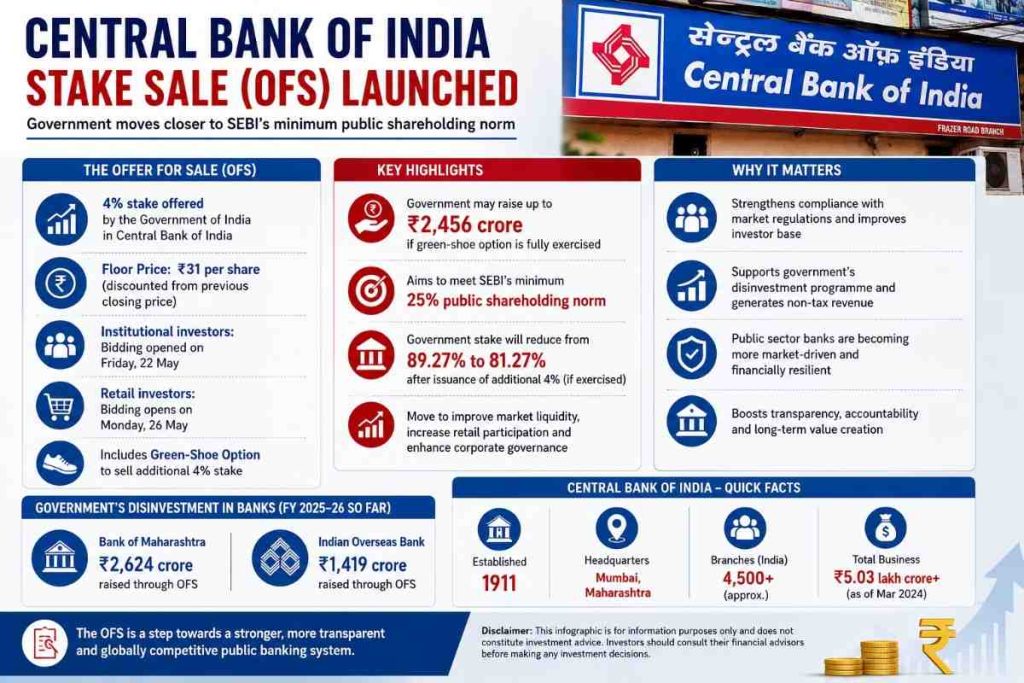
The offer for sale (OFS), opened for institutional investors on Friday, involves an initial divestment of 4% in the Mumbai-headquartered lender. Retail investors are scheduled to participate in the second phase of the share sale on Monday. The floor price has been fixed at ₹31 per share lower than the bank’s recent market closing price a move typically aimed at attracting wider investor participation.
The transaction comes amid the Centre’s ongoing efforts to improve market liquidity in public sector enterprises, deepen retail ownership and generate non-tax revenue through strategic stake dilution.
Discounted Share Price Signals Push for Wider Participation
The government has offered shares at a discount compared with the bank’s previous closing level on the Bombay Stock Exchange, where the stock had settled above ₹33 before the announcement. Such pricing strategies are commonly used in OFS transactions to ensure sufficient demand from institutional and retail investors.
Market analysts noted that discounted pricing often creates short-term pressure on stock valuations, particularly in public sector banks where government ownership remains significantly high. Central Bank of India shares witnessed early weakness in trading following the announcement, reflecting immediate market adjustment to the proposed dilution.
The OFS structure also includes a green-shoe option, allowing the government to offload an additional 4% stake if demand remains strong. If fully exercised, the Centre could raise an estimated ₹2,456 crore from the transaction.
SEBI Norms Driving Public Sector Stake Dilution
One of the primary drivers behind the stake sale is compliance with the Securities and Exchange Board of India’s minimum public shareholding requirement.
Under SEBI regulations, all listed companies are required to maintain at least 25% public shareholding to improve market transparency, liquidity and broader investor participation. However, many public sector banks continue to remain heavily government-owned, requiring gradual dilution over time.
The government currently holds more than 89% in Central Bank of India. Even after the proposed sale and potential green-shoe exercise, the Centre would continue retaining a dominant majority stake in the lender.
Financial sector observers say the government appears to be balancing two parallel objectives: maintaining strategic control over public sector banks while simultaneously improving compliance with market regulations and increasing institutional investor participation.
Public Sector Banking Reform Remains Ongoing
The latest stake sale reflects a larger evolution underway within India’s public sector banking ecosystem.
Over the past several years, the government has focused on recapitalisation, consolidation, governance reforms and capital market participation to strengthen state-owned banks after a prolonged period marked by stressed assets and weak balance sheets.
Public sector banks have shown improved profitability and healthier asset quality in recent years, aided by stronger credit growth, improved recovery mechanisms and relatively stable economic conditions. This recovery has gradually improved investor confidence in government-owned lenders, many of which had previously struggled with high non-performing asset (NPA) levels.
Analysts believe stake sales in banks such as Central Bank of India are also intended to improve institutional discipline and enhance market-driven accountability without immediately pursuing full privatization.
Government Accelerates Disinvestment Activity
The Centre has already raised substantial funds through stake sales in other public sector lenders during the current financial year.
Recent transactions involving Bank of Maharashtra and Indian Overseas Bank generated thousands of crores in revenue, highlighting the government’s continued reliance on capital markets as part of its broader fiscal and disinvestment strategy.
Disinvestment proceeds remain important for supporting government finances, infrastructure spending and fiscal management targets. At the same time, policymakers are attempting to increase market depth in state-run institutions by encouraging wider participation from domestic and foreign investors.
While large-scale privatization of major public sector banks remains politically and strategically sensitive, gradual stake dilution has emerged as a more practical route for improving compliance with market norms and enhancing operational flexibility.
Investor Focus Shifts to Banking Sector Outlook
The success of the Central Bank of India OFS may also depend on broader investor sentiment toward India’s banking sector.
Indian banking stocks have remained relatively resilient amid expectations of sustained domestic credit demand, infrastructure-led economic activity and expanding retail lending. Public sector banks, once considered weaker performers compared to private lenders, have seen renewed investor attention after several years of restructuring and balance-sheet cleanup.
However, analysts caution that public sector banks still face challenges including capital adequacy requirements, operational modernization, digital competition and maintaining profitability during changing interest-rate cycles.
For investors, the OFS represents not only a discounted entry opportunity but also a test of confidence in the long-term trajectory of India’s state-owned banking sector.
As the government continues calibrating its approach toward public sector reforms, transactions like the Central Bank of India stake sale are likely to remain an important feature of India’s evolving financial and capital-market landscape.
Key Highlights:
- Centre launches OFS to sell 4% stake in Central Bank of India
- Floor price fixed at ₹31 per share, lower than previous market close
- Retail investors can participate in the share sale on Monday
- OFS includes green-shoe option for an additional 4% stake sale
- Government could raise up to ₹2,456 crore if full option is exercised
- Move aims to comply with SEBI’s 25% minimum public shareholding norm
- Government stake may reduce from 89.27% to 81.27% after dilution
- Public sector banking reforms and disinvestment push continue
- Banking sector recovery has improved investor interest in PSU banks
- Earlier OFS transactions in Bank of Maharashtra and Indian Overseas Bank also raised significant funds
Input & Images : Hindusthan Samachar
Add outlooknews.in as preferred source on google – click here
Also read – India Name Young Squad for Women’s U-18 Hockey Asia Cup as Focus Shifts to Future Talent Pipeline
Last Updated on: Friday, May 22, 2026 5:39 pm by Monisha Angara | Published by: Monisha Angara on Friday, May 22, 2026 5:37 pm | News Categories: India
About The Author