

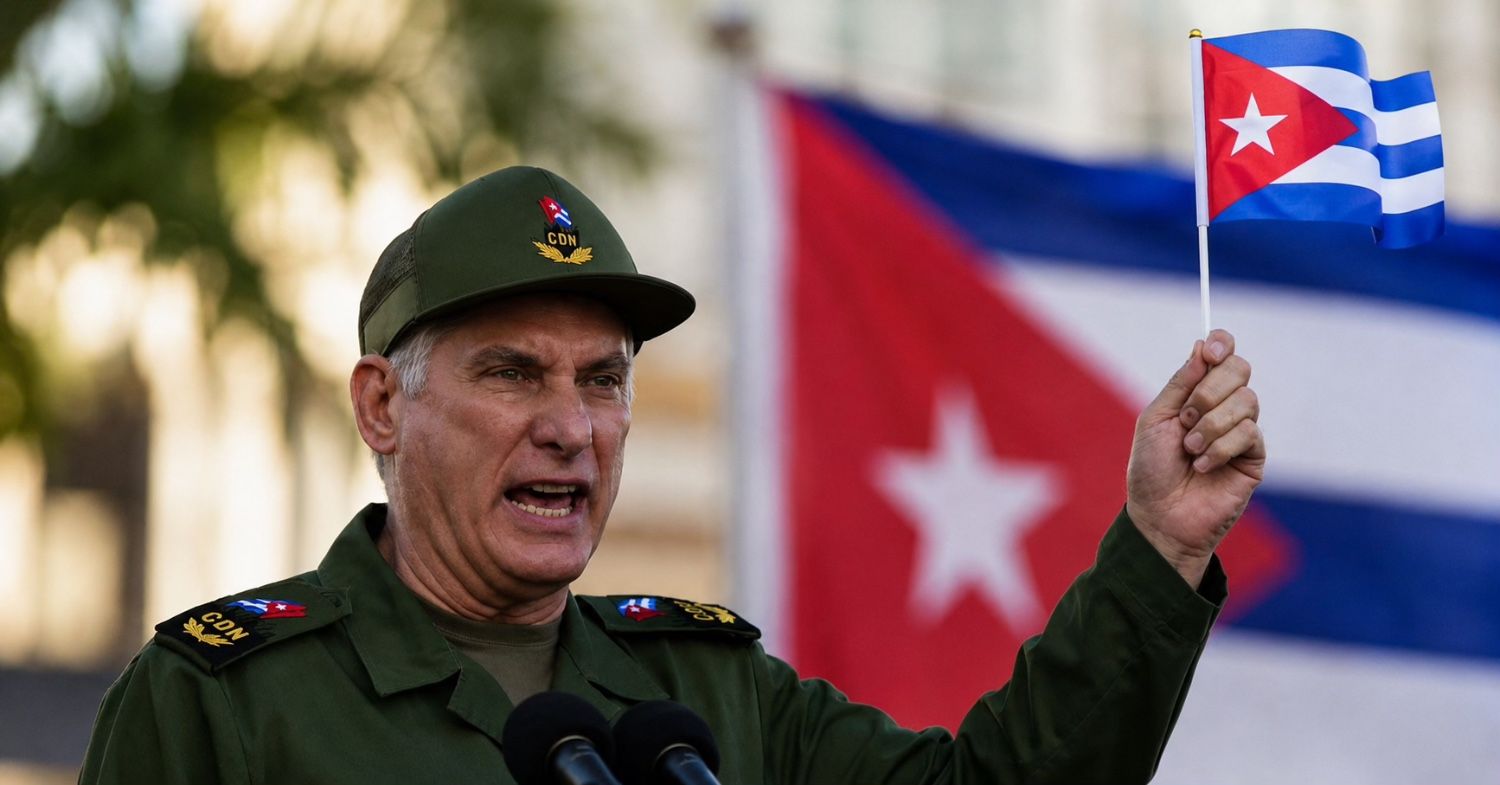
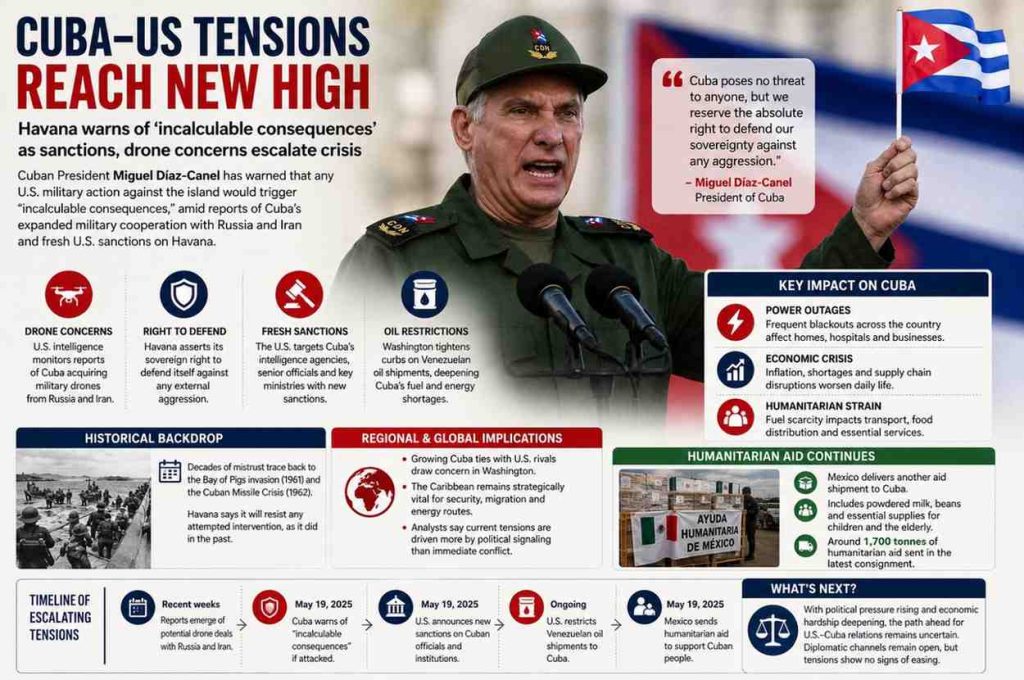
Relations between Cuba and the United States have entered another period of heightened strain after Cuban President Miguel Díaz-Canel warned that any potential military action against the island could trigger “incalculable consequences,” escalating rhetoric at a time of growing geopolitical uncertainty across the Western Hemisphere.
The sharp warning from Havana comes amid reports in U.S. media and intelligence circles suggesting that Cuba may be strengthening its military capabilities through cooperation with Russia and Iran, particularly in the area of unmanned aerial systems. While Cuban authorities have not officially confirmed the acquisition of military drones, the reports have intensified scrutiny in Washington and revived concerns over security dynamics in the Caribbean region.
The developments reflect a broader deterioration in already fragile U.S.-Cuba relations, driven by economic sanctions, regional political tensions, energy shortages and renewed strategic competition involving global powers.
Havana Rejects Security Threat Allegations
In a strongly worded statement posted on social media platform X, President Díaz-Canel rejected suggestions that Cuba poses a military threat to the United States or neighboring countries. However, he insisted that Cuba retains the sovereign right to defend itself against any form of external aggression.
The remarks appeared designed both for international audiences and domestic political messaging, reinforcing the Cuban government’s longstanding narrative that U.S. pressure policies threaten the island’s sovereignty and economic stability.
Cuban officials have increasingly framed Washington’s recent actions as part of a broader campaign of political and economic coercion intended to destabilize the country internally.
The latest tensions gained momentum following reports that American intelligence agencies are closely monitoring alleged Cuban military cooperation with foreign powers, particularly in areas linked to drone technology and surveillance capabilities near strategic locations such as Guantánamo Bay.
Although no publicly verified evidence has emerged confirming any immediate military threat, the reports have fueled speculation about how the United States could respond if tensions continue to escalate.
Historical Distrust Shapes Current Crisis
The confrontation revives decades-old mistrust rooted in Cold War history.
From the Bay of Pigs invasion in 1961 to the Cuban Missile Crisis of 1962, relations between Washington and Havana have long carried strategic and symbolic significance beyond the Caribbean region itself.
Cuba’s Ambassador to the United Nations, Ernesto Soberón Guzmán, invoked that historical memory while warning that the country would resist any attempted intervention. References to the Bay of Pigs invasion remain politically powerful inside Cuba, where the failed U.S.-backed operation is often portrayed as a defining moment of national resistance.
Analysts say the Cuban leadership frequently uses historical parallels to strengthen domestic unity during periods of economic hardship and diplomatic confrontation.
At the same time, renewed geopolitical competition between the United States, Russia and Iran has increased international attention on alliances involving countries historically opposed to Washington’s foreign policy agenda.
Sanctions Pressure Intensifies Economic Crisis
The diplomatic confrontation is unfolding against the backdrop of Cuba’s worsening economic emergency.
The United States has recently expanded sanctions targeting Cuban institutions and senior officials, including individuals linked to intelligence, communications, energy administration and security agencies.
Washington has also tightened restrictions affecting oil shipments from Venezuela, Cuba’s primary external energy supplier. The move has further strained the island’s already fragile fuel supply system.
Cuba has been grappling with prolonged electricity blackouts, inflation, food shortages and transportation disruptions, creating widespread hardship across the country. Energy shortages have become particularly severe, with recurring power outages affecting businesses, hospitals and households.
Economic analysts note that Cuba’s crisis stems from a combination of structural economic weaknesses, declining foreign currency reserves, reduced tourism revenues, inefficiencies within state-controlled sectors and external sanctions pressure.
Havana, however, continues to argue that U.S. sanctions remain the central factor aggravating the humanitarian situation.
Humanitarian Concerns Growing
The worsening economic environment has increasingly drawn humanitarian concern from regional governments and international observers.
On Monday, Mexico delivered another aid shipment to Cuba containing food supplies including powdered milk and beans intended for vulnerable populations such as children and elderly citizens.
The reported shipment of approximately 1,700 tonnes marked the latest in a series of humanitarian consignments sent by Mexico in recent months, highlighting growing regional concern over Cuba’s deteriorating living conditions.
Several Latin American governments have criticized Washington’s sanctions policy toward Cuba, arguing that economic restrictions disproportionately affect ordinary citizens rather than political leadership.
The United States, however, maintains that sanctions are intended to pressure Cuban authorities over governance, political freedoms and human rights concerns.
Strategic Implications Beyond the Caribbean
The latest tensions carry significance beyond bilateral U.S.-Cuba relations.
Security experts note that any increase in military cooperation between Cuba and U.S. geopolitical rivals would likely attract serious attention in Washington, particularly amid wider global tensions involving Russia, Iran and China.
The Caribbean remains strategically important for maritime security, regional migration routes, energy logistics and U.S. military positioning.
At the same time, analysts caution against overstating the immediate risk of direct military confrontation, noting that much of the current escalation appears driven by political signaling, diplomatic pressure and strategic messaging rather than imminent conflict preparations.
Still, the sharp rhetoric from both sides illustrates how quickly dormant geopolitical fault lines can re-emerge during periods of broader global instability.
Political Uncertainty Ahead
The coming months could prove critical for the future direction of U.S.-Cuba relations.
Reports that American authorities may be considering additional legal or political pressure against members of Cuba’s ruling leadership suggest the confrontation could intensify further. Meanwhile, Havana is likely to continue emphasizing sovereignty, anti-intervention messaging and international solidarity partnerships.
For ordinary Cubans already struggling with shortages, inflation and infrastructure breakdowns, however, the geopolitical dispute risks deepening an already severe economic and humanitarian crisis.
While diplomatic channels between the two countries remain open at limited levels, the current trajectory points toward continued tension rather than near-term normalization.
As global strategic rivalries increasingly shape regional politics, the Cuba-U.S. relationship once again appears to be entering a volatile and uncertain phase.
Key Highlights
- Cuba warned of “incalculable consequences” if the United States takes military action against the island, escalating tensions between Havana and Washington.
- The warning came amid reports that Cuba may have acquired military drones from Russia and Iran, prompting increased scrutiny from U.S. intelligence agencies.
- Cuban President Miguel Díaz-Canel said Cuba poses no threat to any nation but retains the “legitimate right” to defend itself against external aggression.
- The United States has imposed fresh sanctions targeting Cuba’s intelligence agencies, senior officials and key government ministries as pressure on Havana intensifies.
- Cuba is facing a worsening economic and humanitarian crisis marked by fuel shortages, blackouts, inflation and supply-chain disruptions.
- Havana accused Washington of attempting to economically destabilize the country through sanctions and restrictions on Venezuelan oil shipments.
- Mexico delivered another humanitarian aid shipment to Cuba, including food supplies for children and elderly citizens affected by the crisis.
Input & Images : Hindusthan Samachar
Add outlooknews.in as preferred source on google – click here
Also read –PM Modi’s Norway Visit Signals India’s Expanding Strategic Push Across Europe
Last Updated on: Tuesday, May 19, 2026 12:44 pm by Monisha Angara | Published by: Monisha Angara on Tuesday, May 19, 2026 12:41 pm | News Categories: News, Politics
About The Author