


The Income Tax Department has officially enabled the Excel utilities for ITR-1 and ITR-4 forms for the financial year 2025-26 (assessment year 2026-27), marking the beginning of India’s annual income tax return filing cycle for millions of taxpayers.
The release is particularly significant for salaried employees, pensioners, freelancers, small business owners and presumptive taxation applicants who rely on these simplified forms for filing returns. Taxpayers can now download the utilities through the government’s e-filing portal and begin preparing and submitting their returns.
The rollout comes at a time when the tax administration is increasingly emphasizing digital compliance, faster processing, and improved taxpayer services, while also introducing revised filing timelines and updated reporting requirements under recent budget provisions.
Who Can File Using ITR-1 and ITR-4?
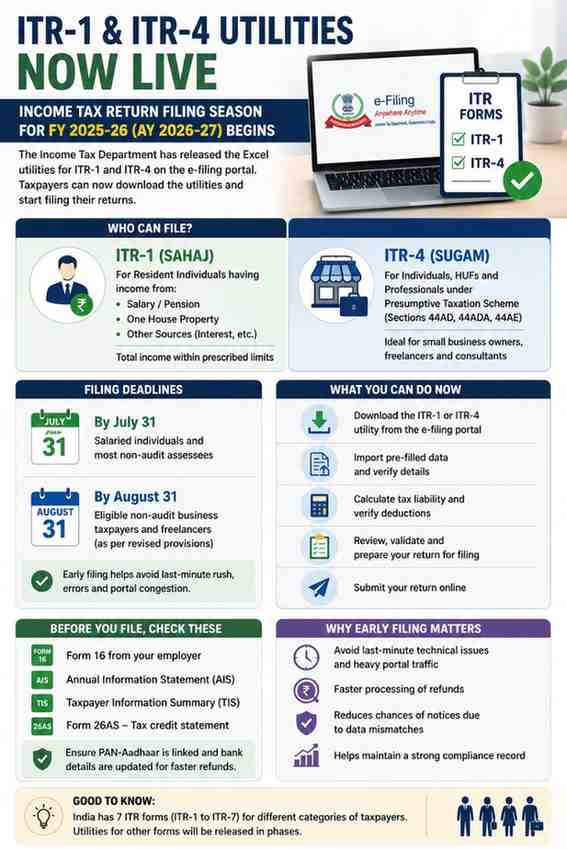
The ITR-1 form, commonly known as “Sahaj,” is designed primarily for resident individuals earning income from salary, pension, one house property, and certain other specified sources within prescribed income limits.
ITR-4, meanwhile, caters to taxpayers opting for the presumptive taxation scheme under sections such as 44AD, 44ADA and 44AE of the Income Tax Act. This form is widely used by small business owners, consultants, freelancers and professionals with relatively simpler income structures.
Tax experts note that these two forms together account for a substantial portion of India’s annual tax return filings, making their release one of the earliest and most closely watched developments in every assessment cycle.
Filing Deadlines See Key Adjustment for Some Taxpayers
Under the standard schedule, salaried taxpayers and most non-audit assessees are expected to file their income tax returns by July 31. However, recent provisions introduced through the Union Budget framework have provided additional filing flexibility for certain categories of small businesses and professionals whose accounts are not subject to mandatory audit requirements.
As a result, eligible non-audit business taxpayers and freelancers may now get until August 31 to complete filings, potentially easing pressure during peak filing periods.
Tax professionals say the revised timeline could help reduce last-minute compliance issues, portal congestion and filing errors that typically arise closer to deadlines.
What the Utility Release Means for Taxpayers
The activation of utilities effectively means the filing season is now operational. Taxpayers can begin:
- downloading the relevant offline utility forms,
- importing pre-filled data,
- calculating tax liability,
- verifying deductions and exemptions,
- and preparing returns for submission.
Chartered accountants and tax consultants often advise taxpayers to begin the process early rather than waiting until the final weeks of the filing season. Early filing can help individuals avoid technical glitches, documentation mismatches, delayed refund processing and compliance notices arising from errors.
Experts also recommend cross-checking information appearing in Form 16, Annual Information Statement (AIS), Taxpayer Information Summary (TIS), and Form 26AS before submission.
Increased Focus on Digital Tax Administration
The Income Tax Department has steadily expanded its digital infrastructure over the past several years as part of a broader modernization push aimed at improving compliance efficiency and reducing manual intervention.
From faceless assessments and AI-assisted scrutiny systems to pre-filled returns and online grievance handling, India’s direct tax administration has undergone major structural transformation in recent years.
The continued rollout of updated utilities reflects the government’s effort to simplify filing procedures while also improving data matching and transparency across financial reporting systems.
Tax professionals say pre-filled data availability has significantly improved accuracy for many salaried taxpayers, though manual verification remains essential, particularly for deductions, capital gains, freelance income and interest earnings.
Importance of Selecting the Correct ITR Form
Choosing the correct return form remains one of the most important aspects of the filing process. Incorrect form selection can lead to defective return notices or delayed processing.
India currently uses seven different categories of ITR forms — ITR-1 through ITR-7 — each designed for specific taxpayer categories, income structures and institutional entities.
While ITR-1 and ITR-4 utilities are now live, utilities for other forms are expected to be released in phases as the filing season progresses.
Why Early Filing Matters This Year
Tax advisers say early filing could become even more important this year because of increased information reporting requirements and stronger data integration between banks, employers, investment platforms and tax authorities.
The Income Tax Department now receives extensive financial transaction data through multiple reporting channels, making mismatches easier to identify during automated scrutiny.
For taxpayers expecting refunds, filing early may also result in faster processing timelines, provided bank verification, PAN-Aadhaar linkage and supporting documentation are properly updated.
Outlook for the 2026-27 Assessment Cycle
With the utilities now active, the focus will gradually shift toward taxpayer compliance, portal stability and the release of additional forms in the coming weeks.
Experts expect this filing season to see continued growth in digital filings, greater reliance on pre-filled information, and stronger scrutiny of inconsistencies between declared income and reported financial activity.
For ordinary taxpayers, however, the immediate takeaway is straightforward: the filing window has officially opened, and preparations for the 2026-27 assessment cycle are now underway.
Key Highlights
- The Income Tax Department has released the Excel utilities for ITR-1 and ITR-4 for FY 2025-26 (AY 2026-27), officially opening the income tax return filing season.
- ITR-1 (Sahaj) is primarily meant for salaried individuals and pensioners, while ITR-4 is designed for small businesses, freelancers, and professionals under the presumptive taxation scheme.
- Salaried taxpayers are generally required to file returns by July 31, while eligible non-audit business taxpayers and freelancers may get an extended deadline until August 31 under revised provisions.
- Taxpayers can now download utilities, import pre-filled information, calculate liabilities, verify deductions, and prepare returns through the Income Tax Department’s e-filing portal.
- Experts are advising taxpayers to file early to avoid portal congestion, refund delays, documentation mismatches, and last-minute compliance issues.
- The filing season reflects the government’s broader push toward digital tax administration, including pre-filled returns, faceless assessments, and increased data integration across financial systems.
- Tax professionals have stressed the importance of selecting the correct ITR form and verifying details in Form 16, AIS, TIS, and Form 26AS before submission.
Input & Images : Hindusthan Samachar
Add outlooknews.in as preferred source on google – click here
Also read – Gold Holds Firm in Indian Markets While Silver Sees Sharp Correction Amid Volatile Global Trade
Last Updated on: Friday, May 15, 2026 11:01 pm by Monisha Angara | Published by: Monisha Angara on Friday, May 15, 2026 10:50 pm | News Categories: Business
About The Author