

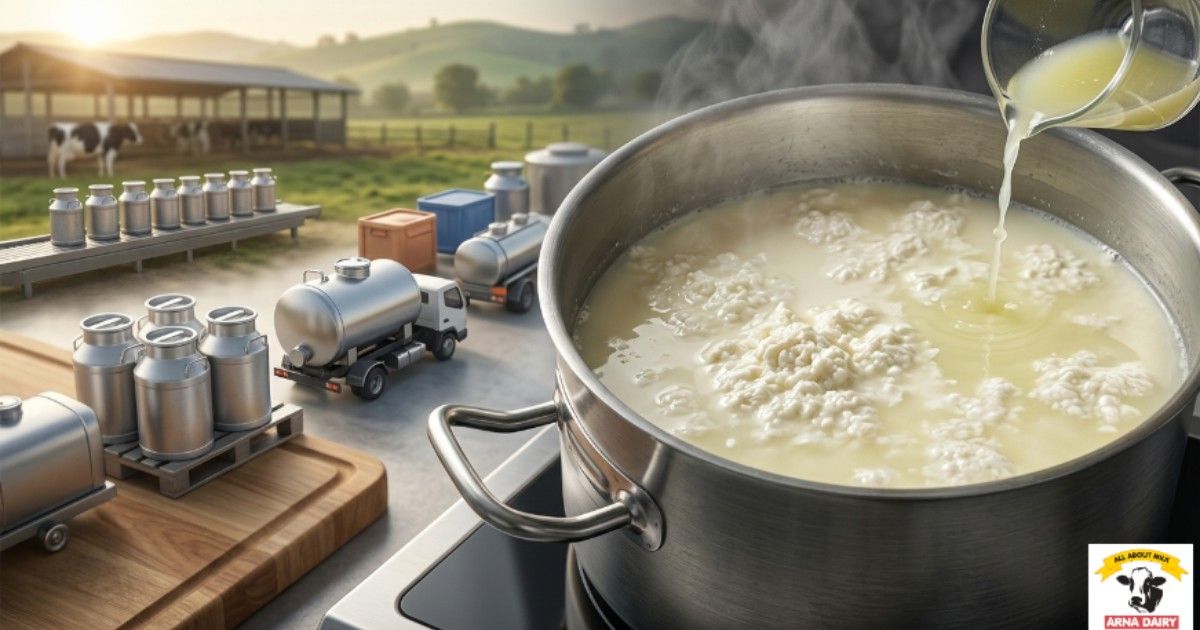
Paneer is one of the most widely used dairy products in Indian commercial and household kitchens. Despite its simplicity in preparation, one recurring challenge faced across kitchens is inconsistent yield.
The same recipe, identical process, and similar equipment often produce different quantities of paneer on different days.
While this variation is frequently attributed to preparation technique, the underlying causes are often upstream — beginning with the milk itself.
The assumption of process control
Paneer production is generally viewed as a controlled kitchen process involving heating milk, adding an acidifying agent, curdling, and pressing the resulting curd.
This framework assumes that consistency is primarily determined by execution.
However, in practice, paneer yield is highly dependent on the composition and quality of the milk used, which introduces variability before the process even begins.
Key determinants of paneer yield
1. Solids Not Fat (SNF)
SNF is one of the most critical factors influencing paneer yield. It represents the non-fat solids in milk, primarily proteins such as casein, which form the structural matrix of paneer.
Higher SNF levels result in stronger curd formation and higher yield, while lower SNF levels lead to weaker structure and reduced output.
Even minor fluctuations in SNF can create noticeable differences in final yield.
2. Fat content
Fat contributes to texture, softness, and sensory quality of paneer. However, fat alone does not determine yield efficiency.
Milk with high fat but low SNF may still produce lower-than-expected paneer output due to insufficient protein structure formation.
This makes fat percentage an incomplete indicator of functional performance.
3. Freshness and acidity balance
Milk freshness and its initial acidity level significantly influence coagulation behaviour.
Milk with elevated acidity or early-stage microbial activity tends to curdle rapidly, often resulting in uneven separation and higher whey loss.
This directly impacts usable paneer quantity and consistency.
Why kitchen-level troubleshooting often fails
When yield variation occurs, kitchens typically evaluate:
- heating temperature
- acid quantity
- timing of curdling
- pressing method
While these are important, they address only the process layer.
They do not account for variability in raw material composition, which is often the primary driver of inconsistency.
Operational impact in commercial kitchens
In food service environments, even small variations in paneer yield can have cumulative operational effects:
- fluctuating cost per portion
- inconsistent dish standardisation
- planning inefficiencies in bulk preparation
- increased wastage due to unpredictable output
Over time, this creates hidden cost pressure on kitchen operations.
Conclusion
Paneer yield variation is often perceived as a process-related issue. However, in most cases, the determining factor lies upstream in the composition and quality of milk.
The kitchen does not create inconsistency — it reveals it.
As food service systems become more data-driven and quality-sensitive, raw material consistency is increasingly recognised as a primary driver of operational reliability.
Last Updated on: Friday, May 15, 2026 6:02 pm by Outlook News Team | Published by: Outlook News Team on Friday, May 15, 2026 6:00 pm | News Categories: Brand Post
About The Author