

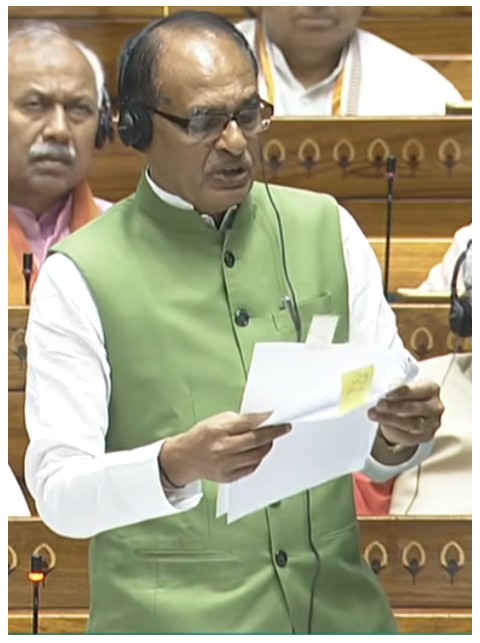
Union Agriculture Minister Shivraj Singh Chouhan told the Lok Sabha on March 24, 2026, that several government initiatives have contributed to increasing farmers’ incomes, with many reportedly seeing their earnings double in recent years.
Speaking during a parliamentary discussion, the minister outlined measures taken by the Centre to ensure fair prices, income security, and risk protection for farmers across the country.
Key Announcements and Highlights
The minister emphasised a multi-pronged approach to support farmers, including:
- Implementation of Minimum Support Price (MSP) at 50% above production cost
- Expansion of procurement beyond wheat and paddy to pulses and oilseeds
- Launch of income protection schemes such as PM-AASHA
- Wider coverage under crop insurance programmes
- Introduction of price difference payment mechanisms
He also noted that agricultural production has increased significantly in recent years, contributing to higher incomes.
Official Statement
Chouhan said the government is committed to ensuring that farmers receive fair value for their produce in all market conditions. He stressed that announcing MSP alone is not sufficient and highlighted the importance of actual procurement at those prices.
He added that the government has created a “security shield” for farmers through multiple schemes, ensuring that they are protected from price volatility and natural risks.
Context and Background
India’s agricultural policy has increasingly focused on income support and risk mitigation. The MSP system sets a minimum price at which the government procures crops, aiming to protect farmers from market fluctuations.
Schemes like the Pradhan Mantri Annadatta Aay Sanrakshan Abhiyan (PM-AASHA) and the Pradhan Mantri Fasal Bima Yojana (crop insurance scheme) are designed to stabilise incomes and provide compensation for crop losses.
The government has also expanded support to non-cereal crops such as pulses, oilseeds, fruits, and vegetables to address broader agricultural challenges.
Public Impact
According to the minister, these initiatives have had several direct benefits:
- Increased income stability for farmers
- Protection against crop losses due to natural calamities
- Faster compensation through digital systems and direct transfers
- Reduced dependence on intermediaries
For example, he cited the use of digital farmer identification systems to transfer relief funds quickly during disasters.
Conclusion
The government’s approach to agriculture policy reflects a shift toward comprehensive income protection rather than price support alone. While the impact of these measures continues to be debated, the Centre maintains that its combined interventions are strengthening farmer security and improving long-term sustainability in the sector.
Source: PIB
Last Updated on: Tuesday, March 24, 2026 5:59 pm by Monisha Angara | Published by: Monisha Angara on Tuesday, March 24, 2026 5:59 pm | News Categories: Bengaluru
About The Author