
Why the India AI Impact Summit 2026 Matters for the Country
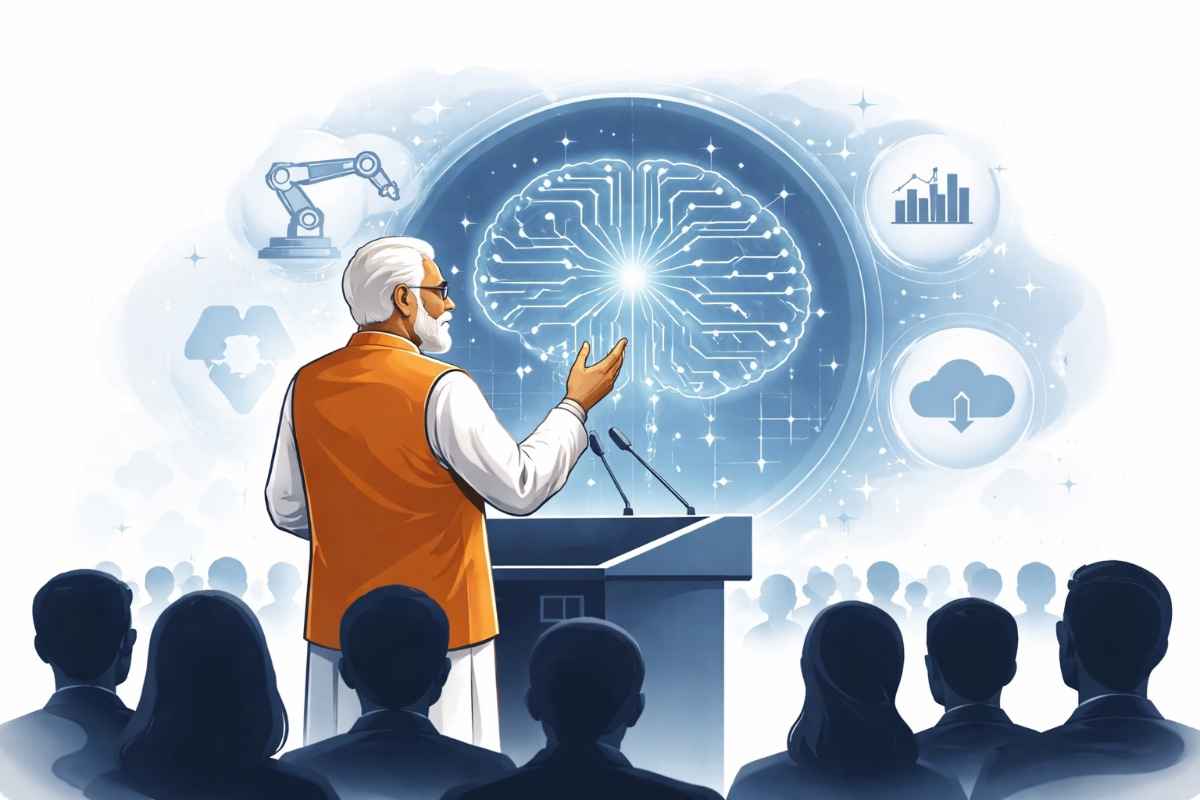
Prime Minister Narendra Modi addressed the India AI Impact Summit 2026 in New Delhi, underlining India’s growing role in artificial intelligence and digital innovation. The summit brought together policymakers, industry leaders, researchers, and startups to discuss the future of AI in governance, healthcare, education, and business.
Artificial Intelligence is now central to India’s digital strategy. With rapid expansion in data infrastructure and startup ecosystems, the country is positioning itself as a global AI hub. The Prime Minister’s speech focused on innovation, ethical use of AI, skill development, and inclusive growth.
The summit comes at a time when countries around the world are debating AI regulation, safety, and economic impact.
Event Overview: India AI Impact Summit 2026
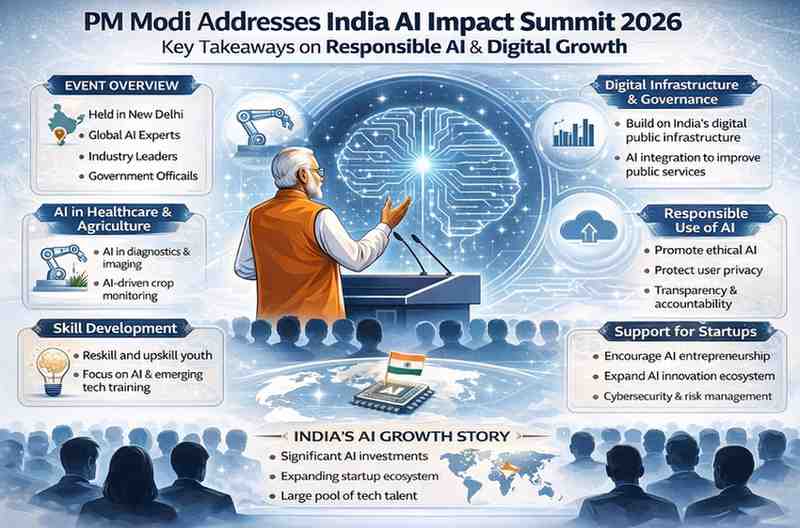
The India AI Impact Summit 2026 was held in New Delhi and saw participation from technology companies, academic institutions, government agencies, and global AI experts.
The event focused on:
- AI for public services
- Responsible AI frameworks
- Startup innovation
- Workforce transformation
- AI in healthcare and agriculture
The summit reflects India’s continued push to integrate AI into national development strategies.
Key Highlights from PM Modi’s Address
AI as a Tool for Inclusive Growth
The Prime Minister emphasised that artificial intelligence should be used to empower citizens, not replace human capability. He stressed that AI can help improve governance and service delivery.
He highlighted the need to ensure that AI benefits reach rural areas and underserved communities.
Focus on Responsible and Ethical AI
PM Modi underlined the importance of developing AI systems that are transparent and accountable. He called for global cooperation to create standards that protect users and prevent misuse.
India has consistently advocated for balanced AI governance that promotes innovation while ensuring safety.
India’s Digital Infrastructure Strength
The Prime Minister referred to India’s digital transformation over the past decade, including large-scale digital public infrastructure.
Initiatives such as Aadhaar, UPI, and digital governance platforms have created a foundation for AI adoption.
India’s large digital user base provides a strong ecosystem for AI-driven services.
India’s AI Growth Story
Artificial Intelligence is becoming a key sector in India’s technology landscape.
India has:
- A large pool of software engineers
- Growing AI research institutions
- Expanding startup ecosystem
- Increasing global investment interest
Several Indian startups are working on AI-based tools in fintech, health tech, agritech, and education.
Government-backed programs also support research and innovation in AI and emerging technologies.
AI in Governance and Public Services
One of the key themes of the summit was AI in governance.
AI tools can assist in:
- Policy analysis
- Predictive planning
- Fraud detection
- Data-driven decision-making
Government departments are exploring AI applications to improve efficiency and transparency.
However, officials have repeatedly stated that human oversight remains critical.
AI in Healthcare and Agriculture
The Prime Minister highlighted the potential of AI in sectors that directly affect citizens.
Healthcare
AI can assist in:
- Disease detection
- Medical imaging analysis
- Hospital data management
India’s healthcare system handles large volumes of patients daily. AI tools can support doctors by speeding up data analysis.
Agriculture
AI can help farmers with:
- Crop monitoring
- Weather prediction
- Soil health analysis
Given India’s large agricultural base, AI-driven advisory tools can improve productivity and reduce risk.
Skill Development and Employment
AI adoption raises questions about job transformation.
PM Modi stressed the importance of reskilling and upskilling India’s youth.
India has a young workforce. Skill development in AI, machine learning, and data science can help maintain competitiveness in global markets.
Training programs and academic partnerships are expected to expand in the coming years.
Startup and Innovation Ecosystem
The India AI Impact Summit 2026 also highlighted the role of startups.
India has one of the world’s largest startup ecosystems. AI-focused startups are emerging in multiple sectors.
Government initiatives such as Startup India and Digital India have encouraged entrepreneurship in technology fields.
Industry leaders at the summit discussed collaboration between government and private sector to scale AI solutions.
Global Context: AI and Regulation
AI regulation is a major global topic. Countries are working on policies to address:
- Data protection
- Algorithm transparency
- AI safety
- Cybersecurity risks
India has indicated that its approach will focus on innovation with safeguards.
PM Modi’s address reflected India’s intention to contribute to global AI policy discussions.
Economic Impact of AI in India
Artificial Intelligence is expected to contribute significantly to productivity growth.
AI-driven automation and analytics can improve efficiency in:
- Manufacturing
- Banking
- Logistics
- Retail
However, policymakers continue to emphasise that technology must create opportunities, not widen inequality.
India’s approach aims to balance growth and inclusion.
Digital Public Infrastructure as an AI Base
India’s digital public infrastructure is seen as a model in global forums.
Platforms like UPI have demonstrated how digital systems can scale rapidly.
Such infrastructure provides large datasets and secure frameworks that can support AI applications.
Experts believe this digital backbone gives India a competitive advantage.
Security and Data Protection Concerns
As AI expands, concerns about data security also grow.
The Prime Minister reiterated the need for strong cybersecurity systems.
Data protection laws and privacy frameworks are essential to maintain public trust in AI systems.
Responsible innovation was a recurring theme at the summit.
International Participation
The summit reportedly included participation from global AI researchers and technology companies.
India’s growing market size makes it an attractive destination for AI investment.
International cooperation in AI research and development remains a key focus.
What This Means for India’s Future
PM Modi’s address at the India AI Impact Summit 2026 signals India’s ambition to be a leader in responsible AI.
Key takeaways include:
- Focus on inclusive AI growth
- Emphasis on ethical standards
- Push for skill development
- Strengthening digital infrastructure
India’s AI strategy appears to prioritise both innovation and regulation.
Conclusion
Prime Minister Narendra Modi’s speech at the India AI Impact Summit 2026 in New Delhi highlighted India’s growing role in the global AI landscape.
As artificial intelligence reshapes economies and societies worldwide, India aims to harness its benefits while ensuring safety and fairness.
The summit reflects the country’s broader vision of combining digital innovation with inclusive development.
With continued investment in skills, research, and governance, India is positioning itself as a major AI player in the years ahead.
The focus now shifts to implementation, collaboration, and measurable outcomes as AI moves from policy discussions to practical impact across sectors.
Disclaimer: The information presented in this article is intended for general informational purposes only. While every effort is made to ensure accuracy, completeness, and timeliness, data such as prices, market figures, government notifications, weather updates, holiday announcements, and public advisories are subject to change and may vary based on location and official revisions. Readers are strongly encouraged to verify details from relevant official sources before making financial, investment, career, travel, or personal decisions. This publication does not provide financial, investment, legal, or professional advice and shall not be held liable for any losses, damages, or actions taken in reliance on the information provided.
Last Updated on: Thursday, February 19, 2026 11:26 am by Outlook News Team | Published by: Outlook News Team on Thursday, February 19, 2026 11:26 am | News Categories: India
About The Author