

Why This Research Matters Today
Mental health is now a major public concern in India.
Work stress, long screen time, exam pressure and urban lifestyles are affecting focus, sleep and emotional balance. At the same time, more Indians are turning to meditation apps, yoga centres and mindfulness programs.
But does meditation really change the brain?
Recent research from leading global universities and health institutes suggests that regular meditation may influence brain structure, stress response and attention control. While it is not a cure for disease, growing scientific evidence shows measurable brain-related benefits.
Here is a clear, research-based look at how meditation impacts brain health.
What Is Meditation and How Does It Affect the Brain?
Meditation is a mental practice that trains attention and awareness. It includes methods such as:
- Mindfulness meditation
- Breathing-focused meditation
- Loving-kindness meditation
- Body scan techniques
Brain imaging studies using MRI scans have helped researchers observe changes in brain activity among regular practitioners.
Key Brain Areas Linked to Meditation
Research shows meditation may affect:
- The prefrontal cortex – linked to decision-making and focus
- The hippocampus – linked to memory and learning
- The amygdala – linked to fear and stress response
These findings come from peer-reviewed studies conducted over the past two decades.
Meditation and Stress Reduction
Lower Activity in the Stress Centre
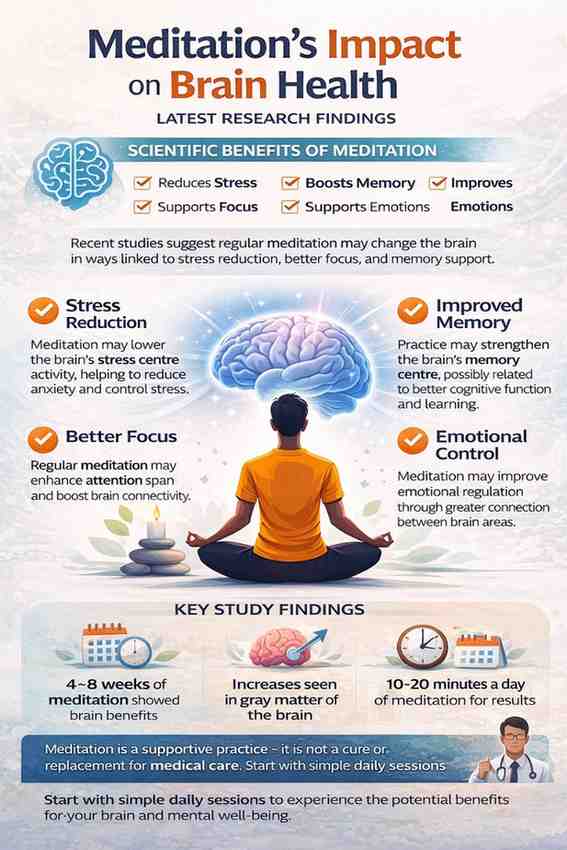
Multiple studies suggest that mindfulness meditation may reduce activity in the amygdala. The amygdala plays a key role in how we react to stress.
Reduced activity in this region may help:
- Lower anxiety levels
- Improve emotional control
- Reduce stress-related reactions
A review published in global medical journals has found that regular mindfulness practice is linked with lower cortisol levels. Cortisol is the hormone released during stress.
Even short programs lasting 8 weeks have shown measurable stress improvements in participants.
Impact on Memory and Learning
Changes in the Hippocampus
Some MRI-based studies have reported increased grey matter density in the hippocampus among people who practice meditation regularly.
The hippocampus is important for:
- Memory retention
- Learning ability
- Emotional regulation
Age-related shrinkage of the hippocampus is linked to memory decline. While meditation does not prevent ageing, some studies suggest it may support brain resilience.
Researchers caution that more long-term studies are needed before drawing strong conclusions.
Meditation and Attention Span
In a digital world filled with distractions, attention is becoming harder to maintain.
Studies show that mindfulness training may improve:
- Sustained attention
- Reaction time
- Task focus
In controlled research settings, participants who completed structured meditation training showed improved attention scores compared to non-meditators.
These improvements were observed after consistent practice over several weeks.
Brain Connectivity and Emotional Control
Meditation appears to influence how different parts of the brain communicate with each other.
Research suggests increased connectivity between:
- The prefrontal cortex
- Emotional processing centres
This improved connectivity may support better emotional regulation.
Some studies also suggest reduced mind-wandering activity in the default mode network, a brain system linked to overthinking and rumination.
Meditation and Ageing Brain Health
With India’s elderly population growing, brain health is becoming an important public issue.
Some early research suggests that long-term meditation may be linked with:
- Slower cognitive decline
- Better attention in older adults
- Improved emotional balance
However, scientists clearly state that meditation should not replace medical treatment for dementia or neurological conditions.
It may be used as a supportive lifestyle habit alongside professional care.
Mental Health Benefits Linked to Brain Changes
Clinical studies show meditation-based programs may help reduce symptoms of:
- Anxiety disorders
- Mild depression
- Chronic stress
Programs such as mindfulness-based stress reduction (MBSR) have been studied in hospitals and universities.
These programs typically run for 8 weeks and include guided meditation sessions.
Improvements reported include:
- Reduced anxiety scores
- Better sleep quality
- Improved mood stability
Again, experts emphasise that meditation is a supportive tool and not a standalone medical treatment.
Scientific Limitations: What Research Still Needs to Prove
While findings are promising, researchers highlight important limitations:
- Many studies have small sample sizes
- Long-term impact data is limited
- Self-reporting can influence results
- Different meditation styles produce different outcomes
More large-scale and long-term studies are needed to confirm how strong and lasting these brain changes are.
It is also important to note that benefits depend on consistency. Occasional practice may not lead to measurable changes.
How Much Meditation Is Considered Effective?
Most structured research programs include:
- 10 to 20 minutes daily practice
- At least 5 days a week
- Over a period of 6 to 8 weeks
Some studies involving experienced meditators track individuals who have practiced for years.
For beginners, experts often recommend starting with short sessions and gradually increasing duration.
Meditation in India: Growing Popularity
India has a long tradition of meditation practices, including forms linked to yoga and spiritual traditions.
In recent years, urban professionals, students and corporate offices have adopted mindfulness programs.
Many workplaces now offer stress management workshops that include guided meditation.
Digital platforms and mobile apps have also contributed to wider access.
Can Meditation Prevent Brain Disease?
There is currently no scientific proof that meditation can prevent diseases like Alzheimer’s or Parkinson’s.
However, some researchers believe that habits which improve stress control, sleep and emotional stability may indirectly support overall brain health.
Brain health depends on multiple factors, including:
- Physical exercise
- Balanced diet
- Sleep quality
- Social interaction
- Medical history
Meditation may be one part of a healthy lifestyle.
Expert Guidance Is Important
For individuals with severe mental health conditions, meditation should be practiced under guidance.
In rare cases, intensive meditation without support may increase anxiety in some individuals.
Healthcare professionals advise:
- Starting slowly
- Seeking certified trainers
- Consulting a doctor if undergoing treatment
Practical Tips for Beginners
For readers interested in meditation for brain health:
- Choose a quiet space
- Focus on breathing
- Start with 5–10 minutes daily
- Avoid judging your thoughts
- Practice regularly
Consistency matters more than duration.
Why Brain Health Is a National Concern
India faces rising mental health challenges.
According to public health estimates, stress-related disorders are increasing, especially among working-age adults.
Improving brain health through preventive habits can reduce long-term healthcare burden.
Simple practices like meditation, when combined with medical care and healthy living, may help build mental resilience.
The Bottom Line
Latest research suggests meditation may influence brain regions linked to stress, memory and attention.
Key findings indicate:
- Reduced stress response
- Possible support for memory-related brain areas
- Improved attention control
- Better emotional regulation
However, meditation is not a miracle solution.
It is a supportive practice backed by growing but still developing research.
For Indian readers seeking simple, low-cost ways to manage stress and improve mental clarity, meditation offers a science-supported option – provided it is practiced regularly and realistically.
As research continues, brain health and meditation will remain an important topic in public health discussions.
Last Updated on: Friday, February 13, 2026 4:36 pm by Outlook News Team | Published by: Outlook News Team on Friday, February 13, 2026 4:36 pm | News Categories: Tech
About The Author