

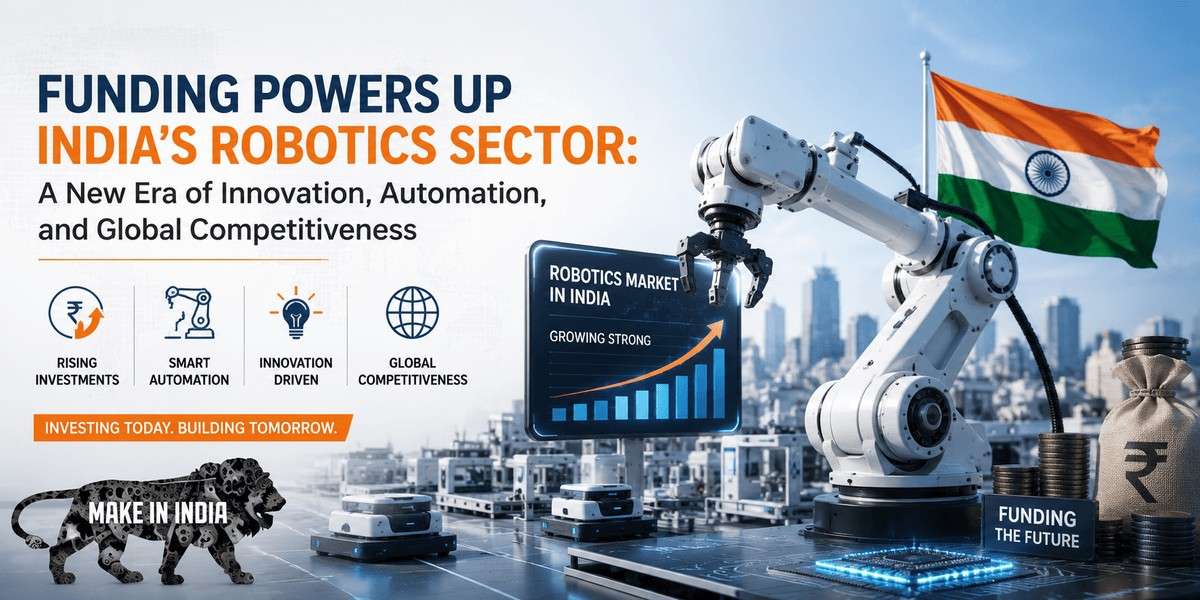
India’s robotics industry is entering one of its most exciting growth phases. After years of gradual development, the sector is now witnessing a significant rise in investor confidence, fueled by advances in artificial intelligence (AI), automation, Industry 4.0, smart manufacturing, logistics, defense technologies, healthcare robotics, and deep-tech innovation.
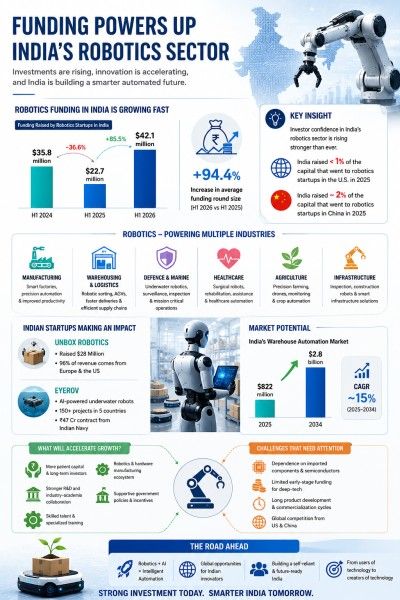
According to recent industry reports, Indian robotics startups raised $42.1 million during the first half (H1) of 2026, nearly doubling the $22.7 million raised during the same period in 2025. The figure also exceeds the $35.8 million secured in H1 2024. Even more encouraging is that the average funding round size grew by nearly 94.4%, indicating stronger conviction among investors.
While these numbers reflect growing momentum, experts believe India’s robotics ecosystem is still at an early stage compared to global leaders such as China and the United States. Nevertheless, increased investment signals that India is beginning to build the foundation for becoming a significant player in the global robotics revolution.
Investment Momentum Signals Growing Confidence
The latest funding figures demonstrate that venture capitalists, institutional investors, and strategic partners increasingly recognize robotics as one of India’s most promising deep-tech sectors.
Unlike earlier years when robotics startups struggled to attract capital due to long product development cycles, investors are now backing companies developing practical automation solutions that solve real-world industrial problems.
Several factors are driving this change:
- Rising adoption of AI-powered automation
- Growth in smart manufacturing
- Expansion of e-commerce logistics
- Increased warehouse automation
- Defense modernization
- Government support for deep-tech innovation
- Demand for precision engineering
Investors are no longer viewing robotics as futuristic technology. Instead, it is becoming an essential component of India’s industrial transformation.
Robotics Is Moving Beyond Manufacturing
Traditionally, robotics in India was largely associated with automotive manufacturing and factory automation. Today, the industry has diversified significantly.
Indian robotics startups are building solutions for:
- Warehouse automation
- Agriculture
- Healthcare
- Defense
- Marine exploration
- Infrastructure inspection
- Retail logistics
- Food processing
- Mining
- Construction
- Smart cities
- Disaster response
This diversification makes robotics one of India’s fastest-growing deep-tech ecosystems.
AI Is Accelerating Robotics Innovation
Artificial Intelligence is transforming robotics from simple programmable machines into intelligent systems capable of making decisions, learning from data, and interacting with dynamic environments.
Modern robots can now:
- Detect objects using computer vision
- Navigate autonomously
- Analyze environments in real time
- Collaborate safely with humans
- Predict maintenance issues
- Improve operational efficiency through machine learning
The convergence of AI, machine learning, edge computing, IoT, and advanced sensors is creating a new generation of intelligent robots capable of performing increasingly complex tasks.
Warehousing and Logistics Drive Commercial Growth
One of the strongest commercial applications for robotics in India is warehouse automation.
The rapid growth of:
- E-commerce
- Quick commerce
- Supply chain modernization
- Third-party logistics (3PL)
- Same-day delivery
has significantly increased demand for robotic sorting, autonomous guided vehicles (AGVs), automated storage systems, and AI-powered fulfillment solutions.
A notable example is Unbox Robotics, a Pune-based startup that recently secured $28 million in funding. Interestingly, around 96% of its current revenue comes from Europe and the United States, highlighting that Indian robotics companies are already building globally competitive products.
Industry estimates suggest India’s warehouse automation market could grow from approximately $822 million in 2025 to more than $2.8 billion by 2034, creating enormous opportunities for robotics companies.
India’s Labor Advantage Is Changing
For decades, India’s manufacturing competitiveness was built on affordable labor.
However, several trends are changing this equation:
- Rising wages
- Labor shortages in specialized roles
- Faster delivery expectations
- Increasing quality standards
- Global manufacturing competition
Modern factories increasingly require automation to maintain productivity, consistency, and scalability.
Rather than replacing human workers entirely, robotics is enabling workers to focus on higher-value tasks while machines handle repetitive, dangerous, and physically demanding operations.
Deep-Tech Startups Are Building Global Products
India’s robotics startups are increasingly designing products for international markets.
Many companies now generate substantial export revenues while serving industries such as:
- Automotive
- Aerospace
- Warehousing
- Healthcare
- Marine engineering
- Defense
- Energy
This global outlook allows startups to access larger markets while validating their technologies against international standards.
As a result, Indian robotics firms are evolving from service providers into product-driven technology companies.
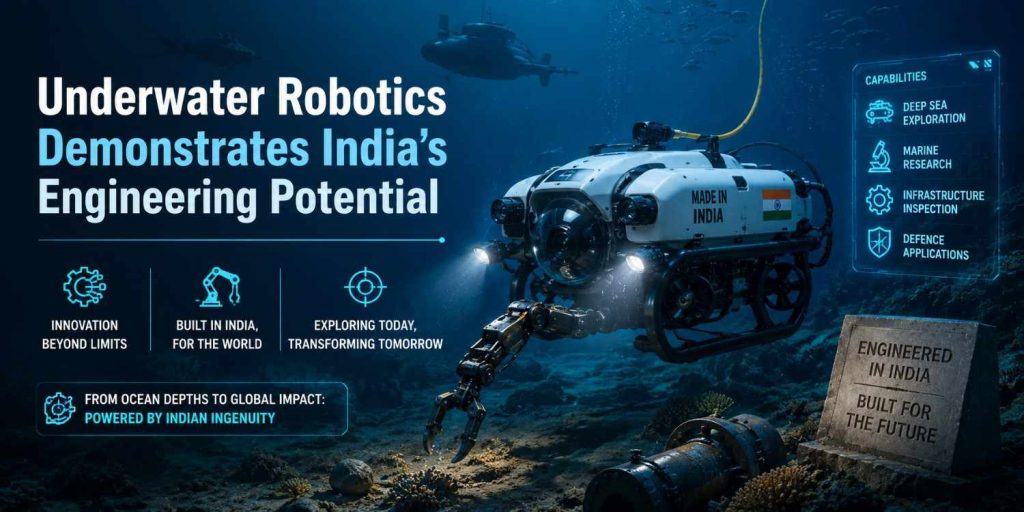
Underwater Robotics Demonstrates India’s Engineering Potential
India’s robotics innovation extends beyond factories.
Kerala-based EyeROV, founded by IIT graduates, has developed indigenous AI-powered underwater robotic systems capable of inspecting dams, ports, pipelines, ships, offshore infrastructure, and marine environments.
Its portfolio includes:
- Commercial underwater drones
- Military-grade remotely operated vehicles
- AI-powered underwater visualization platforms
The company has completed over 150 underwater inspection projects across five countries and has secured a ₹47 crore contract with the Indian Navy, demonstrating the growing importance of robotics in defense, infrastructure, and maritime security.
Such innovations showcase India’s ability to develop specialized robotics solutions for highly demanding applications.
Embodied Intelligence Represents the Next Frontier
The global robotics race is increasingly centered on Embodied Intelligence—robots capable of understanding and interacting with the physical world using AI.
Unlike traditional industrial robots, embodied AI combines:
- Computer vision
- Sensor fusion
- Reinforcement learning
- Motion planning
- Natural language processing
- Autonomous decision-making
Countries such as China and the United States are investing billions to develop humanoid robots and intelligent autonomous systems.
India now has an opportunity to participate in this next technological wave by investing in research, advanced hardware, and AI-driven robotics.
Funding Gap with Global Leaders Remains Significant
Despite encouraging funding growth, India’s robotics ecosystem still trails global competitors.
Industry data indicates that:
- Indian robotics startups raised less than 1% of the capital invested in U.S. robotics startups during 2025.
- They secured only around 2% of the funding attracted by Chinese robotics companies.
The comparison highlights the scale of investment required for India to compete globally.
Chinese robotics startups often raise hundreds of millions of dollars across multiple companies simultaneously, creating a larger innovation ecosystem where talent, capital, and technology circulate rapidly.
India’s ecosystem remains relatively concentrated, with fewer startups receiving significant investment.
Capital Deployment Matters as Much as Talent
India possesses one of the world’s largest engineering talent pools.
However, experts increasingly argue that the key challenge is not talent—but capital deployment.
Building globally competitive robotics companies requires:
- Patient capital
- Long-term investors
- Hardware manufacturing capabilities
- Advanced semiconductor access
- Research commercialization
- Industry-academia collaboration
- Large-scale testing infrastructure
The success of the robotics sector will depend on creating an environment where multiple startups receive sustained support rather than relying on a handful of companies.
Government Initiatives Can Accelerate Growth
Government policies can significantly strengthen India’s robotics ecosystem.
Potential areas of support include:
- Increased R&D funding
- Robotics innovation parks
- Manufacturing incentives
- Startup grants
- University research partnerships
- Skill development programs
- Semiconductor manufacturing
- Export promotion
Programs supporting Make in India, Digital India, Startup India, and Production Linked Incentive (PLI) schemes already provide a foundation for deeper robotics investment.
Industry-Academia Collaboration Will Be Critical
Leading robotics ecosystems around the world thrive on close collaboration between universities and industry.
India’s premier institutions—including IITs, IISc, NITs, and research laboratories—produce highly skilled engineers every year.
Strengthening partnerships between academia and startups can accelerate:
- Technology commercialization
- Patent creation
- Prototype development
- Robotics research
- AI innovation
- Hardware design
This collaboration will be essential for creating world-class robotics products.
Challenges Still Need Attention
Despite growing optimism, several obstacles remain.
Key challenges include:
- Limited early-stage funding
- High hardware development costs
- Dependence on imported components
- Semiconductor availability
- Manufacturing scale limitations
- Long commercialization timelines
- Shortage of specialized robotics talent
- Global competition
Addressing these issues will determine how quickly India can scale its robotics ecosystem.
Key Takeaways
- Robotics funding in India is accelerating, with startups raising $42.1 million in H1 2026, nearly double the $22.7 million raised during the same period in 2025.
- Investor confidence is growing, as the average funding round size increased by 94.4%, signaling stronger backing for robotics and deep-tech ventures.
- AI is driving the next generation of robotics, enabling smarter, autonomous systems for manufacturing, logistics, healthcare, agriculture, and defense.
- Warehouse automation is a major growth driver, fueled by the rapid expansion of e-commerce, quick commerce, and supply chain modernization.
- Indian robotics startups are becoming globally competitive, with companies like Unbox Robotics and EyeROV generating international business and exporting advanced solutions.
- India’s traditional low-cost labor advantage is evolving, making automation and robotics increasingly essential for improving productivity and global competitiveness.
- The robotics ecosystem is expanding beyond factories, with innovations in underwater robotics, infrastructure inspection, healthcare, agriculture, and defense technologies.
- Despite rapid growth, India still lags behind global leaders, attracting less than 1% of the robotics funding received by U.S. startups and around 2% of China’s investment.
- The biggest challenge is not engineering talent but access to capital, along with stronger hardware manufacturing, R&D, and commercialization support.
- Government initiatives, industry collaboration, and academic research will play a crucial role in building a globally competitive robotics ecosystem.
- Embodied AI and intelligent robotics represent the next frontier, creating opportunities for India to become a leader in advanced automation technologies.
- The future of India’s robotics industry looks promising, but sustained investment, innovation, and policy support will determine whether the country emerges as a global robotics powerhouse.
The Road Ahead
India’s robotics sector stands at a pivotal moment. Rising investments, expanding industrial adoption, AI-driven innovation, and increasing global demand are creating unprecedented opportunities for startups and entrepreneurs.
As automation becomes central to manufacturing, logistics, healthcare, defense, agriculture, and infrastructure, robotics will play a critical role in shaping India’s future economy.
While funding levels remain modest compared with China and the United States, the current momentum suggests investors increasingly recognize robotics as one of India’s most promising deep-tech sectors.
The coming years will determine whether India becomes merely a consumer of robotics technologies or emerges as a global leader in designing, manufacturing, and exporting intelligent robotic systems.
With sustained investment, stronger research collaboration, supportive government policies, and ambitious entrepreneurs, India has the potential to transform its robotics ecosystem into a major engine of economic growth, technological leadership, and global competitiveness.
The surge in robotics funding is more than just a financial milestone—it represents growing confidence in India’s ability to innovate in one of the world’s most transformative technologies. As AI, automation, and intelligent machines reshape industries, Indian startups are proving they can build globally relevant solutions across logistics, defense, marine technology, manufacturing, and beyond. Although challenges such as limited capital, hardware dependencies, and global competition remain, the momentum is undeniable. If India continues to invest in research, nurture deep-tech entrepreneurship, and strengthen collaboration between industry and academia, its robotics sector could become a defining pillar of the country’s next phase of industrial and technological growth.
Last Updated on: Saturday, June 27, 2026 9:13 pm by Outlook News Team | Published by: Outlook News Team on Saturday, June 27, 2026 9:11 pm | News Categories: Tech
About The Author