

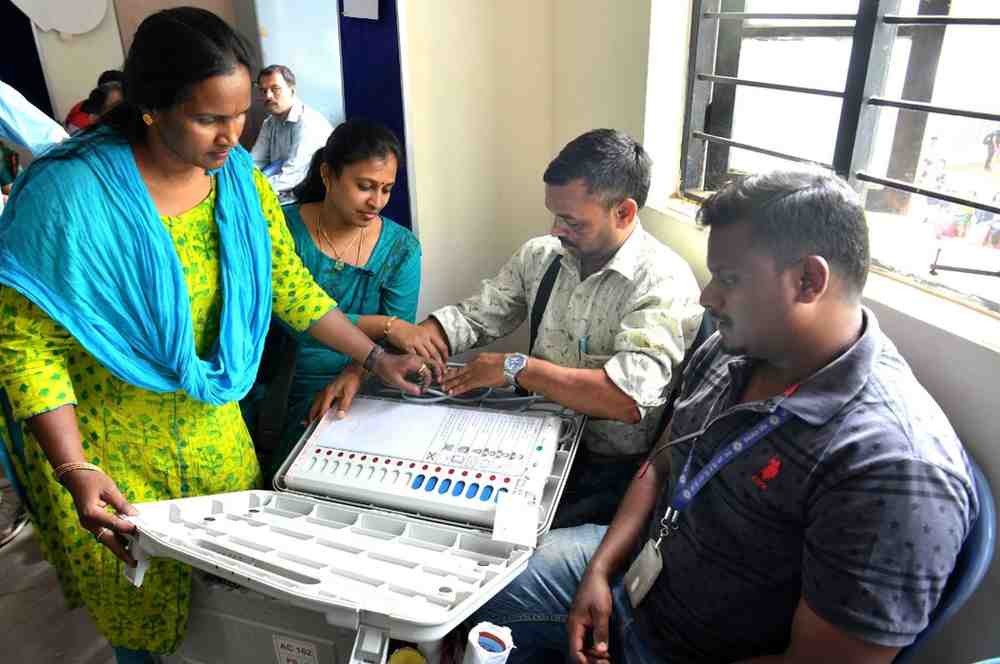
The Election Commission of India (ECI) has introduced stricter guidelines for political advertising and social media use ahead of Assembly elections in Assam, Kerala, Puducherry, Tamil Nadu, and West Bengal.
The measures require political parties and candidates to obtain prior approval for advertisements and disclose their official social media accounts.
Key Highlights
- Political advertisements must be pre-certified by Media Certification and Monitoring Committees (MCMC)
- Rules apply to TV, radio, digital platforms, and social media
- Candidates must declare official social media accounts in nomination affidavits
- Campaign spending on digital platforms to be reported within 75 days of elections
- Authorities to monitor paid news and misinformation
Mandatory Pre-Certification of Ads
The ECI has directed that all political advertisements across electronic media, online platforms, and social media must receive prior clearance from the Media Certification and Monitoring Committee (MCMC).
This applies to political parties, candidates, and even organisations or individuals involved in campaign messaging.
District-level MCMCs will handle applications from individual candidates, while state-level committees will process requests from political parties.
An appellate mechanism has also been set up to address disputes over certification decisions.
Official Statement
The Commission said the guidelines are intended to ensure transparency and fairness in election campaigning, particularly in the digital space.
Officials emphasised that no political advertisement should be released without prior approval, especially on internet-based platforms.
Disclosure of Social Media Accounts
Candidates are now required to declare their official social media accounts in their nomination affidavits.
This step is aimed at improving accountability and enabling authorities to track campaign activities online.
Monitoring Spending and Paid News
Under existing legal provisions, including the Representation of the People Act, 1951, political parties must submit details of campaign expenditure, including digital advertising and social media-related costs, within 75 days of election completion.
The ECI has reiterated that such expenses will include payments to online platforms, content creation costs, and operational expenses.
MCMCs will also monitor suspected cases of “paid news” where promotional content is presented as news and take action where necessary.
Context and Background
The growing influence of digital platforms in election campaigns has prompted regulators to strengthen oversight mechanisms.
In recent years, concerns around misinformation, fake news, and unregulated online advertising have led to tighter guidelines for political communication.
Public Impact
The new rules are expected to improve transparency in political messaging and reduce the spread of misleading content during elections.
For voters, this could mean more reliable information and clearer identification of official campaign communication.
Conclusion
With elections approaching, the ECI’s updated guidelines signal a stronger focus on regulating digital campaigning.
The effectiveness of these measures will be closely watched as authorities attempt to balance free expression with the need for fair and transparent elections.
Source: PIB
Last Updated on: Friday, March 20, 2026 5:13 pm by Monisha Angara | Published by: Monisha Angara on Friday, March 20, 2026 5:13 pm | News Categories: Mumbai
About The Author