
Every year, the arrival of the southwest monsoon is celebrated across India. Farmers eagerly await the first showers, cities welcome relief from scorching temperatures, and reservoirs begin to replenish after months of heat. Yet, for India’s corporate sector, the monsoon often brings more than just rain—it brings uncertainty.
From manufacturing plants and logistics companies to retailers, technology firms, insurance providers, and financial institutions, businesses across the country are increasingly preparing for what many executives now describe as “monsoon anxiety.” Climate unpredictability, urban flooding, supply chain disruptions, employee safety concerns, and operational risks have transformed the rainy season into a significant business challenge.
Why Are Businesses Worried?
India’s economy depends heavily on smooth transportation, uninterrupted infrastructure, and predictable consumer demand. Heavy rainfall has the potential to disrupt each of these simultaneously.
Roads become waterlogged, railway services face delays, airports experience disruptions, and shipping schedules become unpredictable. For companies operating just-in-time supply chains, even a single day of delay can ripple across production schedules and customer deliveries.
Organizations are no longer asking whether the monsoon will affect business—they are asking how severe the impact will be.
Supply Chains Under Pressure
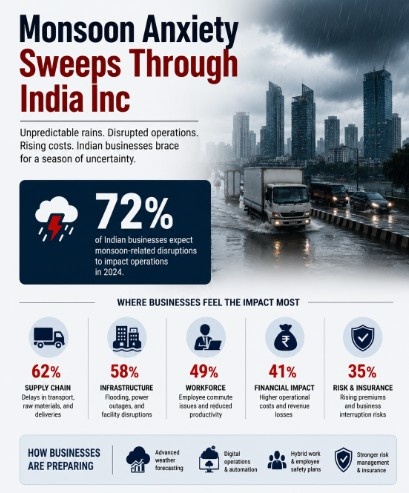
Modern businesses rely on interconnected supply networks that stretch across states and even countries. When one transportation corridor is blocked due to flooding or landslides, the consequences spread quickly.
Manufacturers may struggle to receive raw materials.
Retailers can experience inventory shortages.
E-commerce companies face delayed deliveries.
Exporters risk missing international shipping deadlines.
Industries such as automotive, pharmaceuticals, electronics, and FMCG often prepare contingency plans months before the monsoon begins.
Urban Flooding and Workplace Productivity
India’s largest business hubs—including Mumbai, Bengaluru, Chennai, Hyderabad, and Delhi NCR—have all experienced severe urban flooding in recent years.
For employers, this creates several operational concerns:
- Employees unable to reach offices
- Increased work-from-home arrangements
- Power outages affecting operations
- Internet disruptions
- Delayed client meetings
- Reduced productivity
Many organizations now activate hybrid work policies whenever weather warnings are issued, ensuring business continuity while prioritizing employee safety.
Climate Change Is Increasing the Uncertainty
One of the biggest reasons behind growing corporate anxiety is that rainfall patterns have become increasingly unpredictable.
Instead of steady seasonal rainfall, many regions now experience short periods of extremely intense downpours followed by long dry spells.
This unpredictability makes planning significantly more difficult.
Businesses that once relied on historical weather trends are now investing in advanced forecasting tools, climate-risk analytics, and predictive technologies to improve decision-making.
Rising Costs for Businesses
Extreme weather events carry financial consequences that extend beyond temporary disruptions.
Companies may face:
- Infrastructure damage
- Increased insurance premiums
- Higher logistics costs
- Inventory losses
- Equipment repairs
- Delayed project timelines
- Emergency staffing expenses
For small and medium-sized enterprises (SMEs), these unexpected costs can place considerable pressure on already limited budgets.
Insurance and Risk Management Are Evolving
Insurance companies are also adapting to the growing frequency of weather-related claims.
Businesses are increasingly purchasing:
- Business interruption insurance
- Property damage coverage
- Cyber resilience plans for remote work operations
- Supply chain risk insurance
Risk management teams now include climate resilience as a core part of corporate planning rather than treating it as an occasional concern.
Technology Is Becoming the First Line of Defense
Digital transformation has become one of the strongest tools for reducing monsoon-related disruptions.
Organizations are investing in:
- AI-powered weather forecasting
- Real-time logistics tracking
- Cloud-based operations
- Remote workforce infrastructure
- IoT-enabled warehouse monitoring
- Predictive maintenance systems
Technology allows businesses to respond faster when weather conditions change unexpectedly.
Employee Well-Being Comes First
The human impact of severe weather cannot be overlooked.
Progressive organizations now prioritize employee safety by:
- Offering flexible work arrangements
- Providing transportation support
- Issuing weather advisories
- Expanding mental health assistance
- Allowing emergency leave when necessary
A resilient workforce begins with ensuring people feel safe during periods of uncertainty.
Turning Anxiety into Preparedness
Although the monsoon introduces operational challenges, it also presents an opportunity for businesses to strengthen resilience.
Companies that invest in better infrastructure, digital transformation, climate risk planning, and flexible workplace strategies are better positioned to manage seasonal disruptions.
Rather than reacting to every weather event, successful organizations are building systems that can adapt quickly.
Final Thoughts
The Indian monsoon remains one of the country’s most defining natural phenomena, supporting agriculture, water resources, and millions of livelihoods. However, for India Inc., the season has become increasingly associated with operational uncertainty and financial risk.
As climate variability continues to reshape weather patterns, businesses can no longer view monsoon preparedness as a temporary seasonal exercise. It has become an essential component of long-term corporate strategy.
The companies that thrive will not necessarily be those that avoid disruption—but those that prepare for it, adapt quickly, and build resilience into every aspect of their operations.
In an era of increasing climate uncertainty, preparedness has become one of the most valuable business investments.
Last Updated on: Thursday, June 25, 2026 12:18 pm by Admin | Published by: Admin on Thursday, June 25, 2026 12:15 pm | News Categories: Business
About The Author