


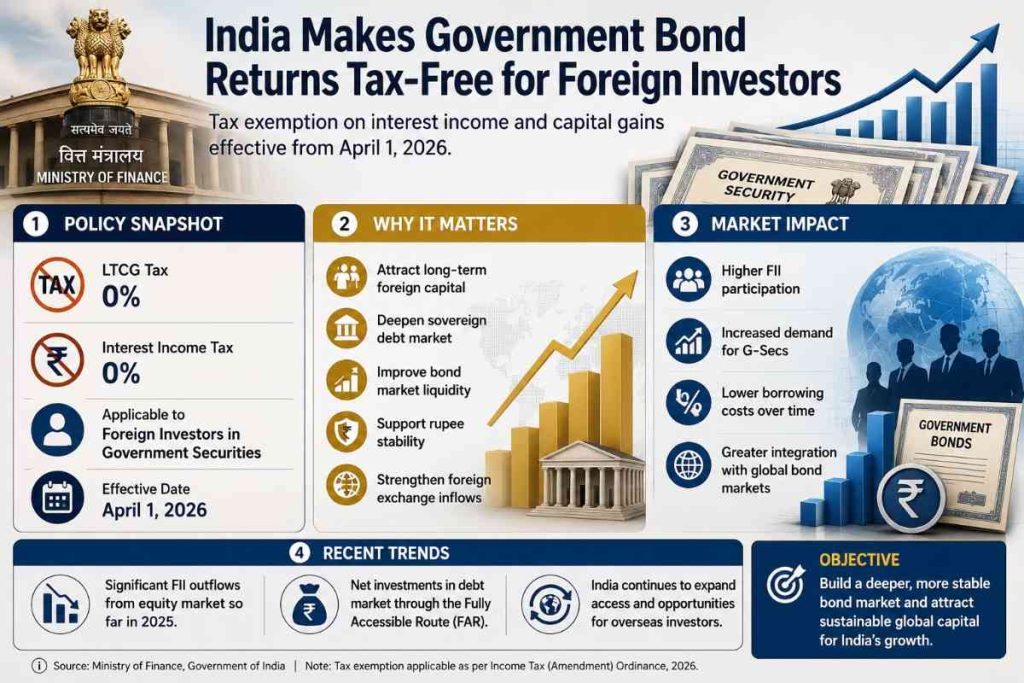
In a significant policy shift designed to attract global capital and deepen India’s debt markets, the central government has announced a complete tax exemption on income and capital gains earned by foreign investors from investments in eligible government securities. The measure, scheduled to take effect from April 1, 2026, marks one of the most investor-friendly reforms introduced in India’s sovereign bond market in recent years.
The move comes as policymakers seek to strengthen foreign participation in government debt at a time when global capital flows remain volatile and geopolitical uncertainty continues to influence investment decisions across emerging markets.
By removing tax liabilities on both interest income and capital gains, the government hopes to position Indian sovereign bonds as a more competitive destination for international investors searching for stable long-term returns.
A Strategic Push to Expand Foreign Participation
Government securities have increasingly become a focal point of India’s efforts to integrate more deeply with global financial markets.
While foreign portfolio investors have traditionally shown greater interest in Indian equities, participation in the country’s bond market has remained relatively modest compared with several other major economies. Regulatory restrictions, taxation policies, and market accessibility have often been cited as factors limiting broader foreign involvement.
The latest reform seeks to address one of those barriers directly.
Under the new framework, foreign institutional investors will no longer be required to pay taxes on interest earnings or capital appreciation generated from investments in designated government securities. Policymakers believe the change could improve the risk-adjusted returns available to international investors and encourage larger allocations to Indian debt instruments.
Why Government Bonds Matter
Government bonds play a crucial role in financing public expenditure, infrastructure development, and broader economic programs.
A larger and more diversified investor base can help governments raise funds more efficiently while improving liquidity and stability in the bond market. Greater foreign participation may also contribute to lower borrowing costs over time by increasing demand for sovereign debt.
Financial analysts note that sovereign bonds are often viewed as relatively stable assets compared with equities, particularly during periods of market uncertainty. For global investors seeking predictable income streams and exposure to emerging-market growth, India’s government debt market has become increasingly attractive as the country’s economy continues to expand.
The tax exemption is expected to strengthen that appeal further.
Policy Builds on Broader Market Reforms
The announcement follows a series of initiatives aimed at making India’s capital markets more accessible to international investors.
In recent years, regulators and policymakers have expanded investment routes for overseas participants, simplified market access procedures, and increased the number of government securities available through the Fully Accessible Route (FAR), which permits unrestricted foreign investment in specified sovereign bonds.
India’s inclusion in major global bond indices has also increased international interest in domestic debt markets. Index inclusion typically prompts global fund managers to allocate capital to eligible securities, resulting in additional inflows into the country’s financial system.
The latest tax changes complement these efforts by enhancing the overall attractiveness of Indian sovereign debt.
Responding to Shifting Capital Flows
The policy announcement comes against a backdrop of fluctuating foreign investment trends.
Recent months have witnessed substantial withdrawals from Indian equity markets as global investors reassessed risk amid geopolitical tensions, changing interest-rate expectations, and uncertainty surrounding global economic growth. Such outflows have periodically placed pressure on emerging-market currencies and asset prices.
At the same time, debt markets have demonstrated greater resilience, with foreign investors continuing to allocate capital to select categories of Indian government securities.
Economists suggest that attracting longer-term debt investments could help reduce reliance on more volatile equity flows and contribute to greater financial stability.
Unlike short-term speculative capital, sovereign bond investments are often associated with longer investment horizons and lower sensitivity to day-to-day market fluctuations.
Implications for the Rupee and Financial Markets
Increased foreign participation in government bonds could have wider implications for India’s financial system.
Higher inflows into sovereign debt may support foreign exchange reserves, improve market liquidity, and provide additional support for the Indian rupee during periods of external pressure. The move may also strengthen India’s position within global fixed-income portfolios as investors seek diversification beyond traditional developed-market debt.
However, experts caution that tax incentives alone are unlikely to determine investment decisions. Factors such as inflation, interest-rate differentials, fiscal discipline, currency stability, and global risk sentiment will continue to influence foreign participation levels.
The success of the initiative will therefore depend not only on tax policy but also on broader macroeconomic conditions and investor confidence in India’s long-term growth trajectory.
Looking Ahead
The decision to make returns from government securities tax-free for foreign investors represents a calculated attempt to strengthen India’s sovereign debt market and attract more stable sources of international capital.
As global investors increasingly search for yield opportunities in fast-growing economies, India appears determined to position its government bond market as a key destination for long-term institutional investment.
With implementation scheduled for the next financial year, market participants will be closely watching whether the reform translates into higher foreign participation, stronger debt-market liquidity, and greater resilience in India’s broader financial ecosystem.
If successful, the policy could become an important milestone in the country’s ongoing efforts to deepen capital markets and enhance its integration with the global financial system.
Key Highlights
- India has announced a full tax exemption on interest income and capital gains earned by foreign investors from eligible government securities.
- The new provisions will come into effect from April 1, 2026.
- The government has issued the Income Tax (Amendment) Ordinance, 2026 to implement the changes.
- Foreign Institutional Investors (FIIs) will no longer pay Long-Term Capital Gains (LTCG) Tax on investments in government bonds.
- The move is aimed at attracting stable, long-term foreign capital into India’s sovereign debt market.
- Policymakers expect the reform to improve the attractiveness of Indian government bonds compared with other emerging-market debt instruments.
- The decision complements earlier measures such as the Fully Accessible Route (FAR), which allows unrestricted foreign investment in select government securities.
- The announcement comes amid significant foreign outflows from Indian equities, with investors seeking safer and more predictable investment opportunities.
- Higher foreign participation in government bonds could support market liquidity, foreign exchange reserves, and rupee stability.
- Experts say the reform strengthens India’s efforts to integrate more deeply with global capital markets while diversifying sources of foreign investment.
Input & Images : Hindusthan Samachar
Add outlooknews.in as preferred source on google – click here
Last Updated on: Friday, June 5, 2026 3:36 pm by Monisha Angara | Published by: Monisha Angara on Friday, June 5, 2026 3:36 pm | News Categories: Business
About The Author