


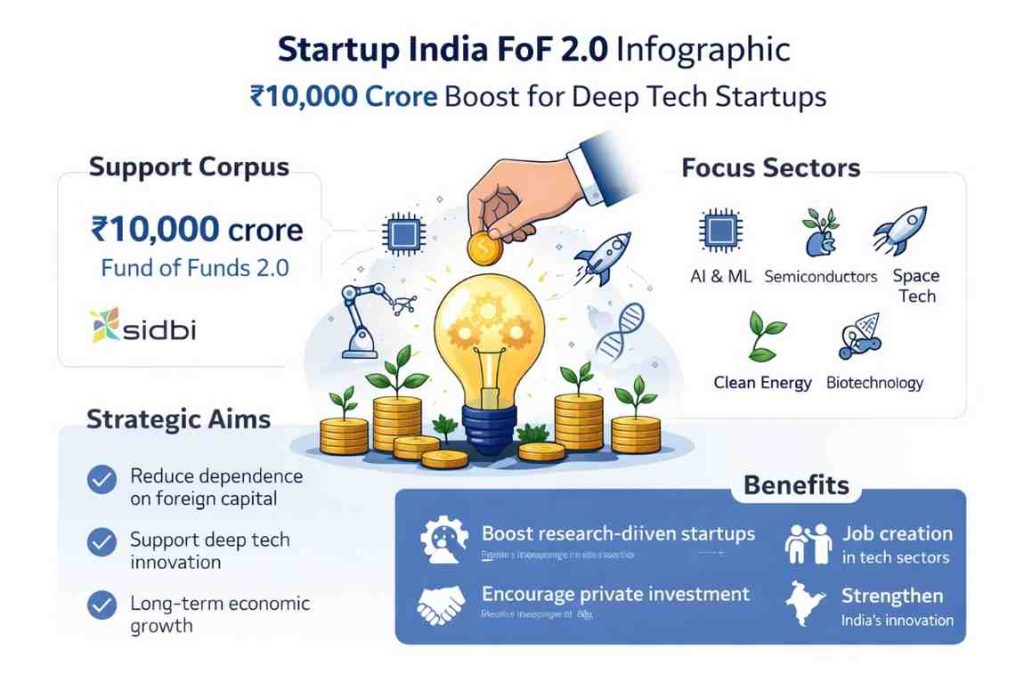
In a major push for innovation, the Government of India has approved Startup India Fund of Funds (FoF) 2.0 with an allocation of ₹10,000 crore to support deep tech startups. The decision is expected to strengthen India’s position in emerging technologies and attract more private investment into the sector.
The move comes at a time when India is aiming to become a global hub for advanced technology, including artificial intelligence, semiconductors, space technology, clean energy, and biotechnology. The new fund is designed to give long-term capital support to startups working in these high-impact areas.
The approval of FoF 2.0 signals the government’s continued focus on innovation-led growth and job creation.
What Is Startup India Fund of Funds (FoF) 2.0?
The Fund of Funds for Startups (FFS) was first launched in 2016 under the Startup India initiative. It was managed by the Small Industries Development Bank of India (SIDBI).
Unlike direct funding schemes, the FoF model does not invest directly in startups. Instead, it invests in SEBI-registered Alternative Investment Funds (AIFs), which then invest in startups.
Now, under FoF 2.0, the government has approved a fresh ₹10,000 crore corpus with a clear focus on deep technology sectors.
This new version builds on the earlier Fund of Funds framework but targets next-generation technology startups that require larger capital and longer development cycles.
Why the ₹10,000 Crore Fund Matters
Deep tech startups often face funding challenges. These companies work on advanced research and product development. They usually need more time and higher capital compared to regular consumer startups.
By approving ₹10,000 crore, the government aims to:
- Support startups in strategic sectors
- Reduce dependence on foreign capital
- Strengthen domestic innovation
- Encourage private investors to participate
The fund is expected to act as a catalyst. Government capital often helps attract additional private investment, multiplying the impact.
For Indian founders working in deep science and technology, this fund provides long-term confidence.
Focus Areas Under FoF 2.0
The new fund will prioritize startups in critical and emerging sectors. These include:
Artificial Intelligence (AI) and Machine Learning
India has seen rapid growth in AI startups. Government support can help them scale globally.
Semiconductors and Electronics
With global supply chain shifts, India is pushing for semiconductor manufacturing and chip design.
Space Technology
Following the success of missions by the Indian Space Research Organisation (ISRO), private space startups are gaining attention.
Clean Energy and Climate Tech
Startups working on green hydrogen, battery storage, and renewable solutions are likely to benefit.
Biotechnology and Health Tech
Deep research in biotech needs long-term funding support, which FoF 2.0 aims to provide.
These sectors are seen as strategic for national growth and economic security.
How the Fund Will Be Managed
The Fund of Funds 2.0 will continue to operate through SIDBI.
SIDBI will allocate capital to registered AIFs. These AIFs will then invest in eligible startups.
This structure ensures professional fund management and market-driven investment decisions.
It also allows the government to support innovation without directly interfering in business operations.
Link to India’s Long-Term Economic Goals
The approval of FoF 2.0 aligns with India’s broader development goals.
India is currently the third-largest startup ecosystem in the world. Over the past decade, the country has seen rapid growth in technology startups.
The government has repeatedly emphasized the importance of innovation in achieving:
- A $5 trillion economy target
- Increased exports in technology products
- Higher-skilled employment opportunities
Deep tech startups play a key role in achieving these targets.
Unlike short-term digital businesses, deep tech companies build core intellectual property. This strengthens India’s global competitiveness.
Impact on Indian Startup Ecosystem
The ₹10,000 crore allocation is expected to improve funding access for early-stage and growth-stage deep tech startups.
In recent years, global venture capital funding has slowed. Many startups faced difficulty in raising capital.
With FoF 2.0, domestic funding support can help:
- Reduce funding gaps
- Support research-driven startups
- Encourage innovation beyond metro cities
- Boost investor confidence
The move may also encourage Indian institutional investors to participate more actively in venture funding.
Encouraging Private Investment
One of the key features of the Fund of Funds model is leverage.
When the government invests in AIFs, it increases credibility. This often encourages private investors to invest alongside.
As a result, the actual capital flowing into startups could be significantly higher than ₹10,000 crore.
This multiplier effect is critical for scaling deep tech companies that require large and patient capital.
Continuity of Startup India Mission
The original Startup India initiative was launched in January 2016 to simplify regulations and support innovation.
Since then, thousands of startups have been recognized under the program.
The approval of FoF 2.0 shows policy continuity.
It signals that startup support remains a priority even amid global economic uncertainty.
How Startups Can Benefit
Startups cannot directly apply to FoF 2.0.
Instead, they must seek funding from SEBI-registered AIFs that receive capital from SIDBI under the scheme.
Eligible startups typically include:
- DPIIT-recognized startups
- Innovation-led technology companies
- Firms with scalable business models
Founders working in research-heavy fields such as AI chips, robotics, biotech, and clean energy may benefit the most.
Challenges Ahead
While the approval is significant, execution will be crucial.
Deep tech startups face challenges such as:
- Long development cycles
- High research costs
- Regulatory approvals
- Global competition
Effective fund allocation and strong due diligence will be important to ensure capital reaches high-quality startups.
Monitoring and transparency will also be key to maintaining trust in the system.
India’s Position in Global Deep Tech Race
Countries like the United States and China have invested heavily in deep technology.
India has strong talent in engineering and research. However, access to long-term funding has often been limited.
FoF 2.0 aims to address this gap.
If implemented effectively, it can help Indian startups build globally competitive products and intellectual property.
This could improve India’s standing in global technology value chains.
What This Means for Investors and Entrepreneurs
For entrepreneurs, this is a positive policy signal.
For investors, it offers an opportunity to partner with government-backed capital pools.
For the economy, it strengthens the innovation ecosystem.
The focus on deep tech also supports national priorities such as digital sovereignty, advanced manufacturing, and sustainable development.
Conclusion
The approval of Startup India FoF 2.0 with a ₹10,000 crore corpus marks a major step in India’s innovation journey.
The fund aims to support deep tech startups in critical sectors like AI, semiconductors, clean energy, biotech, and space technology.
By channeling capital through SIDBI and professional investment funds, the government seeks to boost private participation and build a stronger, research-driven startup ecosystem.
At a time when global funding conditions remain tight, this move provides stability and long-term direction.
If implemented well, FoF 2.0 could play a key role in shaping India’s next decade of technology growth.
For Indian founders and investors, the message is clear: deep tech innovation now has stronger institutional backing than ever before.
Disclaimer: The information presented in this article is intended for general informational purposes only. While every effort is made to ensure accuracy, completeness, and timeliness, data such as prices, market figures, government notifications, weather updates, holiday announcements, and public advisories are subject to change and may vary based on location and official revisions. Readers are strongly encouraged to verify details from relevant official sources before making financial, investment, career, travel, or personal decisions. This publication does not provide financial, investment, legal, or professional advice and shall not be held liable for any losses, damages, or actions taken in reliance on the information provided.
Last Updated on: Monday, February 23, 2026 3:07 pm by Outlook News Team | Published by: Outlook News Team on Monday, February 23, 2026 3:07 pm | News Categories: India
About The Author