
Why India’s Retail Inflation in 2026 Matters Right Now
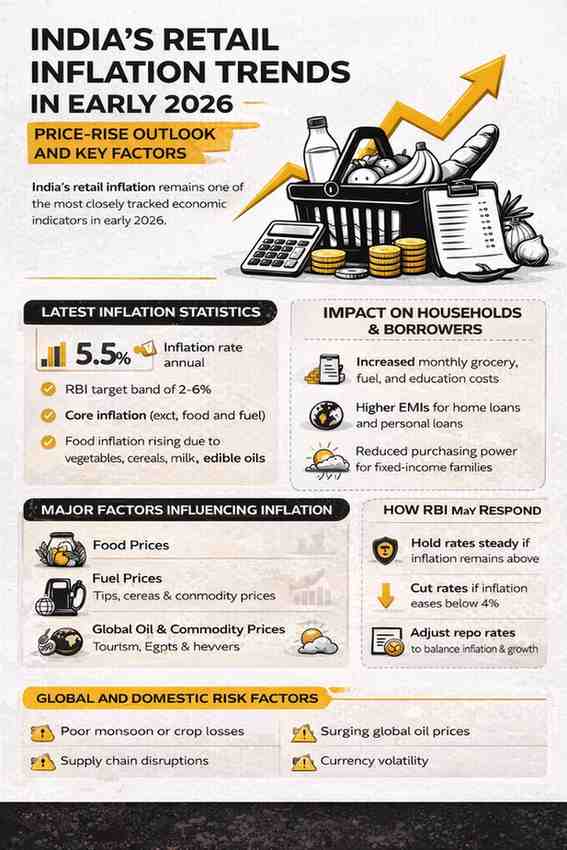
India’s retail inflation remains one of the most closely tracked economic indicators in early 2026. From grocery bills to home loans, inflation directly affects household budgets and business costs.
Retail inflation, measured through the Consumer Price Index (CPI), guides decisions by the Reserve Bank of India. It also shapes government policy, interest rates, and investor sentiment.
After a volatile period in recent years due to global supply disruptions, food price shocks, and geopolitical tensions, inflation trends in early 2026 are being watched closely by markets and consumers alike.
This article explains where inflation stands, what is driving price changes, and what it could mean for Indian households in the months ahead.
What Is Retail Inflation and How Is It Measured
Retail inflation in India is measured by the Consumer Price Index (CPI). The data is released every month by the Ministry of Statistics and Programme Implementation.
The CPI tracks changes in prices across categories such as:
- Food and beverages
- Housing
- Fuel and light
- Clothing and footwear
- Transport and communication
- Health and education
Food inflation has the highest weight in India’s CPI basket. This means changes in vegetable, cereal, and milk prices can sharply move overall inflation numbers.
Inflation Target and RBI’s Role in 2026
India follows an inflation targeting framework. The RBI aims to keep retail inflation at 4%, with a tolerance band of 2% to 6%.
If inflation rises above 6% or falls below 2% for a sustained period, the RBI is required to take corrective steps and explain its actions.
In early 2026, the central bank continues to monitor price stability while balancing economic growth. Interest rate decisions remain closely linked to inflation data.
The RBI’s Monetary Policy Committee (MPC) reviews inflation trends every two months before announcing its policy stance.
Food Prices Continue to Drive Headline Inflation
Vegetable and Cereal Prices Remain Key Factors
In India, food prices often cause sharp swings in inflation. Seasonal factors, weather patterns, and supply chain issues play a major role.
Unseasonal rains or heatwaves can push up vegetable prices quickly. Similarly, cereal prices may move due to changes in production or export policies.
Rice and wheat remain essential staples. Any disruption in procurement or distribution can reflect in retail prices.
Milk, Pulses and Edible Oils Under Watch
Milk and dairy products are part of daily consumption. Even small increases affect household budgets.
Edible oil prices, which saw volatility during global supply disruptions in earlier years, remain under monitoring.
Pulses prices also impact inflation because they are a key protein source for many households.
Fuel and Global Factors Impact Domestic Prices
India imports a significant share of its crude oil needs. Global crude prices influence fuel and transport costs domestically.
Higher fuel costs often increase logistics expenses. This leads to higher prices for goods across sectors.
International developments, including geopolitical tensions and global trade shifts, continue to influence imported inflation.
The rupee’s exchange rate also affects the landed cost of imports.
Core Inflation: A Broader Signal of Price Trends
Core inflation excludes food and fuel. It reflects underlying demand conditions in the economy.
When core inflation remains stable, it suggests controlled price pressures in sectors such as:
- Services
- Education
- Healthcare
- Housing
Economists closely monitor core inflation to assess long-term trends beyond seasonal food price movements.
In early 2026, policymakers are focusing on both headline CPI and core inflation to guide decisions.
Impact on Interest Rates and EMIs
Retail inflation directly influences borrowing costs.
If inflation remains high, the RBI may keep policy rates steady or maintain a tighter stance. If inflation eases sustainably, there could be room for rate adjustments.
For borrowers, this affects:
- Home loan EMIs
- Auto loan rates
- Personal loan interest
Banks align their lending rates based on the repo rate set by the RBI.
Households with floating-rate loans closely track inflation data releases.
Urban vs Rural Inflation Trends
Inflation trends often differ between urban and rural India.
Rural inflation is heavily influenced by food prices. Urban inflation is more affected by services, housing, and transport costs.
Any divergence between rural and urban CPI can signal demand differences across regions.
Monitoring both segments provides a clearer picture of price stability.
Government Measures to Control Inflation
The central government uses multiple tools to manage inflationary pressure.
These include:
- Adjusting import duties on key commodities
- Releasing buffer stock of food grains
- Monitoring hoarding and supply bottlenecks
- Reviewing export policies
In recent years, the government has acted swiftly to stabilize prices of essential items when needed.
Such steps help contain sharp spikes in retail prices.
Global Comparison: Where India Stands
Inflation has been a global challenge over the past few years.
Major economies, including the United States and parts of Europe, faced high inflation due to pandemic-related supply disruptions and energy shocks.
Compared to several advanced economies, India’s inflation has remained within its target band for much of the recent period.
However, global economic conditions continue to influence domestic trends.
What Early 2026 Inflation Means for Households
For ordinary households, inflation affects:
- Monthly grocery bills
- School fees
- Electricity and fuel costs
- Medical expenses
Even a small rise in inflation reduces purchasing power.
Middle-class families and fixed-income households feel the pressure more quickly.
Stable inflation supports savings, investment planning, and long-term financial decisions.
Market Reaction to Inflation Data
Equity and bond markets react sharply to CPI data releases.
Higher-than-expected inflation may reduce hopes of rate cuts. Lower inflation can boost market sentiment.
Investors track monthly CPI announcements for signals on future monetary policy.
Government bond yields also respond to inflation trends.
Outlook for the Rest of 2026
The inflation outlook for the rest of 2026 will depend on:
- Monsoon performance
- Global crude oil prices
- Food supply stability
- Exchange rate movement
- Domestic demand conditions
If food supply remains stable and global energy prices do not spike sharply, inflation could remain within the RBI’s comfort zone.
However, sudden weather disruptions or geopolitical shocks could alter the trend.
Key Takeaways for Readers
- Retail inflation directly affects household budgets.
- Food prices remain the biggest driver in India.
- RBI policy decisions depend heavily on CPI data.
- Stable inflation supports economic growth and borrowing stability.
As India moves through early 2026, inflation remains under close watch by policymakers, businesses, and households.
Monthly data releases from the Ministry of Statistics and Programme Implementation and policy announcements by the Reserve Bank of India will continue to shape expectations.
For Indian consumers, keeping an eye on price trends is not just about economics. It is about managing daily life and planning for the future.
Disclaimer: The information presented in this article is intended for general informational purposes only. While every effort is made to ensure accuracy, completeness, and timeliness, data such as prices, market figures, government notifications, weather updates, holiday announcements, and public advisories are subject to change and may vary based on location and official revisions. Readers are strongly encouraged to verify details from relevant official sources before making financial, investment, career, travel, or personal decisions. This publication does not provide financial, investment, legal, or professional advice and shall not be held liable for any losses, damages, or actions taken in reliance on the information provided.
Last Updated on: Tuesday, February 17, 2026 10:16 am by Outlook News Team | Published by: Outlook News Team on Tuesday, February 17, 2026 10:16 am | News Categories: Business
About The Author