
Why Bharat Bandh 2026 Matters Today
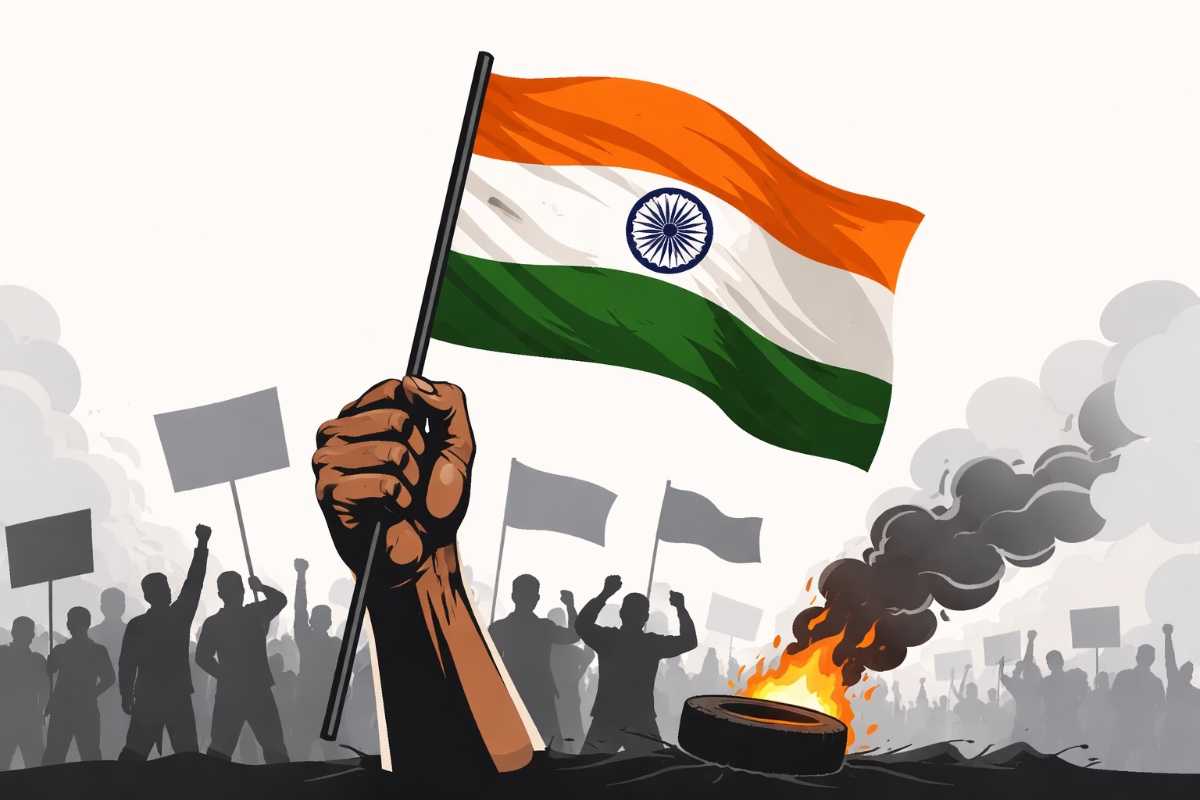
A nationwide strike, or Bharat Bandh, has been called in 2026 by several trade unions and farmer groups across India. The protest has triggered major discussions across states, with transport services, markets, and public offices likely to face disruption.
For millions of Indians, the main question is simple: Will daily life be affected?
From school closures to banking services and transport delays, the Bharat Bandh 2026 is expected to impact routine activities in many cities. This article explains the key reasons behind the strike, what sectors may be affected, and what citizens should prepare for.
What Is a Bharat Bandh?
A Bharat Bandh is a nationwide shutdown called by unions, political groups, or social organizations to protest against government policies or economic issues.
During a bandh:
- Shops may remain closed
- Public transport may be disrupted
- Offices may see low attendance
- Roads and highways may face blockades
While a bandh is not officially declared a holiday by the government, disruptions can still be significant depending on participation levels.
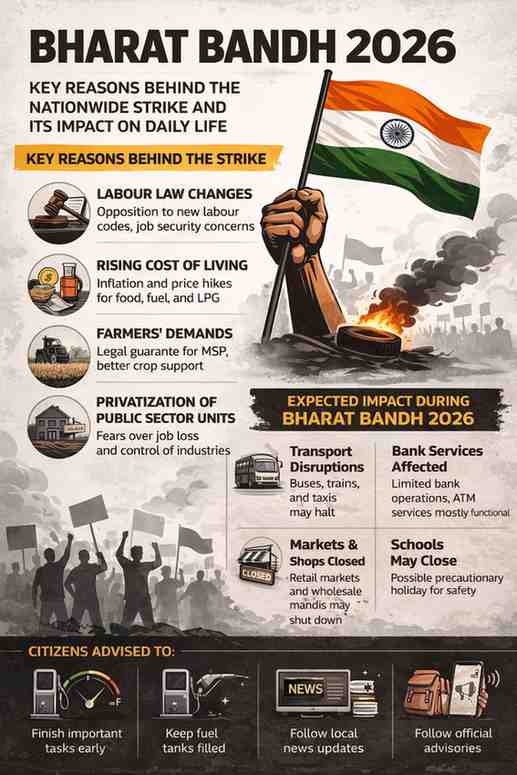
Key Reasons Behind Bharat Bandh 2026
1. Opposition to Labour Law Changes
One of the main reasons behind the Bharat Bandh 2026 is opposition to recent labour reforms.
Trade unions argue that:
- New labour codes may weaken worker protections
- Job security could be affected
- Contract workers may face uncertainty
- Overtime rules and dispute resolution systems may change
Worker unions claim the reforms favour businesses over employees. The government, however, maintains that the changes aim to improve ease of doing business and create jobs.
2. Rising Cost of Living and Inflation
Another major issue raised by protest groups is the rising cost of living.
Common concerns include:
- Increase in food prices
- Higher fuel costs
- Rising LPG cylinder prices
- Expensive electricity bills
For many families, monthly expenses have increased sharply in recent years. Protest organizers say wage growth has not kept pace with inflation.
3. Farmers’ Demands and MSP Concerns
Farmer unions in several states have also extended support to the bandh.
Their key demands include:
- Legal guarantee for Minimum Support Price (MSP)
- Better crop insurance support
- Relief from farm debt
- Timely procurement of crops
Farmers argue that price uncertainty and rising input costs are making agriculture difficult.
4. Privatization of Public Sector Units
Some unions are protesting against the privatization or disinvestment of certain public sector companies.
They fear:
- Job losses
- Reduced social security
- Less public control over key industries
The government has defended its disinvestment plans as part of economic reforms and fiscal management.
States Where Impact May Be Strong
The intensity of Bharat Bandh 2026 may vary by state.
States with traditionally strong union presence, such as:
- Kerala
- West Bengal
- Punjab
- Tamil Nadu
- Bihar
may see higher participation.
In metro cities like Delhi, Mumbai, Bengaluru, Hyderabad, and Kolkata, transport disruptions are possible depending on local participation.
Impact on Daily Life
Public Transport Services
Transport is usually the most affected sector during a Bharat Bandh.
Possible disruptions include:
- State-run bus services
- Auto and taxi unions
- App-based cab services
- Local trains in some regions
However, metro rail services in cities like Delhi and Bengaluru usually continue with security support.
Passengers are advised to check updates before travel.
Banks and Financial Services
Banking services may see partial disruption if employee unions participate.
Possible effects:
- Branch closures
- Delays in cheque clearance
- Limited customer services
Online banking and ATM services are expected to function normally.
Schools and Colleges
Schools and colleges in some states may declare precautionary holidays to ensure student safety.
Private institutions may take decisions based on local conditions.
Parents are advised to check official notices from schools.
Markets and Shops
Retail markets and wholesale mandis may remain closed in areas with strong bandh participation.
Shopping malls in major cities may remain open but with limited staff.
Online deliveries could face delays in affected regions.
Highways and Road Travel
Road blockades and protest marches can slow down highway traffic.
Truck movements may be affected in certain states, which can temporarily impact supply chains.
Authorities usually deploy extra police forces to prevent violence or major disruptions.
Government Response to Bharat Bandh 2026
The central government has appealed for peace and dialogue.
Officials have stated that:
- Security arrangements have been strengthened
- Essential services will be protected
- Law and order will be maintained
State governments are monitoring the situation closely. In the past, administrations have used police deployment and prohibitory orders to prevent unrest.
What Citizens Should Do
To avoid inconvenience during Bharat Bandh 2026, citizens can take simple precautions:
- Complete important bank work in advance
- Avoid unnecessary travel
- Keep fuel tanks filled
- Follow official advisories
- Track local news updates
Essential services such as hospitals, ambulances, and emergency services are expected to remain operational.
Economic Impact of Nationwide Strikes
Nationwide shutdowns can have short-term economic impact.
When markets close and transport slows down:
- Daily wage workers may lose income
- Small businesses face revenue loss
- Supply chains may slow
- Manufacturing output can dip
Even a single day of disruption across major states can affect economic activity.
However, the long-term economic impact depends on the duration and scale of the strike.
Security Measures in Place
Police forces across states have been put on alert.
Measures include:
- Increased patrols
- Monitoring of sensitive areas
- Protection of public property
- Deployment near transport hubs
Authorities have urged protestors to demonstrate peacefully.
Will Bharat Bandh 2026 Be a Public Holiday?
It is important to note:
A Bharat Bandh is not an official public holiday unless declared by a state government.
Most government offices remain open. However, attendance may be low in affected areas.
Private companies may decide work-from-home options depending on local conditions.
Past Bharat Bandhs and Their Impact
India has witnessed several nationwide strikes in the past.
Previous bandhs have:
- Affected rail and road transport
- Disrupted banking services
- Led to temporary market closures
- Triggered political debates
The scale of impact depends largely on union participation and regional political support.
What Happens Next?
The outcome of Bharat Bandh 2026 will depend on:
- Government response
- Level of participation
- Public support
- Law and order situation
If talks between unions and the government progress, further escalation may be avoided.
If demands remain unresolved, more protests could follow.
Final Word
Bharat Bandh 2026 reflects growing concerns among worker unions and farmer groups over economic policies and cost of living issues.
For citizens, the focus remains on safety and minimal disruption.
As India watches developments unfold, the coming hours will determine the real impact of the nationwide strike.
Stay updated through official government announcements and trusted news sources for verified information.
Disclaimer: The information presented in this article is intended for general informational purposes only. While every effort is made to ensure accuracy, completeness, and timeliness, data such as prices, market figures, government notifications, weather updates, holiday announcements, and public advisories are subject to change and may vary based on location and official revisions. Readers are strongly encouraged to verify details from relevant official sources before making financial, investment, career, travel, or personal decisions. This publication does not provide financial, investment, legal, or professional advice and shall not be held liable for any losses, damages, or actions taken in reliance on the information provided.
Last Updated on: Thursday, February 12, 2026 10:17 am by Outlook News Team | Published by: Outlook News Team on Thursday, February 12, 2026 10:17 am | News Categories: India
About The Author