

In a major reform push, the Cabinet Secretariat has rolled out a new performance report card system for senior bureaucrats.
The move signals a shift towards measurable outcomes, accountability, and results-driven governance at the highest levels of the Indian administration.
The new framework replaces broad, narrative-style evaluations with a marks-based review system, where officers are assessed against clearly defined targets and deliverables.
Why This Reform Matters Now
India’s administrative machinery is under pressure to deliver faster results.
With ambitious national goals in infrastructure, digital governance, and welfare delivery, the government wants performance to be visible, comparable, and objective.
The new report card system aims to:
- Reduce subjectivity in appraisals
- Link performance directly with outcomes
- Reward efficiency and innovation
- Flag underperformance early
Officials say the reform is part of a larger push to modernise the civil services.
What Is the New Performance Report Card System?
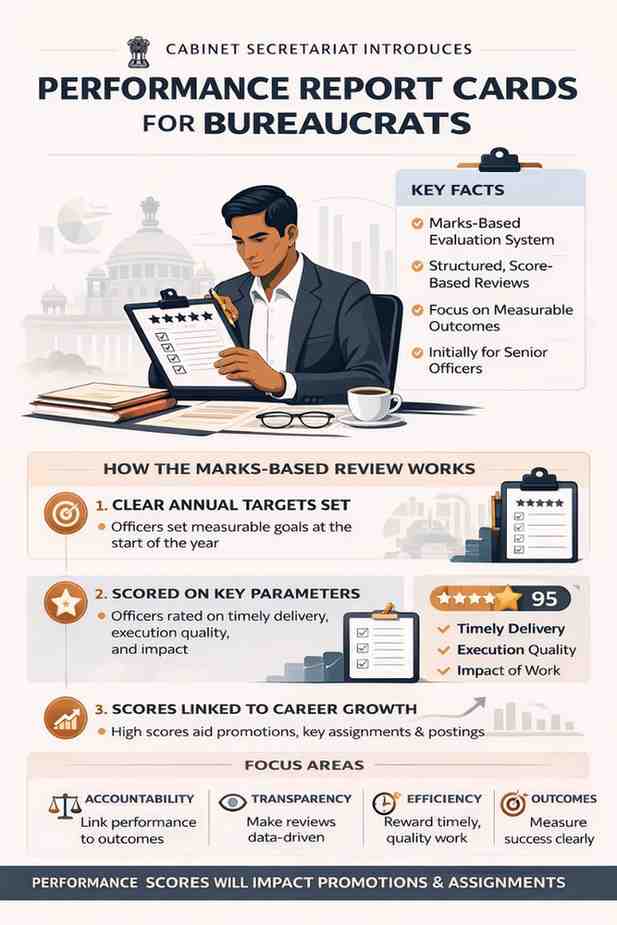
The performance report card is a structured, score-based evaluation tool.
Instead of descriptive remarks, officers will now receive numerical scores across key parameters.
Each officer’s work will be tracked through pre-set annual goals, agreed upon at the start of the review period.
How the Marks-Based Review Works
1. Annual Targets Set in Advance
At the beginning of the year, bureaucrats will be assigned clear, measurable goals, such as:
- Policy implementation milestones
- Project completion timelines
- Inter-ministerial coordination outcomes
- Innovation and reform initiatives
These targets form the base of the final score.
2. Quantified Scoring System
Each performance area carries a fixed number of marks.
Scores are awarded based on:
- Timely delivery
- Quality of execution
- Impact on public service delivery
This allows for side-by-side comparison across departments and officers.
3. Outcome-Focused Evaluation
The emphasis is on results, not just effort.
For example:
- Delays without valid reasons can reduce scores
- Measurable public impact can boost ratings
- Repeated bottlenecks may trigger review
Who Will Be Covered Under the New System?
The initial rollout focuses on senior officers, including:
- Joint Secretaries
- Additional Secretaries
- Secretaries to the Government of India
Over time, the framework may be expanded to other levels of the civil services.
How This Is Different From Earlier Appraisal Systems
Old System
- Narrative-based assessments
- Heavy reliance on senior remarks
- Limited transparency
- Difficult to benchmark performance
New System
- Marks-based, structured scoring
- Clearly defined goals
- Data-backed evaluation
- Easier comparison across officers
Officials say this change will reduce bias and favouritism.
Link Between Performance and Career Progression
Performance scores will play a role in key decisions, such as:
- Empanelment for top posts
- Extension of tenure
- Leadership roles in major projects
- Foreign postings and deputations
High performers may see faster career progression, while consistently low scores could invite scrutiny.
Focus on Accountability and Transparency
The Cabinet Secretariat has stressed that the system is designed to be:
- Transparent – officers know what they are being judged on
- Predictable – targets are set in advance
- Fair – same framework across departments
This also strengthens internal accountability within ministries.
Safeguards Against Mechanical Scoring
Officials clarify that the system is not purely mechanical.
Contextual Review Allowed
- Exceptional circumstances like natural disasters
- Sudden policy shifts
- External constraints beyond an officer’s control
Review committees can factor in context while finalising scores.
Why the Government Is Pushing This Now
The reform aligns with the government’s broader governance agenda, which includes:
- Mission-mode implementation
- Digital tracking of projects
- Time-bound decision-making
- Citizen-centric service delivery
Performance-linked governance is now a clear policy direction.
Impact on Governance and Policy Delivery
Experts believe the new system could lead to:
- Faster file movement
- Better coordination between ministries
- Stronger focus on outcomes
- Reduced project delays
However, they also caution that overemphasis on numbers must be avoided.
Concerns and Challenges Ahead
Risk of Target-Driven Pressure
Some analysts warn that:
- Officers may prioritise easily measurable tasks
- Long-term reforms could get less attention
- Innovation may be avoided if risk affects scores
The government says the framework will evolve based on feedback.
Need for Consistent Implementation
For the system to work:
- Targets must be realistic
- Scoring must be uniform
- Review panels must remain independent
Any inconsistency could weaken trust in the process.
What Happens Next
The Cabinet Secretariat will monitor the first review cycle closely.
Based on outcomes, the system may be:
- Fine-tuned
- Digitally integrated with governance dashboards
- Extended to more services
Officials describe this as a living framework, not a one-time reform.
Big Picture: A Shift in Bureaucratic Culture
This move reflects a broader change in how governance is viewed:
From process-based administration to performance-based governance.
If implemented well, the report card system could reshape how India’s top administrators work, compete, and deliver.
Bottom Line
The new performance report card system marks a significant shift in India’s bureaucratic evaluation process.
By introducing marks-based reviews, outcome tracking, and measurable targets, the government is sending a clear message:
Performance matters and it will now be measured.
How effectively this reform transforms governance will depend on fair implementation, regular review, and balanced judgment in the months ahead.
Disclaimer: The information presented in this article is intended for general informational purposes only. While every effort is made to ensure accuracy, completeness, and timeliness, data such as prices, market figures, government notifications, weather updates, holiday announcements, and public advisories are subject to change and may vary based on location and official revisions. Readers are strongly encouraged to verify details from relevant official sources before making financial, investment, career, travel, or personal decisions. This publication does not provide financial, investment, legal, or professional advice and shall not be held liable for any losses, damages, or actions taken in reliance on the information provided.
Last Updated on: Tuesday, February 10, 2026 11:02 am by Outlook News Team | Published by: Outlook News Team on Tuesday, February 10, 2026 11:02 am | News Categories: India
About The Author