

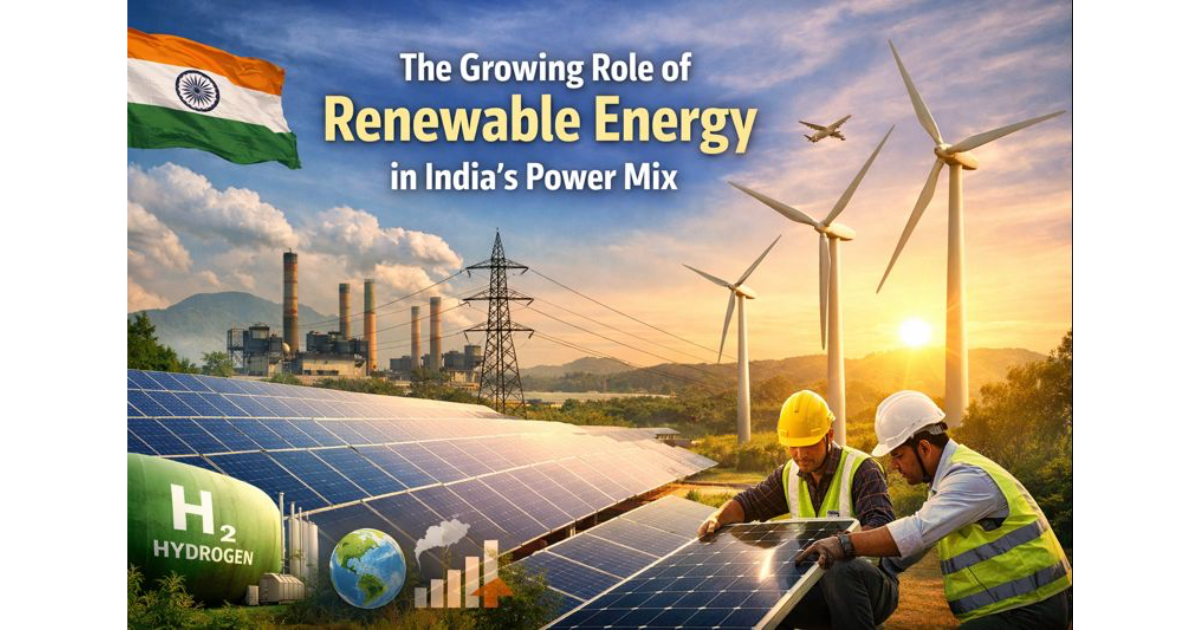
As India accelerates its journey toward a cleaner, more resilient energy future, renewable energy has emerged as a central pillar of national policy, economic strategy, and environmental stewardship. The transformation underway in the country’s power sector is not merely a shift in how electricity is generated — it reflects a profound recalibration of India’s development model, global commitments, and energy security priorities.
A New Era for India’s Power Mix
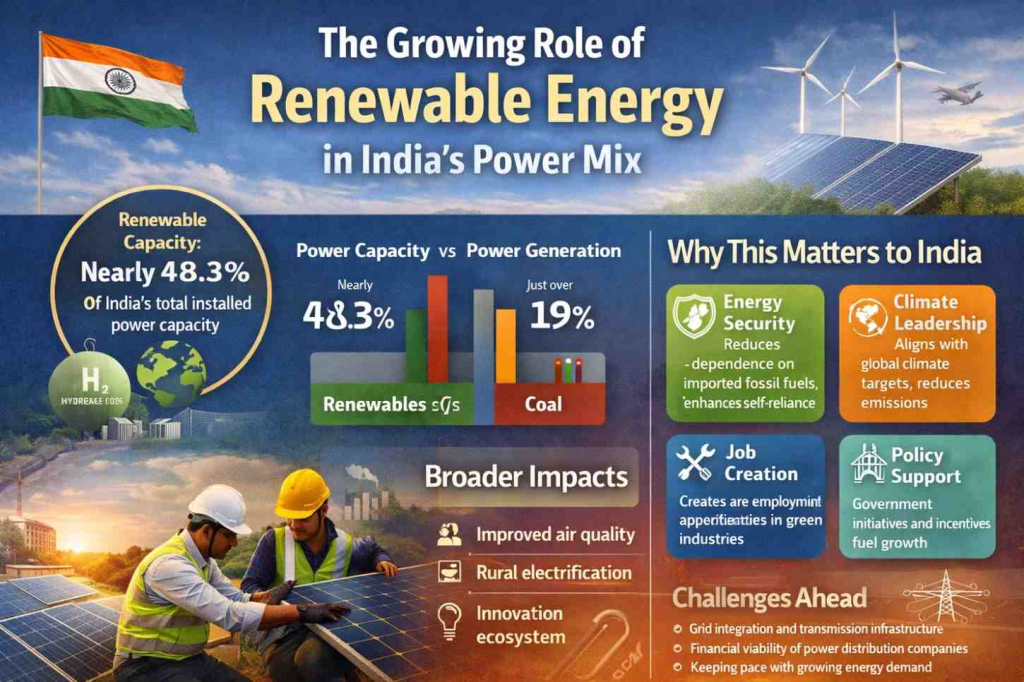
India’s electricity generation landscape has historically been dominated by coal, the workhorse of the grid for decades. While thermal power still accounts for a significant share of generation, renewables — driven by rapid capacity expansion in solar, wind, hydro, and bioenergy — are reshaping that balance. According to official data, renewable energy capacity, including large hydroelectric projects, now constitutes nearly 48.3% of India’s total installed power capacity — a remarkable share in a market that only a decade ago was heavily reliant on fossil fuels.
Much of this growth has been led by solar energy. Solar power installations have surged as costs have fallen and government-led auctions and incentives have catalysed private-sector investment. India’s solar capacity alone accounts for roughly half of the total renewable installed base, underscoring the central role of sunlight in powering the nation’s homes and industries.
From Capacity to Generation: Renewables on the Rise
India’s renewable sector isn’t just growing in capacity — it is also contributing more electricity to the grid. In the first half of 2025, renewable power output increased by 24.4% year-on-year, as solar and wind farms produced more electricity than ever before, even as coal-fired generation dipped amid changing demand dynamics.
While renewables still represent a smaller share of actual electricity generation compared to their capacity share, their rapid output growth signals an energy system in transition. Renewable sources — particularly solar — are increasingly integral to meeting daily peak demand, cutting peak power costs, and reducing dependence on imported fuels.
Why This Matters to India
1. Energy Security and Economic Stability
India’s reliance on imported fossil fuels has long been a vulnerability. By accelerating renewable energy deployment, the country can reduce its exposure to volatile global energy markets, limit foreign exchange outflows for fossil fuel imports, and build a more self-reliant power sector. This is not just an environmental goal — it’s an economic one, with implications for national security and macroeconomic stability.
2. Climate Leadership and Global Commitments
India is a key player in international climate negotiations and has pledged ambitious emissions reduction targets under the Paris Agreement framework. Transitioning to clean energy contributes directly to lowering carbon emissions from the power sector — one of the largest sources of greenhouse gases — helping India align its growth with global climate goals.
Beyond international commitments, domestic climate impacts — such as heatwaves, air pollution, and water stress — make the shift to renewables both a moral and strategic imperative.
3. Job Creation and Industrial Growth
The renewable energy sector is a growing source of employment across India, from solar panel manufacturing to wind turbine installation and maintenance. Investments in decentralized renewable systems also create opportunities in rural areas, contributing to economic development beyond major urban centres.
4. Policy Support and Market Signals
India’s policy environment has played a pivotal role in the renewable surge. Initiatives such as phased auctions for solar and wind projects, incentives for energy storage and green hydrogen, and transmission charge waivers for renewable projects have all contributed to stronger investment signals and faster deployment.
Still, industry voices stress the need for continued and enhanced support — particularly for decentralized renewables and improved financial health of power distribution companies — to sustain momentum and overcome implementation bottlenecks.
Beyond the Numbers: Broader Impacts
The growth of renewable energy also carries broad societal benefits:
Lower Pollution: Reduced reliance on coal helps improve air quality in cities and industrial hubs.
Rural Electrification: Distributed solar systems and off-grid renewables improve electricity access in underserved regions.
These trends reinforce the idea that renewable energy is not just an alternative — it is becoming foundational to India’s power system.
Looking Ahead: Challenges and Opportunities
Despite significant progress, challenges remain. Integrating high shares of variable renewables into the grid requires investment in transmission infrastructure, energy storage, and smarter demand management. Ensuring that distribution companies can financially sustain long-term renewable power contracts is another key hurdle.
Moreover, balancing rapid renewable energy additions with the country’s burgeoning energy demand — expected to grow over the coming decades — will require careful planning and continued innovation.
Yet the trajectory is clear: renewable energy is no longer peripheral in India’s energy strategy — it is central. Its growing role in the power mix matters not just for today’s grid, but for the future of the Indian economy, climate stability, and the daily lives of millions of citizens. As the nation navigates this profound energy transformation, the stakes could not be higher — for India, and for the world.
Add outlooknews.in as a preferred source on google – click here
Last Updated on: Thursday, January 22, 2026 11:30 am by Outlook News Team | Published by: Outlook News Team on Thursday, January 22, 2026 11:30 am | News Categories: News
About The Author