
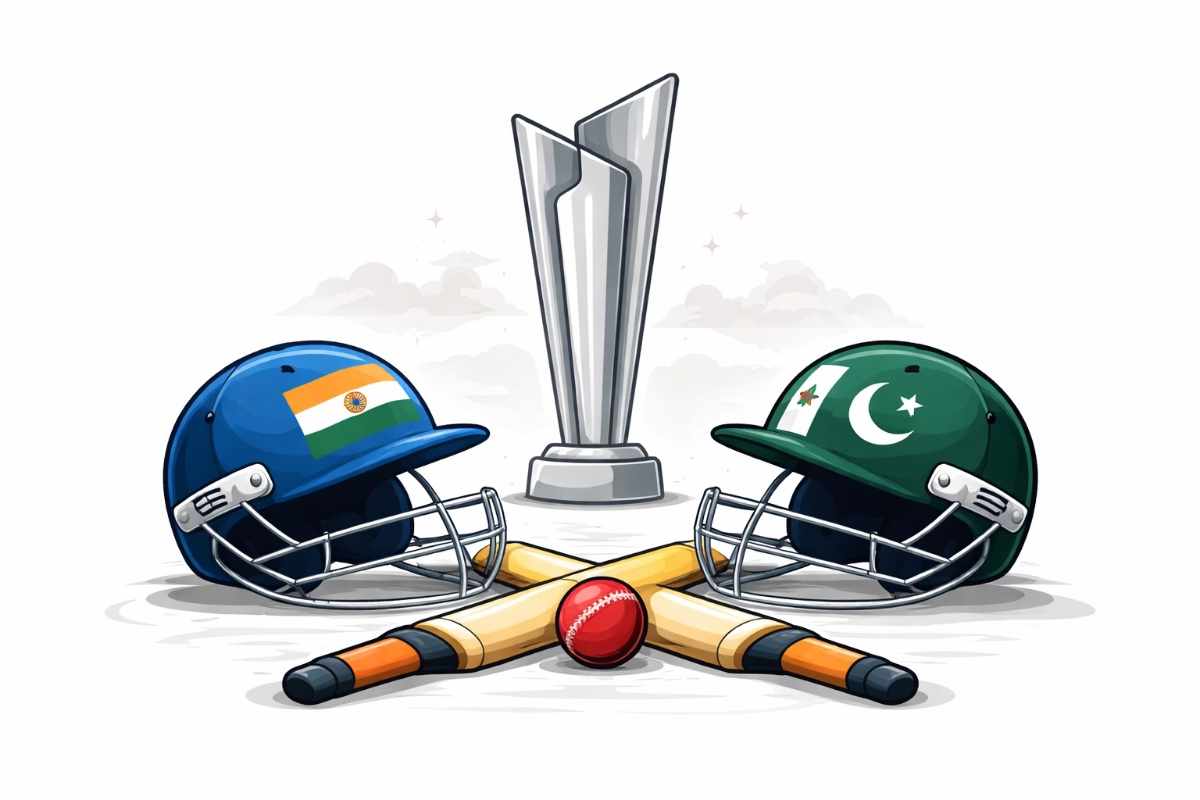
The India vs Pakistan clash at the T20 World Cup 2026 is officially back on the schedule, with the high-voltage match set to be played on February 15.
Pakistan’s decision marks a clear U-turn from earlier signals suggesting a possible boycott of matches against India.
The development is significant not just for cricket fans, but also for tournament planning, broadcast revenues, and the global profile of the T20 World Cup. With the fixture now confirmed, attention has shifted firmly back to the cricketing contest rather than off-field uncertainty.
Why This Decision Matters Right Now
An India–Pakistan match is the biggest draw in world cricket.
Any doubt over its inclusion creates uncertainty for fans, broadcasters, sponsors, and organisers.
The confirmation of the February 15 fixture brings clarity at a crucial stage of tournament preparations. It also signals that cricketing considerations have prevailed over earlier political and administrative tensions.
For Indian fans, the decision ensures that the most anticipated match of the tournament will go ahead as scheduled.
What Changed: Pakistan’s U-Turn Explained
Earlier in the build-up to the T20 World Cup 2026, there were indications from Pakistan cricket officials that matches against India could be reconsidered due to broader bilateral issues.
However, in recent discussions with the tournament organisers and the International Cricket Council, Pakistan has agreed to participate in the scheduled group-stage match.
Officials familiar with the matter say the decision was driven by a combination of sporting, commercial, and logistical factors, with an understanding that global tournaments operate under collective commitments.
February 15 Fixture: What We Know So Far
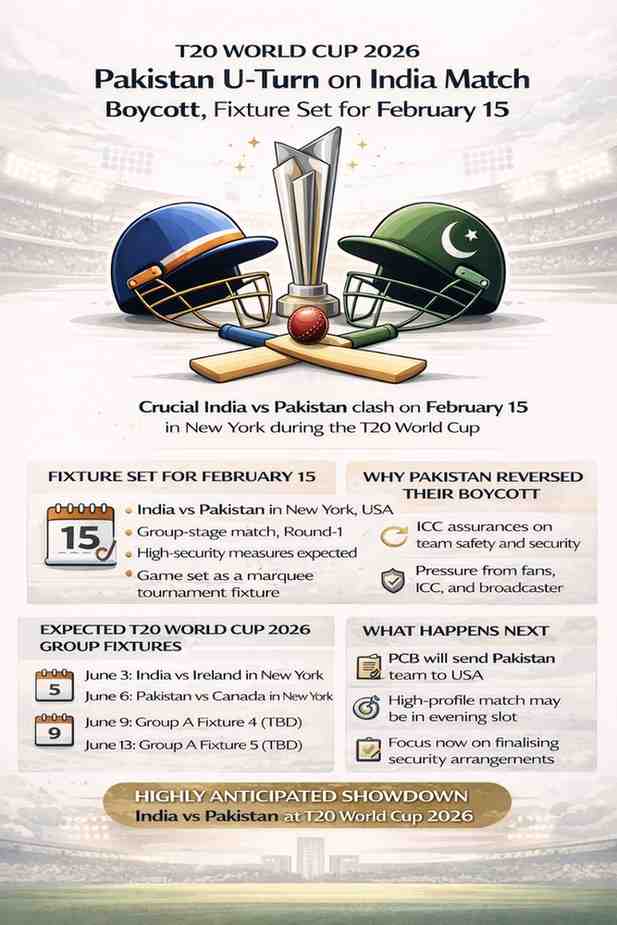
The India vs Pakistan match will be played on February 15, 2026.
It is expected to be a group-stage fixture and one of the marquee matches of the tournament.
While the exact venue details are part of the official tournament schedule, organisers have ensured that the match will be held at a stadium capable of handling massive crowds and global broadcast demands.
The February 15 date falls on a weekend window, maximising viewership across time zones.
Role of the International Cricket Council
The tournament is being conducted under the authority of the International Cricket Council, which finalises fixtures in consultation with member boards.
The ICC has maintained that all participating teams are expected to honour the tournament schedule once confirmed. Sources indicate that sustained dialogue helped ensure that the fixture list remained intact.
The ICC’s stance has been to keep global events insulated from bilateral disputes, focusing instead on competitive balance and tournament integrity.
Why India vs Pakistan Is Central to the T20 World Cup
No other cricket rivalry attracts the same global attention.
India vs Pakistan matches consistently deliver record-breaking television ratings and digital engagement.
For the T20 World Cup, the fixture is often seen as a financial cornerstone due to advertising demand, sponsorship value, and ticket sales.
Tournament planners had been keen to avoid last-minute changes, which could have disrupted the broader match calendar.
Impact on Fans and Broadcasters
The confirmation of the match has brought immediate relief to broadcasters and sponsors.
- Television networks rely heavily on the India – Pakistan game for peak viewership
- Advertisers plan premium campaigns around the fixture
- Fans had already begun travel and viewing plans
With the February 15 date now locked in, stakeholders can proceed without uncertainty.
What This Means for Team India
For India national cricket team, the confirmed fixture allows focused preparation.
India and Pakistan do not play bilateral series, making global tournaments the only stage where the rivalry is renewed. Team management can now plan strategies without distraction.
Historically, India has had strong performances against Pakistan in ICC tournaments, adding further intrigue to the contest.
Pakistan’s Sporting Calculus
From Pakistan’s perspective, playing India at a World Cup is both a challenge and an opportunity.
The match offers:
- Maximum exposure for players
- A chance to reset narratives on a global stage
- Significant experience under pressure conditions
Skipping such a fixture would have had sporting and reputational costs, something analysts say likely influenced the final decision.
Tournament Stability and Scheduling
The U-turn has also helped maintain overall tournament stability.
A boycott or withdrawal would have forced:
- Changes in group dynamics
- Possible points allocation issues
- Schedule reshuffles affecting other teams
By confirming participation, Pakistan has helped ensure a smooth tournament structure.
Security and Logistical Planning
High-profile matches like India vs Pakistan require advanced security planning.
With the fixture confirmed well in advance, organisers can now coordinate:
- Crowd management
- Security deployment
- Team movement and accommodation
Early clarity reduces operational risks for host authorities.
Political Noise vs Sporting Reality
While political tensions between the two countries continue, global cricket events have increasingly followed a clear principle: separate sport from bilateral politics.
The February 15 fixture reflects that approach. Cricket administrators have prioritised the integrity of the tournament over prolonged uncertainty.
How Fans Have Reacted
Fan reaction across India has been largely positive.
Social media discussions surged following confirmation of the fixture, with fans welcoming the decision and shifting focus to team combinations, player form, and match expectations.
For many supporters, the match is not just about points but pride and momentum.
What Comes Next
With the fixture confirmed, attention now turns to:
- Squad announcements
- Match venues and timings
- Group standings and qualification scenarios
The India vs Pakistan match is expected to set the tone for the rest of the tournament.
Why February 15 Could Define the Tournament
Early group-stage clashes often shape qualification paths.
A win in a high-pressure game like this can:
- Boost team confidence
- Improve net run rate strategy
- Influence knockout matchups
Both teams are expected to treat the match as a momentum-builder, not just a rivalry fixture.
Big Picture: Cricket Wins This Round
The confirmation of the India–Pakistan match underlines the enduring power of global cricket tournaments.
Despite political and administrative noise, the game’s biggest rivalry will once again take centre stage.
For the T20 World Cup 2026, February 15 is now firmly circled on the calendar.
Bottom Line
Pakistan’s U-turn on the India match boycott clears the biggest cloud hanging over the T20 World Cup 2026.
With the fixture confirmed for February 15, fans, teams, and organisers can now focus on what matters most – the cricket.
As anticipation builds, the India vs Pakistan clash is set to once again become the heartbeat of a global tournament watched by millions.
Disclaimer: The information presented in this article is intended for general informational purposes only. While every effort is made to ensure accuracy, completeness, and timeliness, data such as prices, market figures, government notifications, weather updates, holiday announcements, and public advisories are subject to change and may vary based on location and official revisions. Readers are strongly encouraged to verify details from relevant official sources before making financial, investment, career, travel, or personal decisions. This publication does not provide financial, investment, legal, or professional advice and shall not be held liable for any losses, damages, or actions taken in reliance on the information provided.
Last Updated on: Tuesday, February 10, 2026 11:53 am by Outlook News Team | Published by: Outlook News Team on Tuesday, February 10, 2026 11:53 am | News Categories: Sports
About The Author