

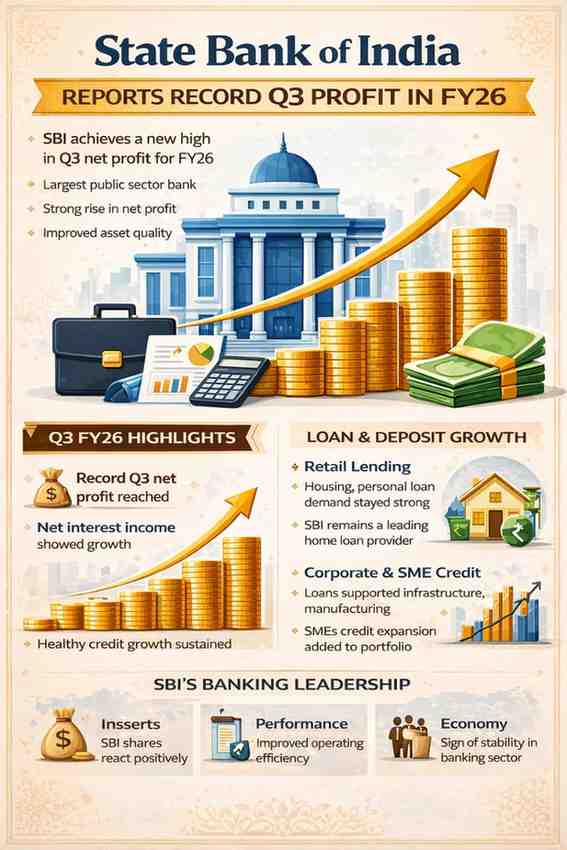
State Bank of India (SBI) has reported its highest-ever third-quarter profit for FY26, reinforcing its position as India’s largest lender. The strong performance reflects steady loan growth, stable asset quality, and improved operating efficiency.
The Q3 results matter for investors, depositors, and the broader banking sector. As the country’s biggest public sector bank, SBI’s performance is closely tracked as a key indicator of India’s credit demand and economic momentum.
India’s Largest Bank Delivers Strong Q3 Performance
The results were announced by State Bank of India as part of its official quarterly earnings disclosure for the financial year 2025–26.
SBI reported a record net profit for the October–December quarter (Q3 FY26). The bank attributed the growth to:
- Healthy expansion in retail and corporate loans
- Improved net interest income (NII)
- Better recovery from stressed accounts
- Controlled operating costs
As India’s largest lender by assets, deposits, and branch network, SBI’s quarterly performance has a direct impact on market sentiment.
Q3 FY26 Key Highlights
According to the official results filing:
- Net profit reached a record high for Q3
- Net interest income saw steady growth
- Gross non-performing assets (GNPA) ratio improved
- Credit growth remained strong across segments
The bank also reported stable margins despite changing interest rate conditions.
Investors reacted positively in early trade following the announcement, with SBI shares seeing movement on stock exchanges.
Strong Loan Growth Across Segments
One of the key drivers of SBI’s record Q3 profit was steady credit expansion.
Retail Lending Gains Momentum
Retail loans, including home loans and personal loans, continued to grow. SBI remains one of the leading home loan providers in India.
Demand for housing loans remained strong in metro cities and tier-2 markets.
Corporate and SME Credit
Corporate lending also saw growth during the quarter. Demand from infrastructure, manufacturing, and services sectors supported loan expansion.
Small and medium enterprises (SMEs) contributed to the credit portfolio as business activity improved.
This balanced growth across segments helped the bank maintain stability.
Improvement in Asset Quality
Asset quality remains a key focus area for public sector banks.
During Q3 FY26, SBI reported:
- Reduction in gross non-performing assets
- Improvement in net non-performing assets
- Higher recovery from written-off accounts
Lower bad loans reduce provisioning costs and improve profitability.
Over the past few years, SBI has steadily cleaned up its balance sheet. The latest quarterly results suggest continued stability in asset quality.
Deposit Growth Remains Stable
Deposits are a core strength for SBI.
With a wide branch network across India, the bank continues to attract savings and current account deposits.
Stable deposit growth supports credit expansion and ensures liquidity comfort.
SBI’s strong CASA (Current Account Savings Account) base helps maintain healthy margins.
Digital Banking Expansion
SBI has invested heavily in digital banking platforms.
Its mobile banking app, YONO, has played a major role in customer engagement and loan processing.
Digital transactions now form a large share of total banking operations. This shift has helped reduce operating costs and improve service speed.
The bank continues to expand digital services to compete with private lenders and fintech firms.
SBI’s Position in the Indian Banking Sector
SBI remains India’s largest public sector bank by:
- Total assets
- Market capitalisation among PSU banks
- Branch and ATM network
The bank plays a critical role in government schemes, rural banking, and financial inclusion.
It also supports major infrastructure and corporate projects across the country.
Strong quarterly results strengthen SBI’s leadership position among public sector banks.
Impact on Investors and Stock Market
SBI is a major component of Indian stock indices.
Quarterly earnings influence:
- Share price movement
- Banking sector sentiment
- Foreign institutional investor activity
Record Q3 profits may improve investor confidence in PSU banks, especially at a time when credit demand remains stable.
However, analysts continue to track factors such as:
- Interest rate movements
- Global economic trends
- Domestic inflation
- Regulatory policies
These factors can influence future earnings performance.
Interest Rate Environment and Margins
The interest rate cycle plays a key role in bank profitability.
Margins depend on the difference between lending rates and deposit rates.
In recent quarters, banks have navigated changes in policy rates set by the Reserve Bank of India.
SBI’s Q3 performance suggests it has managed margins efficiently despite shifts in funding costs.
Maintaining a balance between credit growth and deposit mobilisation remains important.
Government Ownership and Strategic Importance
SBI is majority-owned by the Government of India.
As a public sector bank, it supports:
- Government welfare schemes
- Direct benefit transfers
- Agriculture financing
- MSME lending
Its performance has wider economic implications beyond profits.
Strong financial results help improve capital buffers and support future expansion.
Challenges Ahead
While Q3 FY26 results are strong, the banking sector faces ongoing challenges.
Key areas to monitor include:
- Global economic slowdown risks
- Fluctuations in commodity prices
- Interest rate changes
- Competition from private banks and fintech firms
Maintaining asset quality during credit expansion remains critical.
Banks must also balance growth with risk management.
Why SBI’s Record Q3 Profit Matters
SBI’s performance is closely linked to India’s economic activity.
Higher credit growth often reflects rising consumption and investment.
Improved asset quality suggests financial stability.
For depositors, strong profitability means:
- Better capital strength
- Lower risk perception
- Continued branch and digital expansion
For investors, it signals resilience within the public sector banking space.
What to Watch in Q4 FY26
As the financial year approaches its final quarter, attention will shift to:
- Full-year profit performance
- Dividend announcements
- Capital adequacy levels
- Future growth guidance
Market participants will also track loan demand trends and deposit growth.
If current momentum continues, FY26 could become one of SBI’s strongest financial years.
Conclusion
State Bank of India’s record Q3 profit in FY26 underscores the strength of India’s largest lender amid steady credit growth and improving asset quality.
The results reflect stable banking fundamentals and disciplined cost management.
As India’s financial system continues to expand, SBI’s performance remains a key indicator of economic direction.
Investors, policymakers, and customers will closely watch the bank’s next quarterly update to assess whether this growth trend continues.
Disclaimer: The information presented in this article is intended for general informational purposes only. While every effort is made to ensure accuracy, completeness, and timeliness, data such as prices, market figures, government notifications, weather updates, holiday announcements, and public advisories are subject to change and may vary based on location and official revisions. Readers are strongly encouraged to verify details from relevant official sources before making financial, investment, career, travel, or personal decisions. This publication does not provide financial, investment, legal, or professional advice and shall not be held liable for any losses, damages, or actions taken in reliance on the information provided.
Last Updated on: Tuesday, March 3, 2026 10:58 am by Outlook News Team | Published by: Outlook News Team on Tuesday, March 3, 2026 10:58 am | News Categories: Business
About The Author