
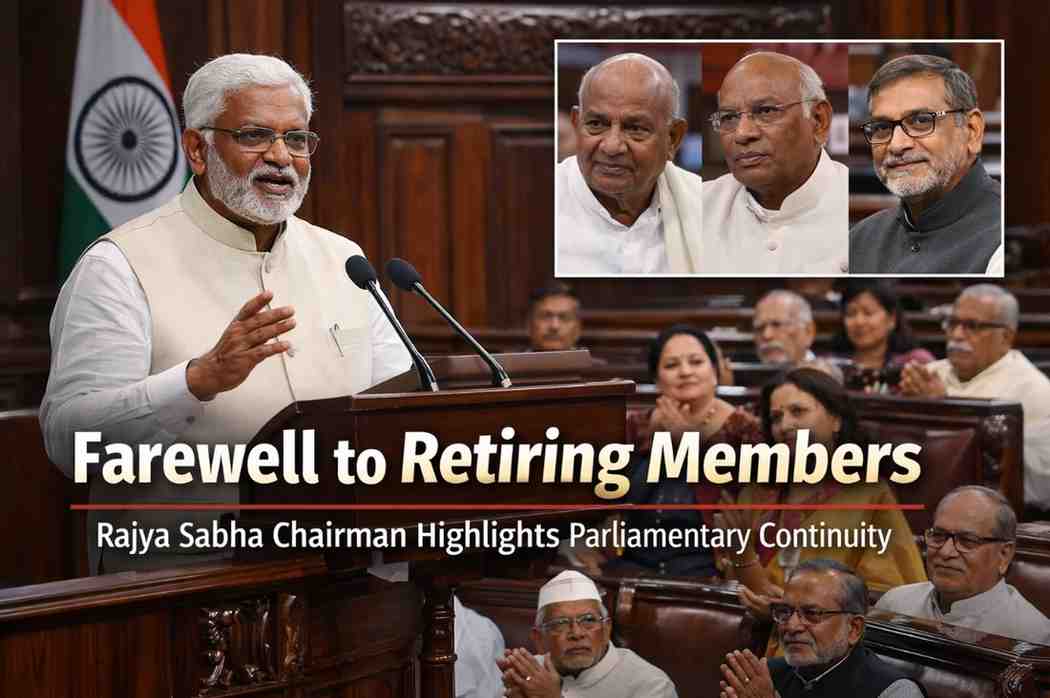
The Chairman of the Rajya Sabha, C. P. Radhakrishnan, on Wednesday delivered a farewell address in the Upper House for 59 members set to retire between April and July 2026.
These members represent 20 states across India, including nine women parliamentarians.
Key Highlights
- 59 Rajya Sabha members will retire over the next four months
- Members belong to 20 states, reflecting regional diversity
- Nine of the retiring members are women
- Several senior leaders and experienced parliamentarians are among those completing their terms
Constitutional Process Ensures Continuity
The Chairman explained that the retirement of members follows a constitutional design where one-third of the Rajya Sabha retires every two years.
This staggered system ensures continuity in the functioning of the Upper House while allowing new members to join and contribute fresh perspectives.
He described the Rajya Sabha as a reflection of India’s diversity, with periodic changes strengthening its democratic character.
Recognition of Senior Leaders
Among the prominent leaders retiring is former Prime Minister H. D. Deve Gowda. The Chairman noted his long-standing contribution to public life, particularly his advocacy for farmers and rural communities.
The House also acknowledged Mallikarjun Kharge, Leader of the Opposition, for his extensive parliamentary experience and role in shaping debates in both Houses of Parliament.
Deputy Chairman Harivansh’s Term Concludes
A special mention was made of Harivansh Narayan Singh, whose term as Deputy Chairman ends on April 9, 2026.
The Chairman praised his impartial conduct, calm approach, and commitment to parliamentary traditions. He also highlighted Harivansh’s contributions to international parliamentary platforms such as the Inter-Parliamentary Union and Commonwealth Parliamentary Association.
Contributions Across Sectors
The Chairman noted that many retiring members have held key roles in governance and administration, bringing valuable experience to legislative discussions.
He said their contributions have helped raise important issues concerning states, communities, and national priorities, strengthening democratic debate in the House.
Appreciation for Women Members
Special recognition was given to the women members who are retiring, with the Chairman acknowledging their dedication and meaningful participation in parliamentary proceedings.
Official Statement
In his address, the Chairman emphasized that retirement in public life should not be seen as an end but as a transition to new responsibilities.
He said the experience and insights of outgoing members would continue to guide future lawmakers, while new members would carry forward the institution’s legacy with renewed energy.
Context and Background
The Rajya Sabha, also known as the Council of States, is a permanent House of Parliament and is not subject to dissolution.
Its rotational retirement system ensures stability in governance while maintaining democratic renewal. Members serve six-year terms, with elections held biennially to fill vacancies.
Public Impact
The retirement of senior parliamentarians marks a shift in the composition of the Upper House.
While new members bring fresh ideas, the departure of experienced leaders can influence legislative dynamics, debate quality, and party representation.
For citizens, this transition is part of the democratic process that balances continuity with change.
Conclusion
Concluding his remarks, the Chairman expressed gratitude to all retiring members for their service and cooperation in conducting House proceedings.
He extended his best wishes for their future endeavors, expressing confidence that they would continue contributing to public life beyond Parliament.
Source:PIB
Last Updated on: Wednesday, March 18, 2026 3:44 pm by Outlook News Team | Published by: Outlook News Team on Wednesday, March 18, 2026 3:30 pm | News Categories: Delhi
About The Author