
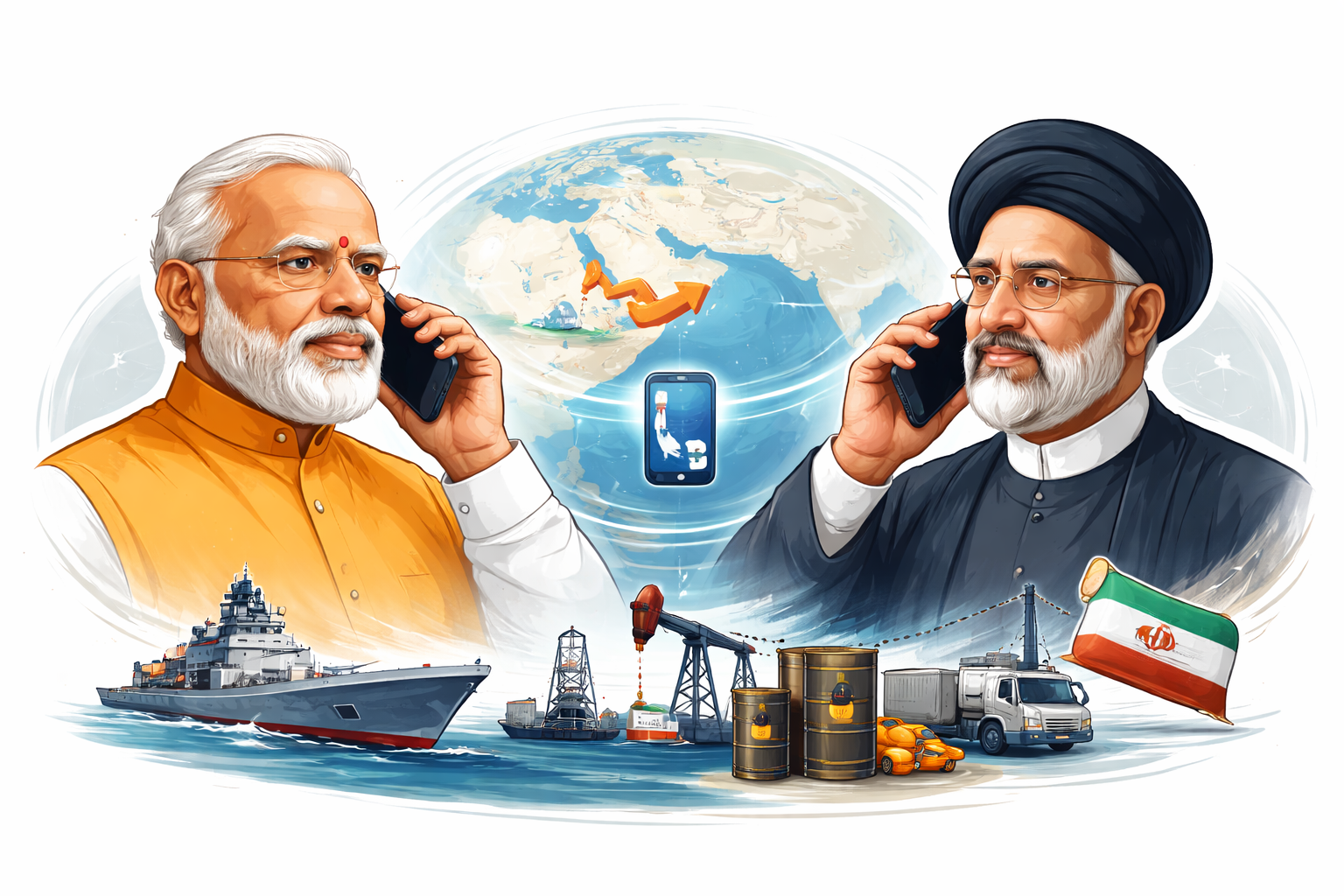
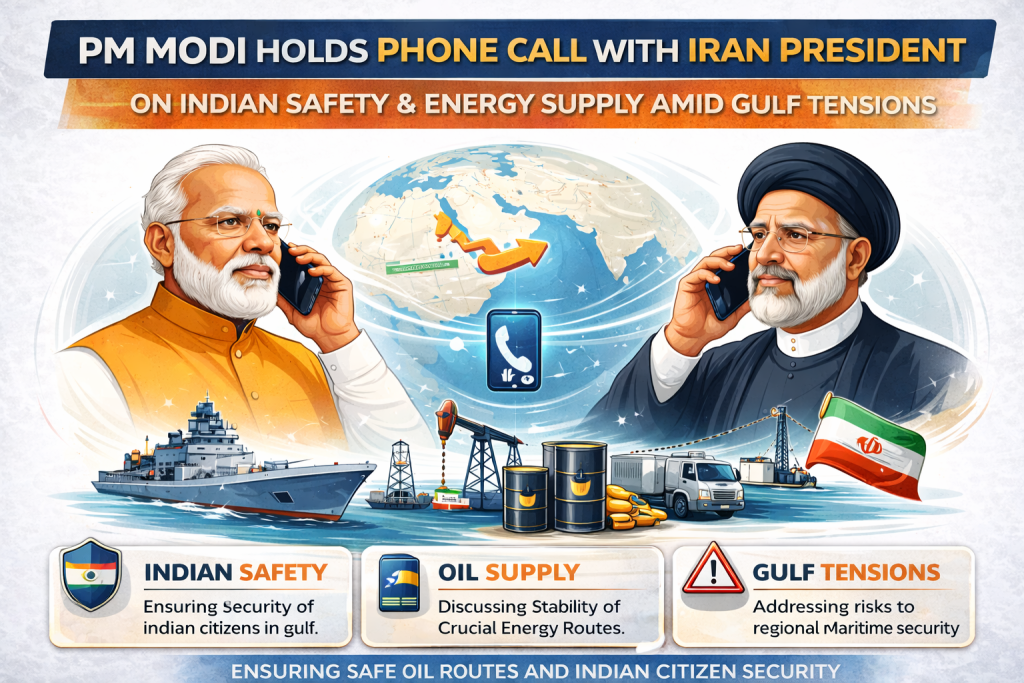
Prime Minister Narendra Modi held a phone conversation with Iran’s President Masoud Pezeshkian to discuss the safety of Indian citizens and the stability of energy supply routes as tensions continue in the Gulf region.
The conversation comes at a time of heightened geopolitical uncertainty in West Asia, where security concerns around shipping lanes and regional stability have raised global attention.
India relies heavily on energy imports from the region, and any disruption to shipping routes can directly affect the country’s fuel supply and economy.
Officials said the discussion focused on protecting Indian nationals, ensuring safe maritime routes, and maintaining stable oil supply chains that pass through the Gulf.
The diplomatic engagement highlights India’s proactive efforts to safeguard both its citizens abroad and its energy security during a period of regional tension.
Phone Call Focuses on Safety of Indians in the Region
One of the main issues discussed during the call was the safety and well-being of Indian citizens living and working in West Asia.
Millions of Indians are employed across Gulf countries in sectors such as construction, healthcare, engineering, and services.
Because of the region’s strategic importance and large Indian diaspora, the Indian government closely monitors developments that could affect citizens abroad.
Prime Minister Narendra Modi emphasised the importance of ensuring that Indian nationals remain safe amid the evolving situation.
The Iranian leadership was briefed on India’s concerns regarding the security of its citizens and regional stability.
Protecting the welfare of Indians overseas has been a consistent priority in India’s diplomatic engagements.
Energy Supply and Oil Routes a Key Topic
Another major issue discussed during the call was the continuity of oil supply routes that pass through the Gulf.
India is one of the world’s largest importers of crude oil, with more than 80% of its energy needs met through imports.
A significant portion of this oil is transported through the strategically important Strait of Hormuz, a narrow waterway that connects the Persian Gulf with global shipping routes.
The strait serves as a crucial passage for oil exports from several major energy-producing nations.
Any disruption in this route could have global economic consequences, including rising energy prices and supply shortages.
During the conversation, both sides discussed the importance of ensuring that maritime routes remain open and secure.
Why the Strait of Hormuz Is Critical
The Strait of Hormuz is considered one of the most important maritime chokepoints in the world.
Each day, a significant share of global oil shipments passes through this route.
Key facts about the strait include:
• Nearly one-fifth of global oil supply passes through the waterway
• It connects the Persian Gulf with the Gulf of Oman and the Arabian Sea
• Oil exporters such as Saudi Arabia, Iraq, Kuwait, and the United Arab Emirates rely on the route
For India, which imports large quantities of crude oil from the Middle East, the stability of this route is essential.
Ensuring uninterrupted passage for oil tankers helps maintain stable fuel supplies and prevent sudden price shocks.
India’s Diplomatic Engagement in West Asia
India maintains strong diplomatic relationships with multiple countries across West Asia.
The region is vital not only for energy imports but also for trade, investment, and the presence of a large Indian diaspora.
India’s foreign policy in the region focuses on:
• Maintaining balanced relations with all partners
• Ensuring the safety of Indian citizens abroad
• Protecting energy supply chains
• Promoting regional stability
The phone conversation between Prime Minister Modi and President Pezeshkian reflects India’s active diplomatic engagement during periods of geopolitical uncertainty.
Global Markets Watching Gulf Developments
Developments in the Gulf region often have immediate effects on global financial and energy markets.
When tensions rise in areas linked to major shipping routes, investors and energy traders closely monitor the situation.
Concerns about shipping disruptions can push oil prices higher and create volatility in global markets.
For oil-importing nations such as India, rising energy prices can increase import costs and contribute to inflation.
By maintaining diplomatic dialogue with regional leaders, India aims to minimise risks to its energy supply.
India’s Energy Security Strategy
India has been working on multiple strategies to strengthen its energy security.
These include:
• Diversifying oil import sources
• Building strategic petroleum reserves
• Expanding renewable energy capacity
• Strengthening diplomatic ties with energy-producing nations
While renewable energy is growing rapidly, crude oil continues to play a critical role in transportation, manufacturing, and industry.
Ensuring stable oil imports remains essential for the country’s economic growth.
Diplomatic outreach with countries in West Asia forms an important part of this strategy.
Importance of the Indian Diaspora in the Gulf
The Gulf region hosts one of the largest Indian diaspora populations in the world.
Millions of Indian workers live in countries such as the United Arab Emirates, Saudi Arabia, Kuwait, Oman, Qatar, and Bahrain.
Their contributions are significant both for the economies of host nations and for India through remittances.
Because of this large population, the Indian government regularly engages with regional governments to ensure the safety and welfare of Indian citizens.
Any escalation in regional tensions can raise concerns among families in India whose relatives work abroad.
The government therefore monitors developments closely and remains prepared to respond if necessary.
Maritime Security and International Shipping
Security of international shipping routes is another critical issue discussed by governments worldwide.
The Gulf region is home to some of the world’s busiest shipping lanes.
In addition to oil tankers, commercial vessels transporting goods between Asia, Europe, and Africa also pass through these waters.
Ensuring safe navigation is essential for global trade.
Countries often cooperate on maritime security through naval patrols, monitoring systems, and diplomatic coordination.
India has previously deployed naval assets in the region during periods of heightened tension to ensure the safety of Indian shipping.
India’s Approach to Regional Stability
India has consistently emphasised the importance of peaceful dialogue and stability in West Asia.
As a major trading partner and energy importer, India has a strong interest in preventing disruptions to regional trade routes.
Diplomatic engagement with regional leaders helps India maintain communication channels and address potential risks early.
The conversation between Prime Minister Modi and President Pezeshkian reflects this broader approach.
Maintaining open dialogue with regional partners allows India to respond proactively to developments that may affect its economic and strategic interests.
What Happens Next
Officials said India will continue to monitor the situation in the Gulf closely.
The government remains in contact with regional partners and international stakeholders regarding developments affecting maritime security and energy supply.
If necessary, India may also coordinate with shipping companies and naval authorities to ensure safe passage for vessels carrying Indian cargo.
Diplomatic engagement is expected to remain an important tool for managing risks related to regional tensions.
Conclusion
Prime Minister Narendra Modi’s phone conversation with Iran’s President Masoud Pezeshkian highlights India’s proactive diplomatic efforts during a period of heightened tension in the Gulf.
The discussion focused on two critical priorities: the safety of Indian citizens and the stability of energy supply routes.
For a country that relies heavily on imported oil and has a large diaspora in the region, developments in West Asia carry significant importance.
By engaging with regional leaders and emphasising the importance of secure shipping routes, India aims to protect its economic interests and ensure the welfare of its citizens abroad.
As the situation in the Gulf continues to evolve, India’s diplomatic outreach and strategic engagement will remain key to safeguarding both national and global stability.
Disclaimer: The information presented in this article is intended for general informational purposes only. While every effort is made to ensure accuracy, completeness, and timeliness, data such as prices, market figures, government notifications, weather updates, holiday announcements, and public advisories are subject to change and may vary based on location and official revisions. Readers are strongly encouraged to verify details from relevant official sources before making financial, investment, career, travel, or personal decisions. This publication does not provide financial, investment, legal, or professional advice and shall not be held liable for any losses, damages, or actions taken in reliance on the information provided.
Last Updated on: Friday, March 13, 2026 4:45 pm by Outlook News Team | Published by: Outlook News Team on Friday, March 13, 2026 4:45 pm | News Categories: India
About The Author