

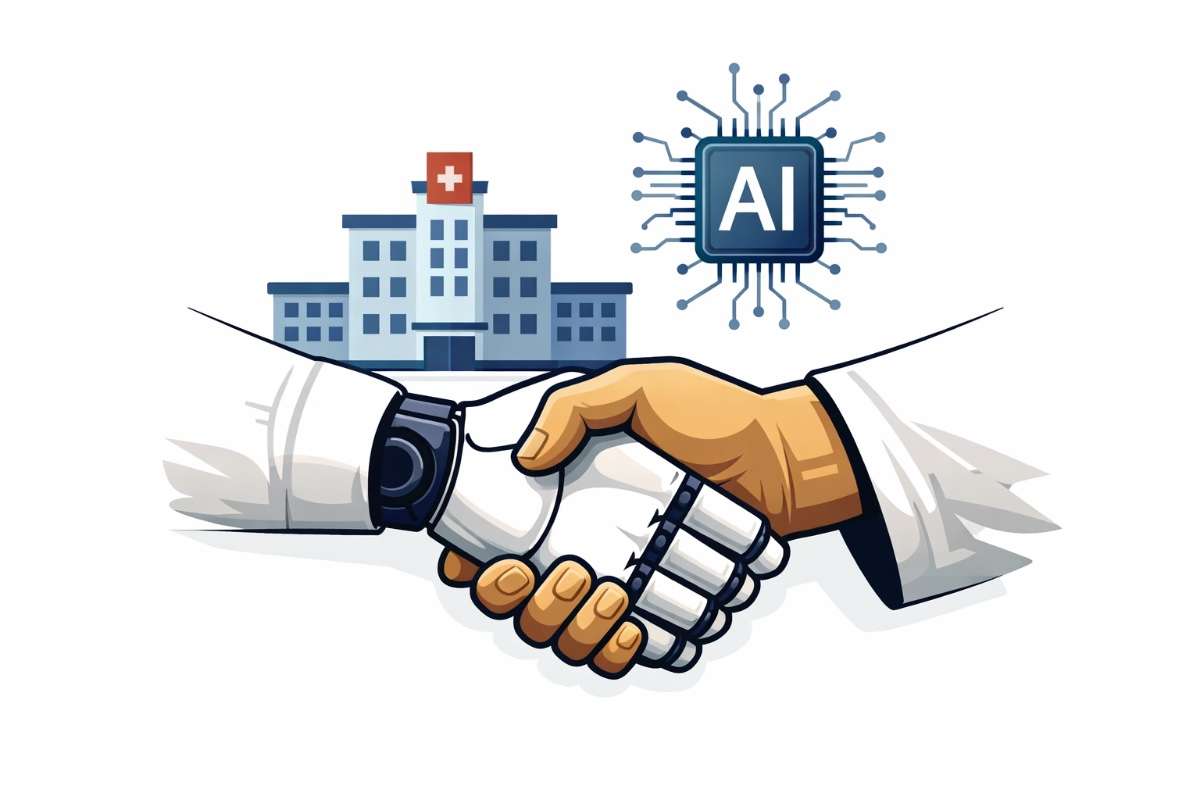
Why This Collaboration Matters for India’s Healthcare Sector
Artificial Intelligence is rapidly transforming global healthcare systems. In India, where patient volumes are high and medical resources are often stretched, AI-based tools can improve diagnosis, research, and hospital management.
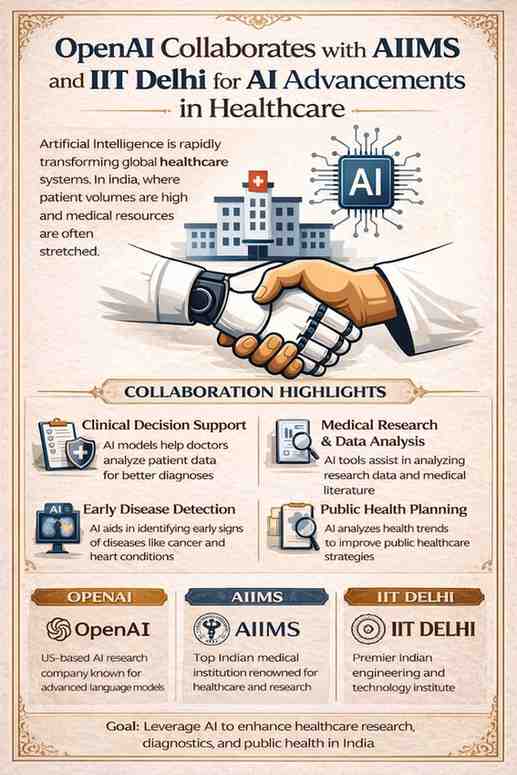
A collaboration involving OpenAI, All India Institute of Medical Sciences (AIIMS), and Indian Institute of Technology Delhi (IIT Delhi) reflects a growing push to integrate advanced AI research into public healthcare and medical education.
Such academic and technology partnerships are becoming central to India’s digital health mission. They aim to combine AI research capabilities with clinical expertise and engineering innovation.
About the Institutions Involved
OpenAI
OpenAI is a US-based artificial intelligence research and deployment company. It develops advanced language models and AI systems used across sectors including education, enterprise tools, and research.
Its AI models are widely used for natural language understanding, data analysis, and research assistance.
AIIMS
AIIMS is one of India’s most respected medical institutions. It provides tertiary healthcare, advanced medical research, and postgraduate education. AIIMS hospitals handle thousands of patients daily and are known for clinical research and specialised treatment.
IIT Delhi
IIT Delhi is a leading engineering and research institute. It has strong departments in computer science, artificial intelligence, data science, and biomedical engineering. IIT Delhi researchers are involved in AI-driven healthcare tools, robotics, and medical device innovation.
Focus Areas of AI Collaboration in Healthcare
Collaborations between global AI firms and Indian academic institutions generally focus on practical applications that can improve healthcare delivery.
Key areas of AI use in healthcare include:
1. Clinical Decision Support
AI systems can assist doctors by analysing patient data, medical records, and diagnostic reports. These systems do not replace doctors but support faster decision-making.
Machine learning models can help identify patterns in:
- Radiology images
- Pathology slides
- Electronic health records
2. Medical Research and Data Analysis
Large language models and AI tools can help researchers:
- Analyse scientific literature
- Identify research gaps
- Organise clinical trial data
- Support academic writing
In institutions like AIIMS and IIT Delhi, AI systems can be used to process large datasets generated from hospital records and research projects.
3. Early Disease Detection
AI models trained on imaging data can help detect early signs of diseases such as cancer, tuberculosis, or heart conditions. India’s large and diverse population offers a rich dataset for research, but strict privacy rules apply.
4. Public Health Planning
AI tools can help analyse disease trends, hospital admission patterns, and health infrastructure needs. This supports policymakers in planning better public health strategies.
India’s Growing AI in Healthcare Ecosystem
India has been actively promoting AI innovation in public services. Government programmes such as the National Digital Health Mission aim to digitise health records and improve access to healthcare services.
Academic institutions including IITs and AIIMS have already been working on:
- AI-based diagnostic tools
- Telemedicine platforms
- Medical robotics
- Health data analytics
Collaboration with global AI companies can help accelerate research and bring international expertise into Indian healthcare systems.
Ethical and Data Protection Considerations
AI in healthcare must follow strict data protection and privacy standards.
In India, health data handling must comply with applicable digital and data protection laws. Medical institutions are required to safeguard patient confidentiality.
Any AI research collaboration involving patient data must:
- Obtain proper ethical approvals
- Ensure anonymisation of data
- Follow institutional review processes
AI tools used in hospitals must be validated and approved before clinical deployment.
Role of IIT Delhi in AI Innovation
IIT Delhi has a strong AI research ecosystem. It runs specialised labs focusing on:
- Machine learning
- Computer vision
- Natural language processing
- Biomedical engineering
Joint work between IIT Delhi researchers and AI companies can help build AI models tailored to Indian healthcare challenges.
India’s disease patterns, population density, and infrastructure needs require localised AI solutions rather than imported models alone.
How AI Can Support Doctors, Not Replace Them
Healthcare experts often stress that AI should assist medical professionals, not replace them.
AI tools can:
- Reduce administrative workload
- Help with documentation
- Support faster report analysis
But final diagnosis and treatment decisions remain the responsibility of trained doctors.
In busy public hospitals, AI support systems may improve efficiency and reduce waiting times.
Training and Capacity Building
One key benefit of such collaborations is skill development.
AIIMS and IIT Delhi students and researchers can gain exposure to:
- Advanced AI model design
- Clinical data interpretation
- Ethical AI practices
Workshops, joint research projects, and training modules can help build India’s AI talent pool.
India is already a global IT hub. Strengthening AI skills in healthcare could position the country as a leader in digital medicine.
Global Context: AI in Healthcare
Across the world, AI is being used to:
- Predict disease outbreaks
- Automate medical imaging review
- Improve drug discovery
Major healthcare systems in the US, UK, and Europe are experimenting with AI-assisted diagnostics.
India’s participation in this global shift is important, given its large patient base and diverse medical challenges.
Challenges Ahead
Despite its promise, AI in healthcare faces challenges:
- Data quality and standardisation
- Interoperability between hospital systems
- High computational costs
- Need for regulatory clarity
Collaboration between research institutes and technology companies can help address some of these issues through pilot studies and validation trials.
Impact on Patients and Public Healthcare
If implemented carefully, AI tools could:
- Improve diagnosis speed
- Support rural healthcare access
- Enhance research accuracy
- Reduce manual paperwork
For patients, the biggest benefit would be faster and more accurate treatment pathways.
However, transparency and accountability remain critical.
Why This Development Is Important for India
India’s healthcare system serves over a billion people. AI-driven tools can help manage this scale more efficiently.
Partnerships involving global AI companies and leading Indian institutions like AIIMS and IIT Delhi signal a shift toward technology-enabled healthcare.
Such collaborations highlight:
- India’s growing AI research capacity
- Integration of global technology with local healthcare needs
- Focus on innovation within academic institutions
Conclusion
The collaboration between OpenAI, AIIMS, and IIT Delhi represents an important step in India’s AI and healthcare journey.
By combining advanced AI research with clinical expertise and engineering innovation, such partnerships aim to improve research capabilities and healthcare delivery.
As AI adoption grows, careful regulation, ethical oversight, and transparent implementation will be essential.
India stands at a crucial point where technology and healthcare can work together to improve outcomes for millions of people.
The coming years will show how effectively these collaborations translate into real-world healthcare improvements.
Disclaimer: The information presented in this article is intended for general informational purposes only. While every effort is made to ensure accuracy, completeness, and timeliness, data such as prices, market figures, government notifications, weather updates, holiday announcements, and public advisories are subject to change and may vary based on location and official revisions. Readers are strongly encouraged to verify details from relevant official sources before making financial, investment, career, travel, or personal decisions. This publication does not provide financial, investment, legal, or professional advice and shall not be held liable for any losses, damages, or actions taken in reliance on the information provided.
Last Updated on: Thursday, February 19, 2026 10:40 am by Outlook News Team | Published by: Outlook News Team on Thursday, February 19, 2026 10:38 am | News Categories: Tech
About The Author