


The Income Tax Act, 2025 marks one of the most consequential rewrites of India’s direct tax system in decades, laying the foundation for how salaried individuals will be taxed from the financial year 2026 onward. Rather than introducing abrupt slab shocks or headline-grabbing rate changes, the new law focuses on simplification, transparency, and predictability. For millions of employees, this shift alters not only how much tax is paid, but also how salary structures, deductions, and compliance are understood in everyday financial planning.
The government’s intent is clear: reduce litigation, minimize ambiguity, and align India’s tax architecture with a modern, digital-first economy. For salaried taxpayers, the implications unfold across exemptions, deductions, reporting norms, and the very design of monthly take-home pay.
From Patchwork Amendments to a Clean Legislative Slate
Over the years, the earlier Income Tax Act had accumulated hundreds of amendments, provisos, and exceptions that made compliance complex even for straightforward salary income. The Income Tax Act, 2025 attempts to reset this by reorganizing provisions, consolidating definitions, and removing overlapping clauses. While the core principle of taxing income remains unchanged, the manner in which salary income is classified and assessed has been streamlined.
This restructured approach reduces interpretational disputes between taxpayers and the department, which is expected to bring down scrutiny cases related to salary components such as allowances, reimbursements, and perquisites.
Salary Structure Becomes More Transparent
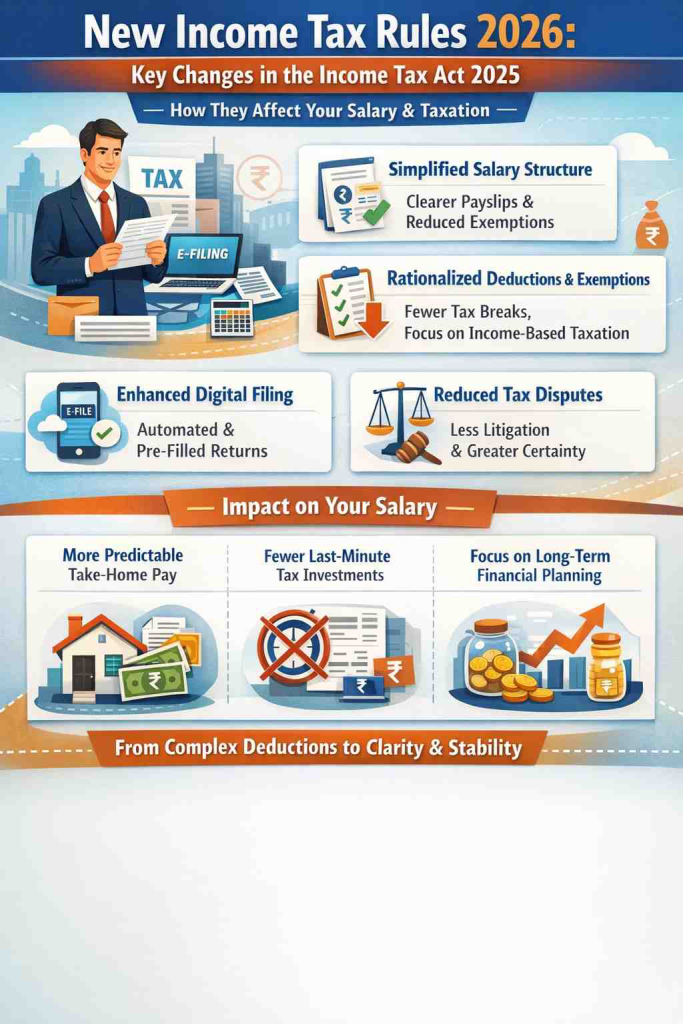
One of the most noticeable effects of the new tax rules in 2026 is the push toward clearer salary breakups. The law narrows the scope for aggressive structuring of pay packages purely to exploit tax exemptions. Several allowances that earlier enjoyed partial or conditional exemptions have been rationalized, encouraging employers to offer cleaner cost-to-company structures.
For employees, this means the gap between gross salary and taxable salary is now easier to understand. Monthly payslips are expected to reflect fewer ambiguous components, making tax deduction at source more accurate and reducing year-end surprises.
Deductions and Exemptions Move Toward Rationalisation
The new framework continues the long-term trend of gradually moving away from a deduction-heavy regime. While popular deductions linked to long-term savings and social security remain relevant, the emphasis is shifting from tax-saving behavior to income-based taxation with lower complexity.
This has a direct impact on salaried individuals who traditionally relied on last-minute investments to reduce tax liability. Under the 2026 rules, tax planning becomes less about paperwork and more about choosing a salary and investment strategy that aligns with long-term financial goals rather than short-term tax avoidance.
Standard Deduction and Employment Benefits Get Clarity
The treatment of standard deduction and employer-provided benefits has been clarified under the new Act to ensure uniform application across sectors. The law reduces interpretational gaps that earlier led to differing tax treatments for similar benefits in public and private employment.
Perquisites such as employer contributions, non-cash benefits, and reimbursements are more clearly defined, reducing disputes over valuation. This clarity helps salaried employees better estimate their annual tax outgo well in advance, aiding financial planning.
Digital Compliance Becomes the Default Experience
A significant change affecting salaried taxpayers in 2026 is the deeper integration of digital systems. Salary income, tax deducted at source, and investment declarations are increasingly pre-filled using data shared by employers, banks, and financial institutions. The new Act supports this ecosystem by aligning reporting timelines and standardizing disclosures.
As a result, the scope for mismatches between Form 16, annual information statements, and tax returns is reduced. For most salaried individuals, filing returns becomes more of a verification exercise rather than a complex compliance task.
Reduced Scope for Litigation, Greater Certainty for Employees
One of the understated but important outcomes of the Income Tax Act, 2025 is its focus on reducing litigation. By simplifying language and removing multiple exceptions, the law aims to cut down on disputes related to salary taxation. For employees, this means fewer notices, less anxiety, and lower dependence on professional intervention for routine tax matters.
This shift is particularly beneficial for middle-income earners, who often lack the resources to contest prolonged tax disputes despite having straightforward income profiles.
How Take-Home Pay Is Likely to Be Affected
The impact on take-home salary in 2026 will vary depending on income level and existing salary structure. Employees who relied heavily on exemptions may notice marginally higher taxable income, while those with simpler pay structures may see little change. However, the predictability of monthly deductions is expected to improve, reducing fluctuations caused by year-end adjustments.
More importantly, employees gain clarity. Knowing the tax impact upfront allows better budgeting and reduces the mental load associated with compliance.
A Shift in the Philosophy of Taxation
Beyond numbers, the new income tax rules reflect a philosophical shift. The government is signaling a move away from incentivizing specific financial behavior through tax exemptions and toward a neutral system where income is taxed with fewer conditions. For salaried individuals, this places greater emphasis on genuine wealth creation, career growth, and disciplined saving rather than tax-driven decisions.
What Salaried Taxpayers Should Do Next
As the 2026 regime settles in, employees would benefit from reviewing their salary structure, understanding revised payslip components, and aligning financial plans accordingly. The era of complex declarations and last-minute proofs is steadily fading, replaced by a cleaner and more transparent system.
The Income Tax Act, 2025 does not merely change how tax is calculated; it changes how salaried Indians interact with the tax system itself. For many, that shift could be the most meaningful reform of all.
Also read :Explained: How the Union Budget 2026–27 Will Impact Your Monthly Household Expenses and Savings
Add outlooknews.in as a preferred source on google – click here
Last Updated on: Thursday, February 5, 2026 10:05 am by Outlook News Team | Published by: Outlook News Team on Thursday, February 5, 2026 10:05 am | News Categories: Trending, Business
About The Author