
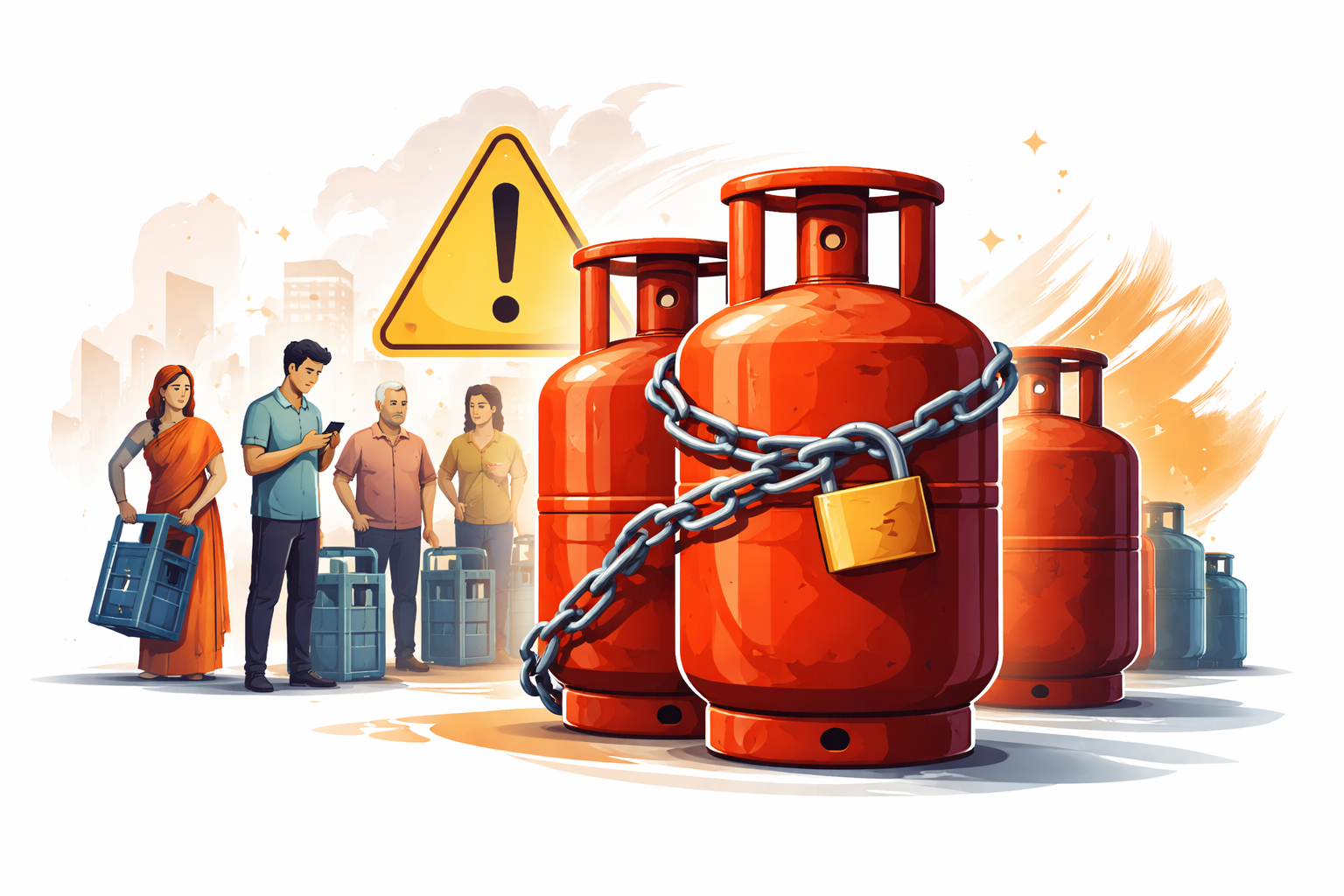
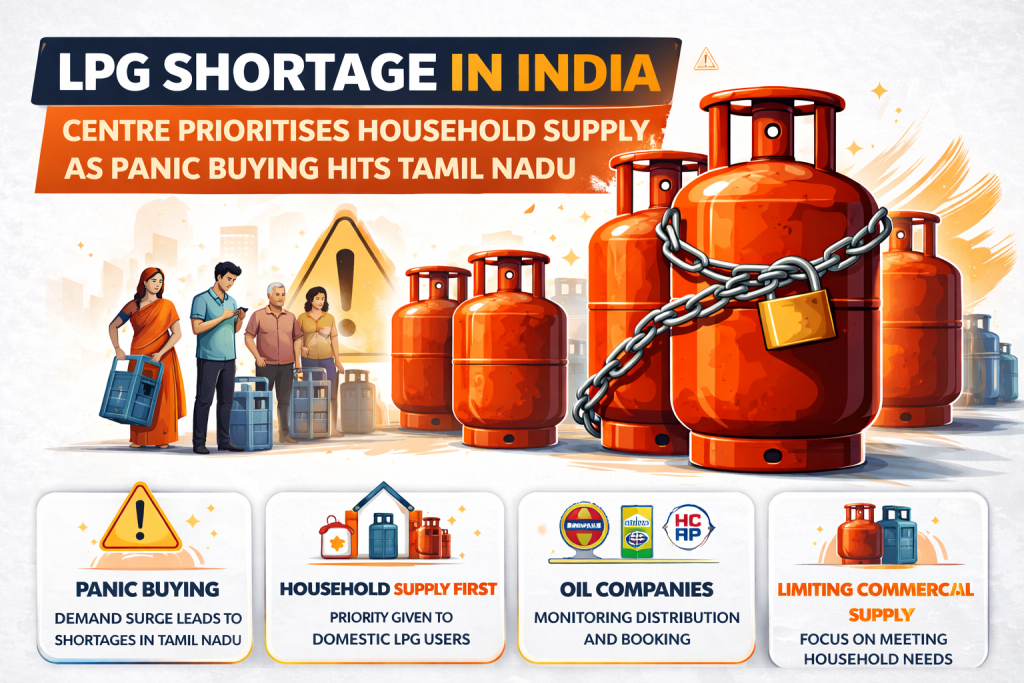
India’s central government has moved to prioritise household LPG supply after reports of panic buying and temporary shortages in parts of Tamil Nadu raised concerns among consumers and local distributors.
Officials said the situation was caused mainly by sudden demand spikes and panic bookings, rather than a nationwide shortage of cooking gas. Authorities have urged citizens not to hoard cylinders and assured that steps are being taken to stabilise supply.
The issue has drawn attention because liquefied petroleum gas (LPG) remains the primary cooking fuel for millions of Indian households. Any disruption in supply can quickly affect daily life, especially in urban and semi-urban areas.
Government agencies and oil marketing companies are now working to ensure that domestic LPG users receive priority access, while monitoring distribution networks in affected regions.
Panic Buying Triggers Temporary LPG Shortage in Tamil Nadu
Reports of LPG supply disruptions began emerging from several districts in Tamil Nadu, where consumers rushed to book additional cylinders.
Local distributors said that panic bookings and increased demand caused delays in deliveries in certain areas.
Retail outlets and LPG agencies experienced unusually high booking volumes within a short period. This surge placed pressure on distribution systems, leading to temporary shortages in some locations.
Officials clarified that the situation was not caused by a shortage of LPG stocks at the national level.
Instead, the main issue was localised demand spikes that disrupted the normal delivery cycle.
Authorities are now monitoring bookings closely to prevent misuse of the system.
Centre Prioritises Household LPG Supply
In response to the situation, the central government has instructed oil marketing companies to prioritise domestic LPG cylinder supply.
India’s LPG distribution network is largely managed by three state-owned oil marketing companies:
• Indian Oil Corporation
• Bharat Petroleum Corporation Limited
• Hindustan Petroleum Corporation Limited
These companies operate extensive supply chains that deliver cooking gas cylinders to millions of households across the country.
Officials said distributors have been advised to ensure timely deliveries to domestic consumers, especially in regions where demand has surged.
Commercial LPG supply for restaurants and businesses may be managed carefully to ensure that household needs remain the top priority.
Why LPG Supply Is Critical for Indian Households
LPG is one of the most widely used cooking fuels in India.
Government programs such as Pradhan Mantri Ujjwala Yojana have expanded access to LPG connections across rural and low-income households.
Under the scheme, millions of families received subsidised LPG connections to replace traditional cooking fuels like firewood and coal.
Because of this large user base, even small disruptions in LPG distribution can quickly affect households.
Consumers rely on regular cylinder deliveries for daily cooking needs.
Any delay in supply can therefore lead to anxiety and panic buying, which may further increase pressure on the system.
Authorities Urge Public to Avoid Panic Booking
Officials have appealed to consumers to avoid unnecessary bookings or stockpiling of LPG cylinders.
Panic buying can create artificial shortages in local markets, even when supply levels remain adequate.
Industry experts say that LPG distribution networks work best when demand follows predictable patterns.
Sudden spikes in bookings can overwhelm delivery systems, causing delays that may appear like supply shortages.
Authorities have reassured the public that LPG stocks remain sufficient at the national level.
Consumers are being encouraged to book cylinders only when needed.
How LPG Supply Chains Work in India
India has one of the largest LPG distribution systems in the world.
The supply chain includes several stages:
• Import and production of LPG
• Storage at large terminals and refineries
• Transportation to bottling plants
• Filling of cylinders
• Delivery to distributors and households
Oil marketing companies coordinate logistics across these stages to ensure steady supply.
In large states like Tamil Nadu, thousands of LPG distributors manage last-mile delivery.
When demand suddenly rises in a particular region, distribution schedules may require adjustments to restore normal supply.
Government Monitoring Distribution Networks
Officials said the government is closely monitoring LPG supply chains in affected areas.
Distribution data from oil marketing companies is being reviewed to track demand patterns and ensure that deliveries reach households quickly.
State authorities are also working with distributors to manage logistics and reduce delivery delays.
If necessary, additional supply may be routed to high-demand areas.
Such measures are common when temporary disruptions occur in essential commodity distribution.
Impact on Restaurants and Commercial Users
The government’s decision to prioritise domestic LPG supply may affect commercial users in the short term.
Restaurants, hotels, and food businesses rely heavily on commercial LPG cylinders for cooking operations.
In situations where household demand rises sharply, supply allocation may be adjusted to ensure that domestic consumers receive priority access.
However, officials have not announced any major restrictions on commercial LPG supply at this stage.
Industry observers say commercial demand is also monitored carefully to avoid disruptions to businesses.
Tamil Nadu’s High LPG Consumption
Tamil Nadu is among the states with high LPG consumption, due to its large urban population and extensive LPG penetration.
Most households in cities such as Chennai, Coimbatore, and Madurai rely on LPG for cooking.
The state also has a large number of restaurants and food businesses that use commercial LPG.
Because of this high demand, any sudden increase in bookings can place additional pressure on supply networks.
Authorities believe the current disruptions will ease once booking patterns return to normal.
Government Efforts to Stabilise Supply
Officials have outlined several measures to stabilise LPG supply in affected areas.
These include:
• Increasing delivery frequency in high-demand districts
• Monitoring unusual booking patterns
• Ensuring distributors prioritise household customers
• Coordinating supply between oil marketing companies
These steps aim to restore regular delivery schedules and reduce consumer anxiety.
Government agencies are also working with distributors to communicate accurate information to consumers.
Clear communication can help prevent panic buying and stabilise demand.
Digital Booking Systems Help Manage Demand
Most LPG bookings in India are now made through digital platforms, mobile apps, or automated phone systems.
These systems allow oil marketing companies to track booking volumes and identify unusual demand spikes.
Digital data helps authorities respond quickly when booking patterns change.
For example, if a particular district records an unusually high number of bookings, supply routes can be adjusted to increase deliveries.
Technology therefore plays an important role in maintaining the efficiency of India’s LPG distribution system.
Consumers Advised to Follow Normal Booking Cycles
Authorities have reminded consumers that LPG supply remains stable at the national level.
Households are encouraged to continue booking cylinders through normal channels without attempting to stockpile additional cylinders.
The government has emphasised that regular booking cycles will ensure smooth distribution for everyone.
Consumers can also contact their local LPG distributors or customer service centres for updates on delivery schedules.
Clear communication between distributors and customers is expected to help reduce panic.
What Happens Next
Officials expect the LPG supply situation in Tamil Nadu to stabilise as panic buying subsides and deliveries catch up with demand.
The central government and oil marketing companies continue to monitor distribution networks across the state.
India’s large LPG supply chain is designed to handle fluctuations in demand, and authorities say there is no nationwide shortage of LPG cylinders.
For consumers, the key message remains clear: avoid panic bookings and rely on regular supply channels.
With coordinated action between the government, oil companies, and local distributors, normal delivery schedules are expected to resume in affected regions soon.
Disclaimer: The information presented in this article is intended for general informational purposes only. While every effort is made to ensure accuracy, completeness, and timeliness, data such as prices, market figures, government notifications, weather updates, holiday announcements, and public advisories are subject to change and may vary based on location and official revisions. Readers are strongly encouraged to verify details from relevant official sources before making financial, investment, career, travel, or personal decisions. This publication does not provide financial, investment, legal, or professional advice and shall not be held liable for any losses, damages, or actions taken in reliance on the information provided.
Last Updated on: Thursday, March 12, 2026 1:50 pm by Outlook News Team | Published by: Outlook News Team on Thursday, March 12, 2026 1:50 pm | News Categories: India
About The Author