


Introduction: Infosys Tightens Hybrid Work Rules
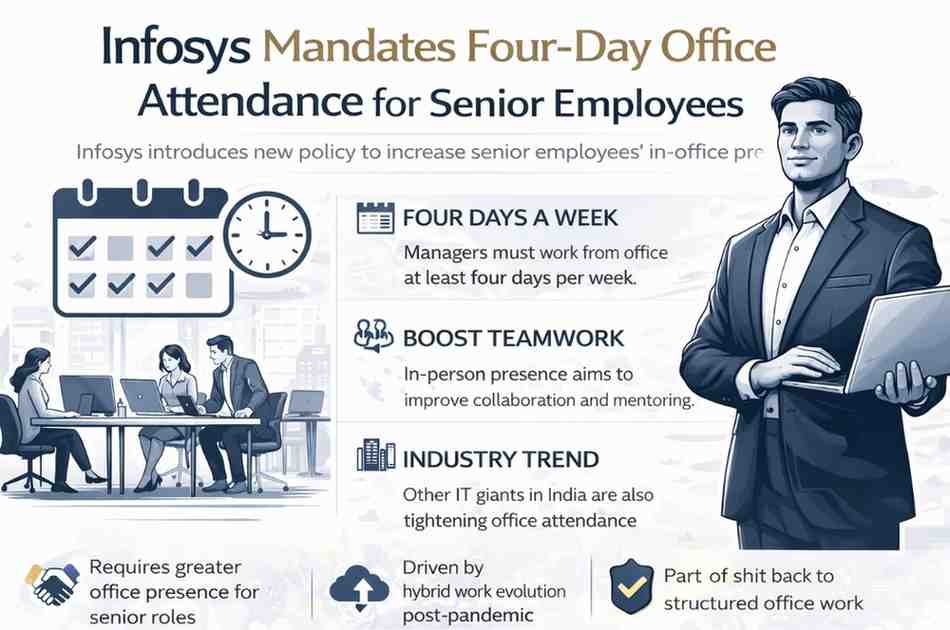
Infosys has asked its senior employees to work from the office for at least four days a week, signalling a stronger push toward in-person work across India’s IT sector.
The new policy applies mainly to senior leaders and managers, who are expected to be present in the office more frequently to guide teams, coordinate projects and strengthen workplace collaboration.
The move reflects a broader trend among technology companies that are gradually reducing fully remote work arrangements introduced during the pandemic.
For India’s IT workforce, the decision is significant because Infosys is one of the country’s largest technology employers. Any change in its workplace policy often influences practices across the wider industry.
The company believes that greater office presence can improve teamwork, mentoring and innovation, especially for large engineering teams working on complex technology projects.
Infosys’ New Office Attendance Policy Explained
Infosys now requires senior employees to work from the office for at least four days each week.
The directive is part of the company’s evolving hybrid work framework, which balances remote flexibility with regular in-office collaboration.
Key points of the policy include:
• Four days of office attendance per week for senior employees
• Managers expected to lead teams from physical workplaces
• Continued hybrid options for many junior and mid-level employees
The policy mainly affects employees who hold leadership or managerial responsibilities within the organisation.
Infosys believes these roles require greater face-to-face interaction with teams and clients.
Why Infosys Is Increasing Office Attendance
The company’s decision is linked to several operational priorities.
1. Stronger Team Collaboration
Large technology projects often involve multiple teams working together across departments.
Being physically present in the office can help employees:
• Discuss technical challenges faster
• Coordinate development work more easily
• Build stronger working relationships
Many companies say that in-person interaction improves problem solving and communication.
2. Mentoring Young Employees
India’s IT workforce includes a large number of young engineers who are at early stages of their careers.
Senior leaders play a key role in mentoring them.
Regular office presence allows experienced professionals to:
• Guide new employees
• Provide technical feedback
• Support training and development
3. Client Engagement
Infosys works with global clients in areas such as:
• Cloud computing
• Artificial intelligence
• Digital transformation
• Enterprise software services
Leadership teams often need to collaborate closely with both internal teams and clients.
The company believes that in-person leadership improves project coordination and delivery quality.
Infosys’ Hybrid Work Model After the Pandemic
Like most technology companies, Infosys adopted remote work during the COVID-19 pandemic.
At the height of the pandemic, a majority of its employees worked from home as offices across India remained closed.
After restrictions eased, the company gradually introduced a hybrid model that allows employees to split time between home and office.
The model typically includes:
• A few days of office work each week
• Flexibility depending on project requirements
• Different rules for different roles
The new four-day rule for senior employees represents a shift toward more structured office attendance.
Infosys Workforce and Global Presence
Infosys is one of India’s largest IT services companies.
The Bengaluru-based firm employs more than 300,000 people worldwide, with a significant portion of its workforce based in India.
The company provides services to businesses across industries including:
• Banking and financial services
• Healthcare
• Retail and e-commerce
• Manufacturing
• Telecommunications
Its major development centres are located in cities such as:
• Bengaluru
• Hyderabad
• Pune
• Chennai
• Mysuru
Given the size of its workforce, changes in workplace policy can affect thousands of employees.
Return-to-Office Trends Across the IT Industry
Infosys is not the only technology company tightening office attendance policies.
Several major IT firms have already introduced stricter return-to-office guidelines.
Industry Trends
Across India’s IT sector, companies are increasingly asking employees to spend three to four days a week in the office.
Industry leaders say this approach helps maintain:
• Organisational culture
• Innovation and brainstorming
• Faster project delivery
Global technology companies such as Microsoft, Amazon and Google have also moved toward structured hybrid work policies.
Balancing Flexibility and Productivity
Many companies now believe the future workplace will combine:
• Office collaboration
• Remote flexibility
Hybrid work models attempt to balance both.
However, leadership roles often require greater physical presence, which is why companies are tightening rules for senior employees first.
Employee Perspectives on Return-to-Office Policies
Return-to-office mandates have triggered mixed reactions among employees across the technology industry.
Advantages of Office Work
Some employees support regular office attendance because it provides:
• Better collaboration with colleagues
• Clear separation between work and home life
• Opportunities for networking and mentorship
Challenges of Increased Office Days
Others say frequent office attendance can create challenges such as:
• Long commuting times in major cities
• Higher daily expenses
• Less flexibility for personal schedules
Technology companies are therefore trying to balance operational needs with employee expectations.
Impact on Workplace Culture
Infosys leadership believes stronger office presence can help rebuild workplace culture after years of remote work.
Physical workplaces allow employees to:
• Participate in brainstorming sessions
• Interact with colleagues across teams
• Build stronger organisational connections
Many companies say these interactions are difficult to fully replicate through video meetings.
Office environments also support:
• Training programs
• Innovation labs
• Team-building activities
Role of Senior Leaders in Hybrid Workplaces
The new policy focuses on senior employees because leadership visibility is considered important for organisational success.
Managers and senior engineers often guide large teams and oversee critical projects.
Their presence in the office can help:
• Address technical challenges quickly
• Provide real-time guidance to teams
• Improve decision-making speed
Infosys believes that leadership presence plays a major role in maintaining productivity and project quality.
India’s IT Sector and Workplace Evolution
India’s technology sector is one of the largest employers in the country.
Companies are constantly adjusting workplace models as the industry evolves.
Major factors influencing these changes include:
• Global client expectations
• Digital transformation projects
• Competition for skilled talent
• Advances in remote collaboration technology
Hybrid work arrangements are expected to remain common in the industry, but companies are increasingly defining clearer rules about office attendance.
What the Policy Means for the Future of Work
Infosys’ decision highlights a broader shift in how companies are thinking about workplace structure.
Key trends likely to shape the future of work include:
Hybrid Work as the Standard
Most large technology firms are expected to continue hybrid work rather than returning fully to traditional office models.
Greater Office Presence for Leadership Roles
Senior employees may be required to work from the office more frequently to support teams.
Flexible Policies for Technical Roles
Many engineering and development roles may continue to allow some remote flexibility.
Companies are still experimenting with the best balance between flexibility and productivity.
Conclusion: Infosys Signals a New Phase in Hybrid Work
Infosys’ four-day office attendance rule for senior employees marks an important step in the evolution of hybrid work in India’s IT industry.
The policy reflects the company’s belief that leadership presence, collaboration and mentoring are easier to achieve through regular office interaction.
While hybrid work remains an important part of modern workplaces, companies are increasingly redefining how and when employees should be physically present.
For India’s technology sector, Infosys’ decision may influence how other firms design their workplace policies in the coming years.
As organisations continue to adapt to post-pandemic work patterns, the balance between flexibility and in-person collaboration will remain one of the most important challenges for employers and employees alike.
Disclaimer: The information presented in this article is intended for general informational purposes only. While every effort is made to ensure accuracy, completeness, and timeliness, data such as prices, market figures, government notifications, weather updates, holiday announcements, and public advisories are subject to change and may vary based on location and official revisions. Readers are strongly encouraged to verify details from relevant official sources before making financial, investment, career, travel, or personal decisions. This publication does not provide financial, investment, legal, or professional advice and shall not be held liable for any losses, damages, or actions taken in reliance on the information provided.
Last Updated on: Friday, March 6, 2026 3:43 pm by Outlook News Team | Published by: Outlook News Team on Friday, March 6, 2026 3:43 pm | News Categories: Tech
About The Author