
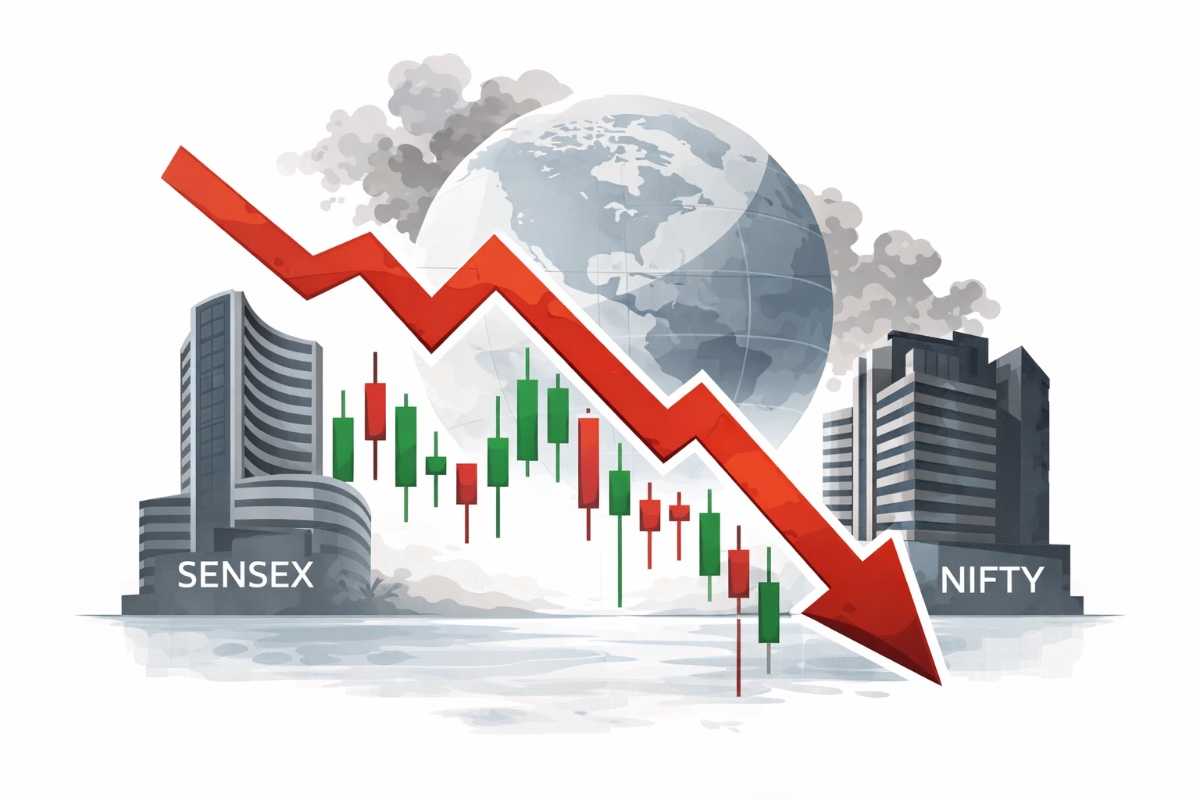
Sensex and Nifty Face Pressure as Global Cues Turn Uncertain
The Indian stock market is expected to open cautious on February 27, 2026, as investors react to mixed global signals and continued volatility in international markets. Traders are closely watching key support levels in benchmark indices amid uncertainty driven by global economic concerns, commodity price swings, and foreign institutional investor (FII) activity.
For Indian investors, today’s session is important. The direction taken by the BSE Sensex and the Nifty 50 could set the tone for the final trading days of February.
Market participants are advised to track global cues, domestic institutional flows, and technical support zones before making fresh positions.
Global Volatility Weighs on Sentiment
Overnight developments in global markets have added to uncertainty.
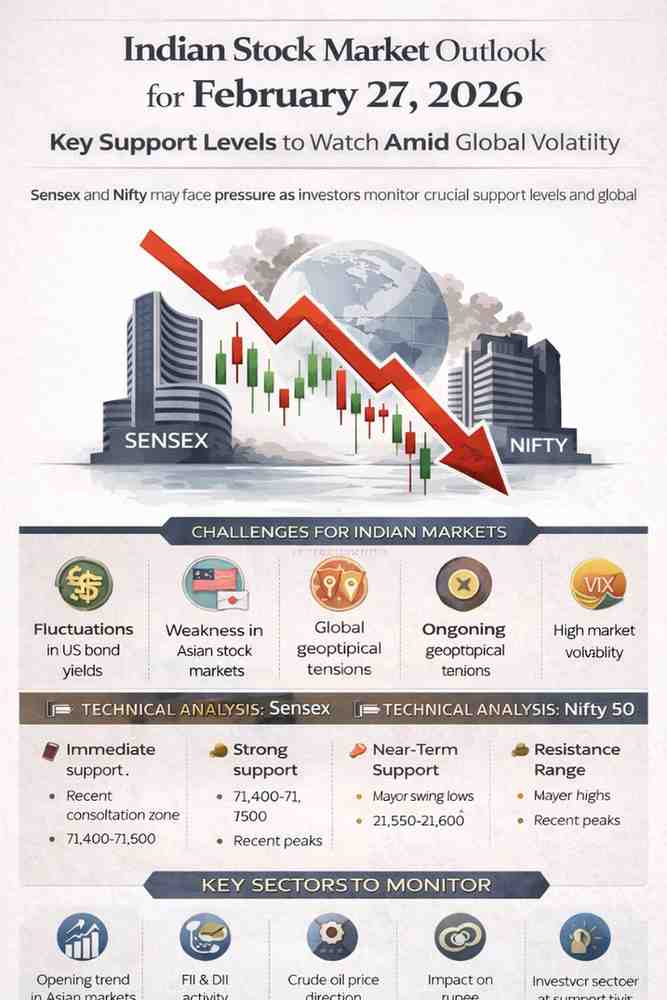
Key Global Factors Impacting Indian Markets
- Fluctuations in US bond yields
- Mixed closing on Wall Street
- Weakness in select Asian markets
- Ongoing geopolitical tensions
- Commodity price volatility
Global risk appetite remains fragile. When overseas markets show instability, Indian equities often react with higher intraday swings.
Foreign portfolio investors play a significant role in short-term market direction. Sustained FII selling can pressure benchmark indices, especially large-cap stocks.
Previous Trading Session Recap
In the last session, benchmark indices traded in a narrow but volatile range.
- The Sensex saw fluctuations driven by banking and IT stocks.
- The Nifty 50 tested short-term support levels before recovering late in the session.
Midcap and smallcap indices showed mixed performance, indicating selective buying interest.
Market breadth remained balanced, suggesting that investors are cautious rather than fully risk-averse.
Technical Outlook: Key Support and Resistance Levels
Technical analysts are closely watching important support zones.
Nifty 50 Levels to Watch
- Immediate support: Near recent swing lows
- Strong support: Around key psychological levels
- Resistance: Near recent highs
If Nifty holds above its immediate support, a short-term recovery is possible. However, a decisive break below support could trigger fresh selling pressure.
Sensex Technical View
- Short-term support: Previous consolidation zone
- Major support: Lower band of recent trading range
- Resistance: Recent peak levels
Traders should watch price action near these levels. Volatility may remain elevated throughout the session.
Sectoral Trends to Monitor
Sectoral performance will be crucial in determining overall direction.
Banking and Financial Stocks
Banking stocks often lead market movement. Any sharp move in private banks can influence both Sensex and Nifty.
Investors will monitor:
- Credit growth data
- Bond yields
- RBI policy signals
IT Sector
The IT sector is sensitive to global trends, especially US market movements. Weakness in US tech stocks can impact Indian IT counters.
Energy and Oil & Gas
Crude oil price volatility affects energy stocks and inflation outlook. Any sharp spike in oil prices could pressure broader markets.
Auto and FMCG
Defensive sectors such as FMCG may see selective buying if broader market weakness continues.
Role of FIIs and DIIs
Foreign Institutional Investors (FIIs) and Domestic Institutional Investors (DIIs) often drive short-term trends.
- FII outflows can increase volatility.
- DII buying can provide stability during corrections.
Tracking institutional activity during the session will be important.
Impact of Currency and Bond Markets
The Indian rupee’s movement against the US dollar is another key factor.
A weaker rupee can:
- Increase import costs
- Affect inflation outlook
- Pressure certain sectors
Bond yields also influence equity markets. Rising yields can make equities less attractive compared to fixed-income investments.
Monthly Expiry and Volatility
With February nearing its end, traders are also watching derivative positions.
Options data may show:
- Heavy open interest at certain strike prices
- Increased hedging activity
- Higher volatility premiums
Expiry-related movements can lead to sharp intraday swings.
What Retail Investors Should Do
In volatile conditions, experts often recommend a disciplined approach.
Key Strategies
- Avoid panic selling
- Follow stop-loss levels
- Focus on quality stocks
- Avoid excessive leverage
- Maintain diversified portfolios
Long-term investors may consider staggered buying in fundamentally strong companies if markets see sharp corrections.
Economic Data and Upcoming Events
Investors will also track:
- Domestic macroeconomic indicators
- Global economic releases
- Central bank commentary
Any surprise data could influence intraday momentum.
Midcap and Smallcap Outlook
Broader market indices have shown relative resilience in recent sessions.
However, midcaps and smallcaps tend to react more sharply during global uncertainty.
Investors should remain selective and avoid chasing momentum-driven stocks.
Short-Term vs Long-Term Market View
Short-Term Outlook
- Volatility likely to remain elevated
- Support levels crucial for stability
- Global cues may dominate sentiment
Long-Term View
India’s structural growth story remains intact, supported by:
- Strong domestic consumption
- Infrastructure spending
- Digital expansion
- Manufacturing growth
Short-term volatility does not necessarily alter long-term fundamentals.
Key Market Triggers for Today
On February 27, 2026, traders should monitor:
- Opening trend in Asian markets
- FII and DII activity
- Crude oil price movement
- Rupee direction
- Price action near support levels
A stable opening above key technical support could calm investor nerves.
Why Today’s Session Is Important
The final sessions of the month often influence portfolio rebalancing decisions.
Institutional investors may adjust positions ahead of month-end.
Holding above major support levels can improve sentiment going into March.
Final Outlook: Cautious but Watchful
The Indian stock market outlook for February 27, 2026 remains cautious amid global volatility.
Key support levels in the Sensex and Nifty will determine near-term direction.
Investors are advised to stay disciplined, avoid emotional decisions, and focus on data-driven strategies.
While global uncertainty may drive short-term swings, India’s broader economic outlook continues to provide a stable foundation.
Markets may remain range-bound unless a strong trigger emerges.
Stay tuned for live market updates as trading begins.
Disclaimer: The information presented in this article is intended for general informational purposes only. While every effort is made to ensure accuracy, completeness, and timeliness, data such as prices, market figures, government notifications, weather updates, holiday announcements, and public advisories are subject to change and may vary based on location and official revisions. Readers are strongly encouraged to verify details from relevant official sources before making financial, investment, career, travel, or personal decisions. This publication does not provide financial, investment, legal, or professional advice and shall not be held liable for any losses, damages, or actions taken in reliance on the information provided.
Last Updated on: Friday, February 27, 2026 4:53 pm by Outlook News Team | Published by: Outlook News Team on Friday, February 27, 2026 4:52 pm | News Categories: News
About The Author