

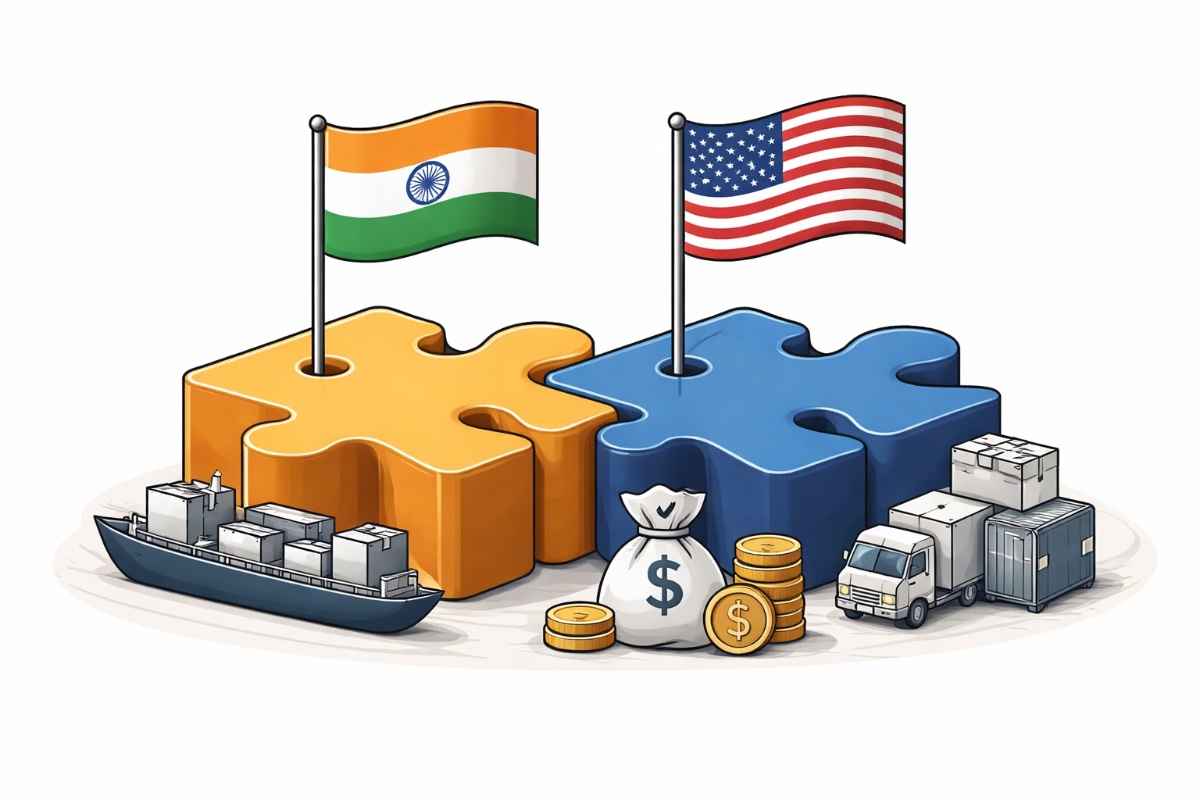
India’s trade negotiations with the United States are back in focus after Union Commerce and Industry Minister Piyush Goyal responded to recent US tariff-related remarks using a cricket analogy.
The statement comes at a crucial stage as both countries work towards a proposed India-US Trade Pact in 2026, aimed at strengthening bilateral trade and resolving long-standing market access issues.
The exchange has drawn attention not just for its tone, but for what it signals about India’s negotiating position at a time of shifting global trade dynamics.
Why This Matters Right Now
India and the US are among each other’s largest trading partners.
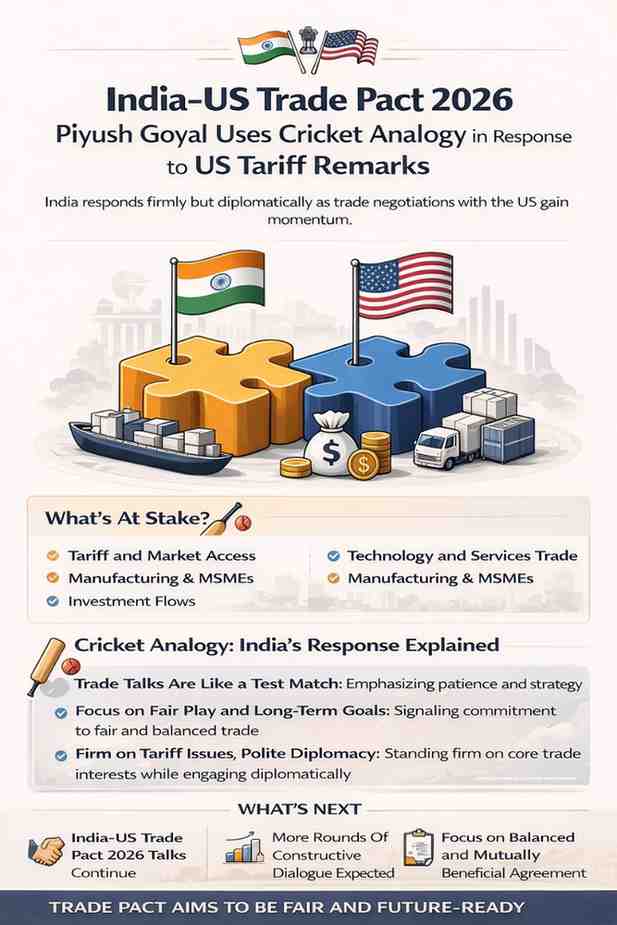
Any friction over tariffs, market access, or trade rules can have a direct impact on:
- Indian exporters
- Manufacturing and MSMEs
- Technology and services trade
- Investment flows
With negotiations underway for a new-generation trade framework, the remarks highlight how both sides are balancing domestic interests with strategic ties.
What Triggered the Latest Exchange
The comments came after US officials raised concerns on tariff structures and trade barriers affecting American exports to India.
In response, Piyush Goyal used a cricket analogy to underline that trade talks must be viewed as a long game, not a single delivery or over.
Officials familiar with the matter say the analogy was meant to stress:
- Patience in negotiations
- Mutual respect for each side’s strengths
- The need for fair play in trade discussions
Cricket Analogy Explained: What the Minister Meant
Trade Talks Are a Test Match, Not a T20
By using cricket as a reference point, the minister conveyed that:
- Trade agreements take time
- Sudden pressure does not lead to lasting outcomes
- Both sides must play by agreed rules
For Indian audiences, the analogy resonated as cricket is often seen as a game of strategy, endurance, and balance.
Message to Global Partners
The subtext of the remark was clear:
India will not rush into trade concessions that hurt domestic industry.
At the same time, the government signalled that it remains open to constructive dialogue.
Status of the India-US Trade Pact 2026
What Is Being Negotiated
The proposed trade pact aims to address:
- Tariff and non-tariff barriers
- Market access for goods and services
- Digital trade rules
- Supply chain cooperation
- Ease of doing business
Both sides are working towards a balanced and mutually beneficial framework.
Why 2026 Is a Key Target Year
Officials have indicated that 2026 is being viewed as a realistic timeline, considering:
- The scale of the agreement
- Political calendars in both countries
- The need for stakeholder consultations
This also aligns with broader global trade realignments.
India’s Stand on Tariffs
India has consistently defended its tariff structure, arguing that:
- Tariffs protect sensitive sectors
- Developing economies need policy space
- One-size-fits-all trade rules are not fair
The government has also highlighted that India has reduced tariffs in several sectors over the years, while expanding trade volumes.
US Concerns and Expectations
From the US perspective, key concerns include:
- High import duties on select products
- Regulatory barriers
- Predictability in trade policy
American businesses have sought greater access to India’s large consumer market, especially in agriculture, medical devices, and technology products.
How Big Is India-US Trade Today
Bilateral trade between India and the US runs into hundreds of billions of dollars annually.
The partnership covers:
- Goods trade
- IT and professional services
- Defence and aerospace
- Energy cooperation
The US remains one of India’s top export destinations.
Why the Tone of the Response Matters
Firm but Not Confrontational
Trade experts note that the cricket analogy helped:
- Lower the temperature of the debate
- Avoid sharp diplomatic language
- Keep negotiations on track
It reflects India’s approach of being firm on interests, but polite in diplomacy.
Domestic Signal to Indian Industry
The response also reassured Indian businesses that:
- Their concerns are being heard
- Sudden tariff cuts are unlikely
- Negotiations will protect core sectors
This is especially important for MSMEs and manufacturing units.
Global Context: Trade Talks in a Changing World
The India-US trade discussions are happening amid:
- Rising protectionism globally
- Supply chain diversification
- Strategic competition between major economies
India is positioning itself as a reliable trade partner, while safeguarding economic sovereignty.
What Experts Are Saying
Trade analysts believe that:
- Analogies aside, negotiations remain complex
- Real progress will depend on sector-wise compromises
- Political will on both sides is critical
They also point out that incremental deals may precede a broader pact.
What Happens Next
More Rounds of Talks Expected
Officials from both sides are expected to:
- Continue technical-level discussions
- Engage industry stakeholders
- Narrow down contentious issues
No formal deadline has been announced, but momentum is building.
Focus on Practical Outcomes
Rather than grand announcements, negotiators are focusing on:
- Reducing friction points
- Improving predictability
- Building trust step by step
Why This Matters for Indian Consumers and Businesse
If successful, the trade pact could lead to:
- Better export opportunities
- Stable trade rules
- Stronger investment flows
- Deeper technology collaboration
However, safeguards will be key to ensure domestic industries are not disrupted.
Big Picture: Strategy Over Speed
The cricket analogy captures India’s broader trade philosophy:
Play a steady game. Protect the wicket. Build partnerships for the long run.
In an era of fast-moving geopolitics, India is signalling that trade deals must be durable, not hurried.
Bottom Line
Piyush Goyal’s response to US tariff remarks was more than a soundbite.
It reflected India’s intent to engage, but on its own terms, as negotiations for the India-US Trade Pact 2026 move forward.
The coming months will show whether both sides can convert dialogue into a balanced and future-ready trade agreement that works for businesses and consumers in both countries.
Disclaimer: The information presented in this article is intended for general informational purposes only. While every effort is made to ensure accuracy, completeness, and timeliness, data such as prices, market figures, government notifications, weather updates, holiday announcements, and public advisories are subject to change and may vary based on location and official revisions. Readers are strongly encouraged to verify details from relevant official sources before making financial, investment, career, travel, or personal decisions. This publication does not provide financial, investment, legal, or professional advice and shall not be held liable for any losses, damages, or actions taken in reliance on the information provided.
Last Updated on: Tuesday, February 10, 2026 11:11 am by Outlook News Team | Published by: Outlook News Team on Tuesday, February 10, 2026 11:11 am | News Categories: Business
About The Author