

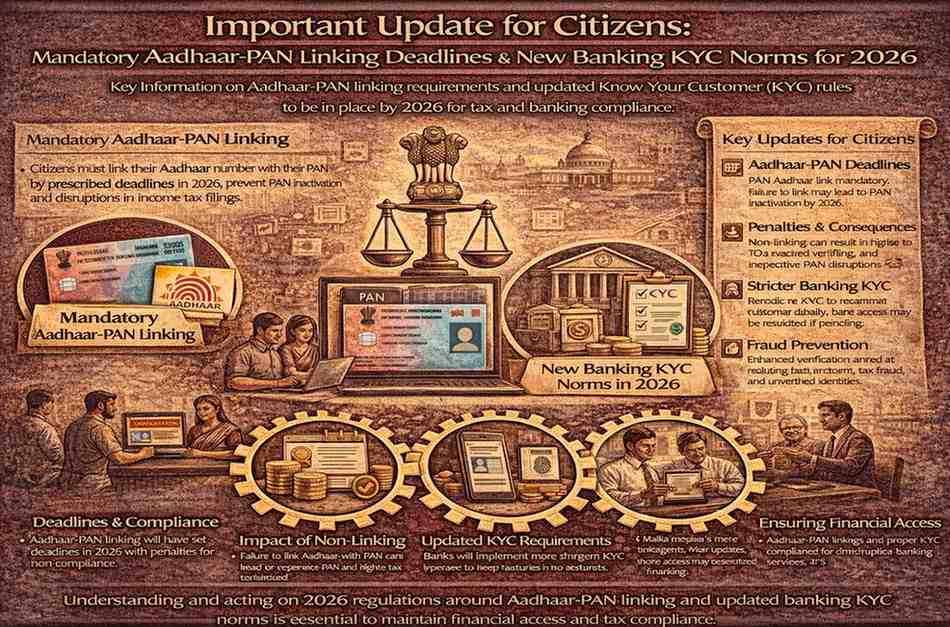
India’s compliance landscape is entering a tighter, more digitised phase as authorities push for stronger identity verification, cleaner financial records, and improved fraud prevention. Two developments are especially significant for citizens in 2026: mandatory Aadhaar–PAN linking and updated banking Know Your Customer (KYC) norms. Together, these measures aim to streamline tax administration, strengthen financial integrity, and ensure that government services reach the intended beneficiaries. For individuals, however, they also bring clear deadlines and compliance responsibilities that cannot be ignored.
Why Aadhaar-PAN Linking and KYC Rules Are Being Tightened
Over the past decade, India has built a digital public infrastructure that relies heavily on verified identity. Linking Aadhaar with PAN and strengthening banking KYC norms are part of a broader effort to reduce tax evasion, prevent money laundering, and eliminate duplicate or fake identities in the financial system.
Authorities have repeatedly flagged gaps in identity verification as a risk to both revenue collection and financial security. The 2026 updates reflect a shift from voluntary or phased compliance to a more enforceable framework, where non-compliance can directly impact financial access and tax-related transactions.
What Aadhaar-PAN Linking Means for Citizens
Aadhaar-PAN linking requires individuals to link their Permanent Account Number with their Aadhaar number. PAN is essential for tax filings, high-value financial transactions, and investments, while Aadhaar serves as a universal identity proof.
The linking process enables authorities to cross-verify income, prevent multiple PANs held by the same individual, and improve the accuracy of tax data. For citizens, this means that PAN-related services increasingly depend on successful Aadhaar authentication.
Mandatory Deadlines and Penalties in 2026
By 2026, Aadhaar-PAN linking is no longer a soft compliance requirement. Deadlines have been clearly communicated, and failure to link within the prescribed timeframe can lead to PAN becoming inoperative.
An inoperative PAN can disrupt a wide range of activities, including filing income tax returns, opening new bank accounts, investing in mutual funds, or conducting certain high-value transactions. Penalties for delayed linking may also apply, reinforcing the importance of timely compliance.
Impact on Income Tax Filings and Financial Transactions
Once PAN becomes inoperative due to non-linking, taxpayers may face higher tax deductions at source, difficulty in claiming refunds, and rejection of returns. Financial institutions may also refuse transactions that require a valid PAN.
For salaried individuals, professionals, and small business owners, this can have cascading effects on cash flow and compliance. The 2026 framework leaves little room for last-minute corrections, making proactive action essential.
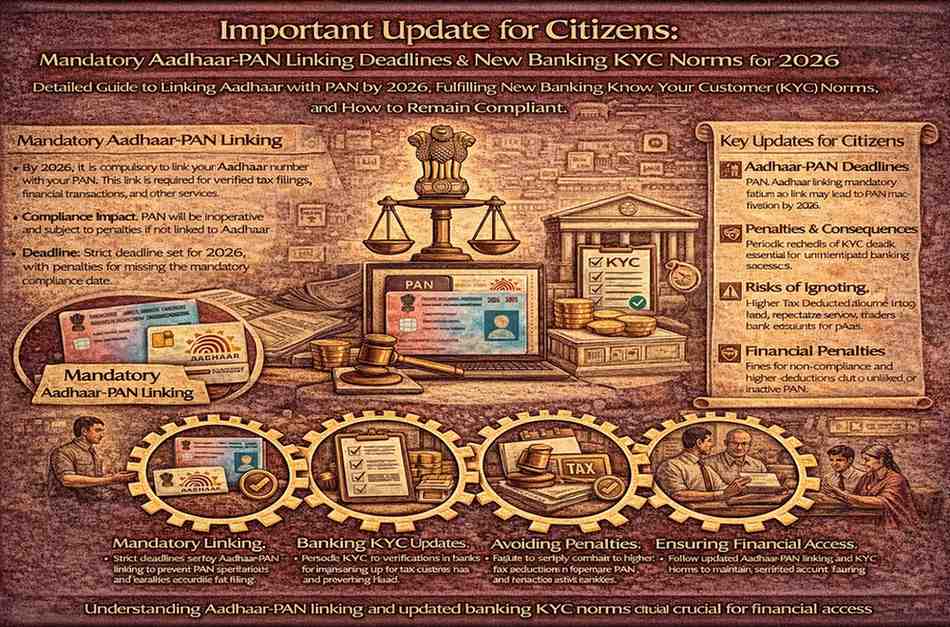
New Banking KYC Norms Explained
Alongside Aadhaar-PAN linking, banking KYC norms are being updated to reflect changing risk profiles and digital usage patterns. Banks and financial institutions are required to maintain up-to-date customer information, including identity, address, and contact details.
The revised norms emphasise periodic KYC updates, especially for accounts that have been inactive, flagged for discrepancies, or linked to higher-risk transactions. Digital KYC processes are being expanded, but the responsibility for accuracy ultimately rests with the customer.
What Changes Under the 2026 KYC Framework
Under the updated KYC rules, customers may be asked to reconfirm or update their details even if their accounts are long-standing. Aadhaar-based e-KYC, video KYC, and secure digital document submission are expected to become the default modes.
Banks are also required to apply stricter monitoring for accounts with incomplete or outdated KYC. In some cases, services such as withdrawals, transfers, or credit facilities may be restricted until KYC compliance is completed.
Link Between Aadhaar, PAN, and Banking Access
The Aadhaar-PAN linkage increasingly acts as a backbone for banking compliance. Many banks rely on PAN for tax reporting and Aadhaar for identity verification. When these records are not linked or are inconsistent, accounts may be flagged for review.
This integration reflects a policy push toward a unified financial identity. While it improves system-wide transparency, it also means that lapses in one area can affect access across multiple services.
Special Implications for Senior Citizens and Rural Users
Authorities have acknowledged that certain groups may face challenges in meeting digital compliance requirements. Senior citizens, individuals in rural areas, and those with limited digital literacy may need additional support.
Banks and government agencies are expected to provide assisted modes of KYC and linking, including offline options where feasible. However, the responsibility to initiate and complete the process still lies with the individual or their authorised representative.
Role of Banks and Government Agencies
Banks act as the front line in enforcing KYC norms, while tax authorities oversee Aadhaar-PAN linking. Institutions are required to notify customers, provide clear instructions, and offer reasonable opportunities to comply before imposing restrictions.
Policy oversight and implementation guidance come from bodies such as the Reserve Bank of India and the Income Tax Department, while Aadhaar-related processes are managed by the Unique Identification Authority of India.
What Citizens Should Do Now
Citizens should verify the status of their Aadhaar-PAN linkage and complete it immediately if pending. It is equally important to check KYC status with banks, especially for older accounts that may not have been updated recently.
Keeping personal details consistent across Aadhaar, PAN, and bank records reduces the risk of flags or service disruptions. Citizens should also be cautious of fraud and use only official portals or bank channels for compliance activities.
Risks of Ignoring the 2026 Compliance Updates
Ignoring Aadhaar-PAN linking deadlines or KYC update requests can result in operational inconvenience and financial exclusion. From frozen accounts to higher tax deductions and blocked transactions, the consequences can be significant.
As systems become more automated, exceptions and manual interventions are likely to reduce. Compliance delays that were once manageable may no longer be easily resolved.
The Bigger Picture
Mandatory Aadhaar-PAN linking and updated banking KYC norms reflect India’s move toward a more transparent, accountable, and digitally governed financial system. For the government, these measures improve oversight and efficiency. For citizens, they offer long-term benefits such as reduced fraud and faster service delivery, but only if compliance is timely and accurate.
The important update for citizens in 2026 is clear: identity and financial compliance are now deeply interconnected. Staying informed, acting early, and maintaining accurate records will be essential to ensuring uninterrupted access to banking, taxation, and government services in the years ahead.
Add outlooknews.in as preferred source on google – click here
Last Updated on: Wednesday, January 28, 2026 12:40 pm by Outlook News Team | Published by: Outlook News Team on Wednesday, January 28, 2026 12:40 pm | News Categories: India
About The Author