

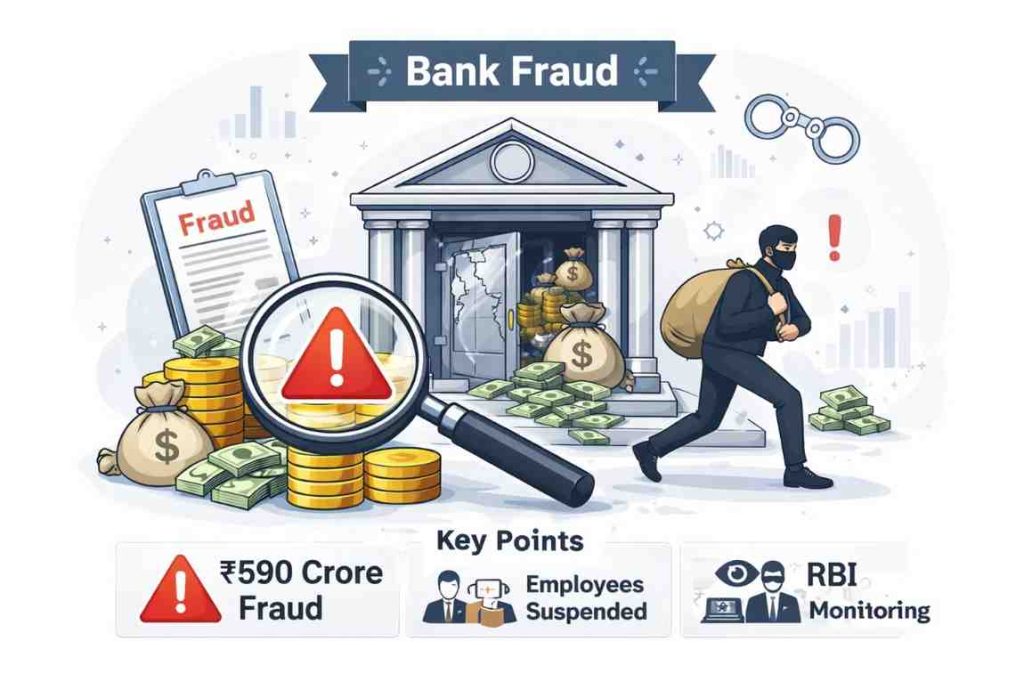
The discovery of a suspected ₹590 crore fraud at IDFC First Bank linked to government accounts in Haryana has triggered a major banking sector alert in India. This news matters to depositors, investors, and regulators, as it raises questions about internal controls, governance practices, and public trust in private banks. The incident has already led to employee suspensions, forensic audits, de-empanelment by the Haryana government, and close attention from the Reserve Bank of India (RBI).
What Happened: ₹590 Crore Fraud Unearthed at Chandigarh Branch
IDFC First Bank disclosed that an internal review uncovered suspected fraudulent and unauthorized transactions totalling about ₹590 crore in accounts linked to the Government of Haryana at its Chandigarh branch. The irregularities first came to light when a Haryana government department requested closure of an account and transfer of funds, but large discrepancies were found between the actual balances and records.
The bank said the suspected fraud resulted from unauthorized activities by certain employees and possibly others. As a result:
- Four bank employees have been suspended pending investigation.
- A police complaint has been filed by the bank.
- An independent forensic audit has been ordered to establish the full extent and details.
Immediate Government Action: Haryana De-Empanels Bank
Following the disclosure, the **Government of Haryana issued a circular on ** 23 February 2026 de-empanelling IDFC First Bank and another lender – AU Small Finance Bank – from all government business. This means that:
- No future government funds will be parked, deposited, invested, or transacted through these banks.
- All departments have been instructed to close existing accounts and transfer balances immediately.
This action reflects serious concern within the state administration about deposit safety and operational oversight.
RBI Response: No Systemic Risk, But Monitoring Closely
The Reserve Bank of India has publicly stated that it does not see any systemic threat to the Indian banking system due to this fraud case. Instead, the central bank emphasised that it is actively watching developments and engaging with the bank and regulators to ensure proper resolution and preventive safeguards.
This assurance is meant to calm market fears and reassure depositors that the broader financial system remains sound.
Market Impact: Shares Hit Lower Circuit
The revelation of the fraud had an immediate and severe impact on market sentiment:
- IDFC First Bank’s **stock plunged by up to ** 20% on 23 February 2026, hitting the lower circuit limit on the stock exchanges.
- This dramatic drop wiped out significant shareholder wealth, and investor confidence took a major hit amid governance concerns.
Major institutional investors, including the Government of India and the Life Insurance Corporation of India (LIC), suffered substantial notional losses due to the stock’s fall in value.
Bank’s Actions and Next Steps
In response to the fraud discovery, the bank has taken multiple measures:
Forensic Audit and Investigation
The bank has appointed a professional agency to perform a detailed forensic audit. This review aims to reveal the full sequence of irregularities, determine whether external parties were involved, and identify control failures.
Legal Process and Recovery Efforts
In addition to police complaints, the bank is expected to pursue disciplinary actions and civil and criminal proceedings as warranted. It is also working on recovery mechanisms to limit financial loss.
Regulatory Compliance and Reporting
IDFC First Bank has informed statutory auditors and relevant regulators about the incident. The bank is cooperating with ongoing investigations by law enforcement and financial authorities.
What This Means for Depositors and Customers
Despite public concern sparked by the case, the RBI’s assertion that there is no systemic risk to the banking sector is crucial. Depositors’ core savings and fixed deposits are subject to deposit insurance up to ₹5 lakh under the Deposit Insurance and Credit Guarantee Corporation (DICGC) scheme. This scheme protects individual savings in the event of bank failure, not operational fraud. However, most retail customers are not directly affected by the specific accounts linked to the fraud.
Still, many customers have expressed anxiety on social media about deposit safety, illustrating how impactful fraud cases can be on general public confidence in banks.
Sector Perspective: Governance and Controls Under Scrutiny
This fraud case raises broader questions about internal controls and risk management in private sector banks:
- Financial regulators such as the RBI have strict guidelines on fraud monitoring, reporting and mitigation.
- Governance lapses can significantly impact investor sentiment, often more than the absolute size of the underlying loss.
Analysts note that the suspected fraudulent amount, while serious, represents only a small share of the bank’s overall size. Nonetheless, the involvement of government-linked accounts and employee collusion intensifies scrutiny.
Background: How the Fraud Was Detected
According to multiple reports, the irregularities surfaced when a Haryana government department sought to close its account. Revaluation showed discrepancies between reported balances and actual funds. From that point, additional mismatches were found in other related accounts, triggering deeper internal reviews and revealing the suspected ₹590 crore fraud.
The fact that detection occurred during routine reconciliation rather than external audit highlights the need for robust and regular internal control mechanisms.
Looking Ahead: Regulatory Oversight and Industry Impact
The RBI’s close monitoring and rapid government action indicate that regulators will likely require stronger governance frameworks and improved risk controls in banks of all sizes. The Maharashtra government’s de-empanelment order also signals that state administrations are taking deposit safety seriously.
Industry bodies and banking watchdogs are expected to study this case to develop guidelines that prevent similar incidents. This could lead to new compliance mandates or tighter oversight, especially for accounts tied to public funds.
Conclusion
The disclosure of a suspected ₹590 crore fraud at IDFC First Bank involving Haryana government-linked accounts is a significant event in India’s banking sector. It has led to:
- Employee suspensions
- Forensic audits
- Government de-empanelment
- A sharp market reaction
- RBI monitoring
While the RBI has assured that there is no systemic threat, the episode underscores the importance of internal controls, transparency and depositor confidence in financial institutions.
This incident will likely lead to further regulatory and operational reforms, as financial authorities seek to strengthen safeguards and restore trust in banking governance.
For bank customers, investors, and the public, ongoing updates from IDFC First Bank, law enforcement and regulators will be crucial in understanding the full impact and final outcomes of the investigation.
Disclaimer: The information presented in this article is intended for general informational purposes only. While every effort is made to ensure accuracy, completeness, and timeliness, data such as prices, market figures, government notifications, weather updates, holiday announcements, and public advisories are subject to change and may vary based on location and official revisions. Readers are strongly encouraged to verify details from relevant official sources before making financial, investment, career, travel, or personal decisions. This publication does not provide financial, investment, legal, or professional advice and shall not be held liable for any losses, damages, or actions taken in reliance on the information provided.
Last Updated on: Monday, February 23, 2026 3:17 pm by Outlook News Team | Published by: Outlook News Team on Monday, February 23, 2026 3:17 pm | News Categories: News
About The Author