


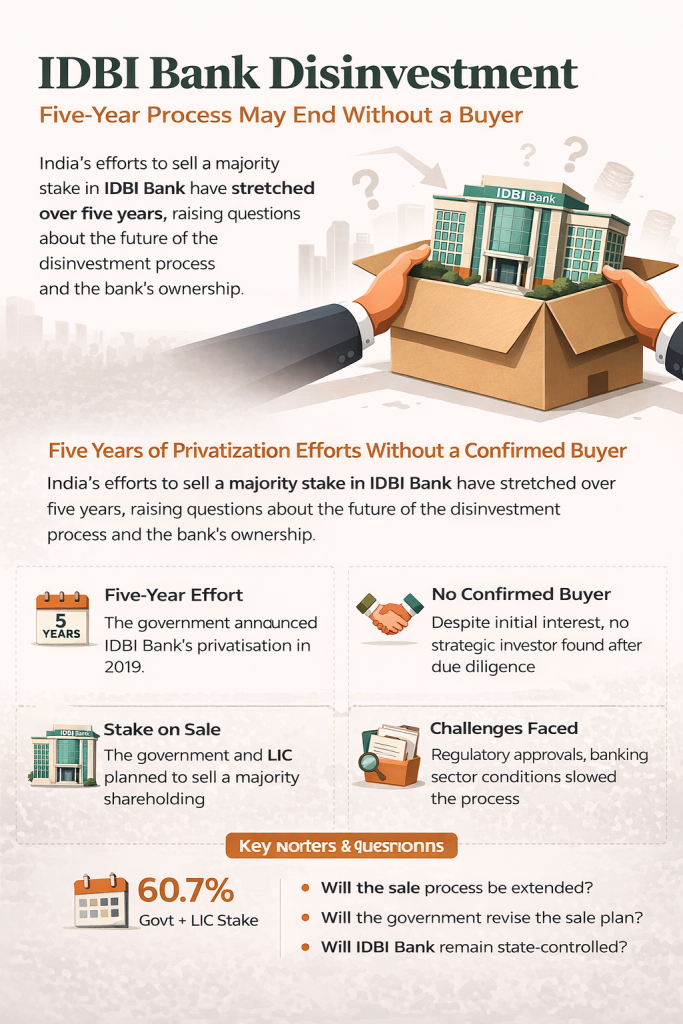
India’s long-running attempt to privatise IDBI Bank may be nearing an uncertain conclusion, with reports suggesting the five-year disinvestment process could end without a confirmed buyer.
The planned strategic sale, led by the Government of India and Life Insurance Corporation of India, was expected to mark one of the country’s biggest banking privatisation efforts. However, delays, regulatory complexities, and limited bidder interest appear to have slowed progress.
The development matters because the IDBI Bank sale is part of India’s broader privatisation push aimed at reducing government ownership in public sector enterprises and improving efficiency in the banking sector.
If the process ends without a buyer, it would raise important questions about the future of the bank’s ownership and the government’s wider disinvestment strategy.
Why the IDBI Bank Disinvestment Matters
The planned sale of IDBI Bank has been closely watched by investors, policymakers, and financial institutions.
The government and LIC together hold a majority stake in IDBI Bank, and the disinvestment plan aimed to transfer management control to a private strategic investor.
The objective behind the move included:
- Reducing government ownership in banks
- Improving operational efficiency
- Strengthening capital and governance structures
- Encouraging private sector participation in banking
The process was expected to become a major milestone in India’s banking reforms, particularly because IDBI Bank was among the first large banks considered for full strategic sale.
How the Disinvestment Process Began
The privatisation plan began several years ago as part of the government’s broader disinvestment programme.
In 2019, the government announced its intention to reduce its stake in IDBI Bank. Later, a structured sale process was initiated.
The proposed transaction involved selling a combined stake held by:
- The Government of India
- LIC
Together, these shareholders planned to sell a majority shareholding along with management control.
The process was overseen by the Department of Investment and Public Asset Management (DIPAM) under the Ministry of Finance.
Interest From Potential Buyers
Over the past few years, the government invited expressions of interest from potential strategic investors.
Several global and domestic financial groups were reported to have initially shown interest in evaluating the bank.
However, the process involved multiple stages, including:
- Preliminary expressions of interest
- Due diligence by shortlisted bidders
- Regulatory clearances
- Financial bidding
Each stage required detailed review of the bank’s financial position, regulatory obligations, and long-term growth prospects.
Market analysts have noted that such complex banking transactions often take longer than expected.
Challenges That Slowed the Sale
The IDBI Bank disinvestment process faced several hurdles that contributed to delays.
Regulatory and Approval Requirements
Any buyer would need approvals from key regulators, including:
- The Reserve Bank of India
- Insurance and financial sector regulators where applicable
Because the transaction involves a bank, regulatory scrutiny is typically extensive.
Banking Sector Conditions
Changes in the financial sector and global economic environment have also affected investor sentiment.
Large acquisitions in the banking sector require:
- Strong capital commitment
- Long-term strategic planning
- Compliance with strict regulatory rules
These factors can reduce the number of potential bidders.
Complex Ownership Structure
The joint ownership between the government and LIC also adds complexity to the transaction structure, including stake transfer and governance arrangements.
Current Situation: Five-Year Process Nearing End
The disinvestment effort has now stretched close to five years since the initial privatisation discussions began.
Recent developments suggest that the process may not conclude with a final buyer in the current timeline.
While the government has not formally announced the end of the process, policy discussions are reportedly underway on the next steps.
Possible options could include:
- Extending the sale process
- Reworking the disinvestment structure
- Maintaining the current ownership arrangement
Any official decision would likely be announced by the Finance Ministry or DIPAM.
Financial Position of IDBI Bank
IDBI Bank has seen notable changes over the past few years as it worked to strengthen its balance sheet.
After facing challenges related to non-performing assets earlier, the bank undertook several reforms, including:
- Improved asset quality management
- Capital strengthening measures
- Operational restructuring
These efforts were aimed at improving the bank’s financial performance and making it more attractive to potential investors.
The bank also operates a nationwide network of branches and serves a wide range of retail and corporate customers.
What Happens if the Sale Does Not Go Through
If the current disinvestment process ends without a buyer, the government could consider multiple options.
Possible outcomes may include:
Continuation of Current Ownership
The government and LIC may continue to remain the main shareholders while evaluating future opportunities.
Revised Sale Strategy
Authorities could redesign the sale plan, possibly offering a different stake structure or attracting new strategic investors.
Alternative Disinvestment Models
The government could also explore partial stake sales through market routes instead of a full strategic sale.
However, any such move would depend on policy decisions and market conditions.
Impact on India’s Disinvestment Programme
The IDBI Bank sale has been one of the most closely watched privatisation efforts under India’s broader asset monetisation and disinvestment plans.
The government has used disinvestment as a tool to:
- Raise funds for public spending
- Improve efficiency in public sector companies
- Encourage private sector participation
If the IDBI Bank transaction does not conclude as planned, it could influence how future banking privatisation efforts are structured.
However, experts note that large financial-sector sales often take longer due to regulatory and market factors.
Broader Context: Banking Reforms in India
Over the past decade, India has implemented several reforms aimed at strengthening the banking system.
Key steps have included:
- Bank recapitalisation programmes
- Consolidation of public sector banks
- Improved asset quality monitoring
- Governance reforms
The potential privatisation of IDBI Bank was seen as part of this broader effort to modernise the sector and bring in private sector expertise.
What to Watch Next
The coming months will be important in determining the future of the IDBI Bank disinvestment process.
Key developments to watch include:
- Any official announcement from the Finance Ministry or DIPAM
- Updates on strategic investors or revised bidding timelines
- Policy discussions around banking sector privatisation
Financial markets will also closely track how the government approaches the next phase of the process.
Conclusion
The proposed privatisation of IDBI Bank has been one of India’s most significant banking disinvestment efforts. After nearly five years of discussions and negotiations, the process now appears to face uncertainty due to the absence of a confirmed buyer.
While the government’s broader disinvestment goals remain in place, the outcome of the IDBI Bank sale will likely influence how future banking privatisation initiatives are planned.
For investors, policymakers, and the banking sector, the next steps in this process will be closely watched as India continues its efforts to reform and strengthen its financial system.
Disclaimer: The information presented in this article is intended for general informational purposes only. While every effort is made to ensure accuracy, completeness, and timeliness, data such as prices, market figures, government notifications, weather updates, holiday announcements, and public advisories are subject to change and may vary based on location and official revisions. Readers are strongly encouraged to verify details from relevant official sources before making financial, investment, career, travel, or personal decisions. This publication does not provide financial, investment, legal, or professional advice and shall not be held liable for any losses, damages, or actions taken in reliance on the information provided.
Last Updated on: Monday, March 16, 2026 4:45 pm by Outlook News Team | Published by: Outlook News Team on Monday, March 16, 2026 4:45 pm | News Categories: Business
About The Author