


Why the Global AI Summit in India Matters in 2026
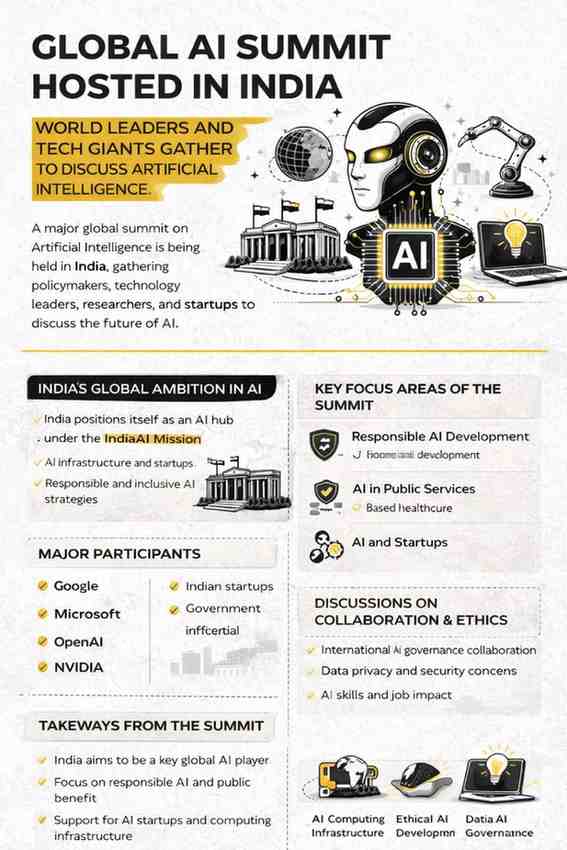
India has hosted a major global summit focused on Artificial Intelligence, bringing together policymakers, technology companies, researchers, and startups from across the world.
The summit reflects India’s growing role in shaping the global AI conversation. As artificial intelligence transforms sectors such as healthcare, education, finance, and governance, global coordination has become critical.
The event builds on India’s recent push to strengthen its digital ecosystem under the IndiaAI Mission, approved by the Union Cabinet in 2024 to boost AI research, compute capacity, and startup innovation.
For Indian businesses, students, and tech professionals, the summit signals fresh opportunities and international collaboration.
India Positions Itself as a Global AI Hub
India has steadily expanded its digital infrastructure over the past decade. With one of the world’s largest internet user bases and a strong IT services industry, the country is positioning itself as a key AI development centre.
Government initiatives such as Digital India and the IndiaAI Mission aim to:
- Expand AI research infrastructure
- Support AI startups
- Build large-scale computing facilities
- Develop skilled AI professionals
The summit highlighted India’s ambition to combine scale with responsible AI development.
Key Participants and Global Representation
The summit saw participation from representatives of major technology companies, multilateral institutions, and research bodies.
Executives from companies such as Google, Microsoft, OpenAI, and NVIDIA were part of panel discussions.
Indian technology firms and startups also showcased AI applications tailored for local needs.
Government officials, including members of the Ministry of Electronics and Information Technology, discussed regulatory frameworks and digital governance.
Focus Areas of the Summit
Responsible and Ethical AI
One of the central themes was responsible AI development.
Discussions covered:
- Data privacy
- Bias in algorithms
- Transparency in AI systems
- Accountability for automated decisions
India has been actively working on its Digital Personal Data Protection framework. Responsible AI standards are expected to align with global norms while reflecting local realities.
AI in Public Services
Another key topic was the use of AI in public services.
Examples discussed included:
- AI-based disease detection in healthcare
- Smart agriculture tools for crop monitoring
- Language translation tools for regional communication
- AI-powered grievance redressal systems
India’s multilingual population makes AI language tools especially important.
AI and Startups
The summit also spotlighted Indian startups building AI-based products.
Startups demonstrated applications in:
- Financial fraud detection
- EdTech learning models
- Supply chain optimization
- Climate monitoring
Government-backed incubators and funding support were discussed as part of ecosystem growth.
IndiaAI Mission and Infrastructure Push
The IndiaAI Mission aims to build a national AI computing infrastructure.
Key objectives include:
- Expanding GPU-based computing capacity
- Supporting AI research institutions
- Encouraging open datasets
- Building AI talent pipelines
India has emphasized the need for affordable AI access for startups and academic institutions.
The summit reinforced the message that AI growth must not be limited to large corporations.
Global Cooperation and Policy Coordination
Artificial intelligence is a global technology. Many speakers stressed the need for international cooperation.
India has been active in global forums discussing AI governance, including meetings linked to G20 discussions in recent years.
The summit highlighted the importance of:
- Cross-border research collaboration
- Shared safety standards
- AI risk assessment frameworks
- Preventing misuse of AI systems
Balancing innovation and regulation remains a key challenge worldwide.
AI and Employment Concerns
Job impact remains a major public concern.
Panel discussions addressed how AI may automate certain tasks while creating new roles.
Experts emphasized:
- Upskilling and reskilling programs
- AI literacy in schools and colleges
- Industry-academia collaboration
India’s large young workforce makes skill development crucial in the AI era.
Semiconductors and AI Hardware
AI development depends heavily on advanced chips.
India has been encouraging semiconductor manufacturing through policy incentives. Companies like NVIDIA, which design AI chips, are central to global AI infrastructure.
Discussions included supply chain resilience and reducing dependency on limited chip sources.
Data Governance and Privacy
AI systems rely on large volumes of data.
India’s approach focuses on:
- Protecting user data
- Promoting consent-based data sharing
- Ensuring secure digital platforms
Regulatory clarity is seen as essential for long-term investor confidence.
Education and Research Collaboration
Universities and research institutions participated in the summit.
India’s IITs and other technical institutes are expanding AI research labs.
International academic partnerships were discussed to encourage joint research projects.
Encouraging open research while protecting intellectual property remains a delicate balance.
Industry Reaction and Market Impact
Technology stocks and AI-focused startups closely track policy announcements from such summits.
While no speculative financial claims were made, industry observers see the event as a signal of India’s commitment to becoming a serious AI innovation hub.
Private sector collaboration with government initiatives is expected to grow.
Challenges Ahead
Despite optimism, several challenges remain:
- High computing costs
- Data security risks
- AI misinformation threats
- Need for strong regulatory oversight
Global competition in AI is intense. Countries such as the United States and China continue to invest heavily in AI research.
India’s strategy appears focused on inclusive growth and public-interest applications.
Why This Summit Is Significant for India
Hosting a global AI summit enhances India’s diplomatic and technological standing.
It signals that India is not only adopting AI tools but also contributing to policy debates.
For students and young professionals, it highlights emerging career paths in machine learning, data science, and AI ethics.
For businesses, it indicates future regulatory clarity and possible government support.
What Comes Next
Post-summit follow-ups are expected to include:
- Policy consultations
- Industry working groups
- Expanded research funding
- Public-private collaboration projects
Observers will watch how announcements translate into implementation.
The coming months will determine how summit discussions shape real-world AI deployment.
Key Takeaways
- India hosted a major global AI summit in 2026.
- Responsible AI and governance were central themes.
- Major global tech firms and Indian startups participated.
- The IndiaAI Mission remains a core pillar of AI development.
- Skill development and data protection are major priorities.
Artificial intelligence is reshaping economies and societies.
By hosting a global AI summit, India has reinforced its ambition to be a key player in the future of AI innovation and governance.
For Indian readers, the message is clear: AI is not a distant technology. It is already influencing daily life, business growth, and public services and India aims to be at the forefront of this transformation.
Disclaimer: The information presented in this article is intended for general informational purposes only. While every effort is made to ensure accuracy, completeness, and timeliness, data such as prices, market figures, government notifications, weather updates, holiday announcements, and public advisories are subject to change and may vary based on location and official revisions. Readers are strongly encouraged to verify details from relevant official sources before making financial, investment, career, travel, or personal decisions. This publication does not provide financial, investment, legal, or professional advice and shall not be held liable for any losses, damages, or actions taken in reliance on the information provided.
Last Updated on: Tuesday, February 17, 2026 10:26 am by Outlook News Team | Published by: Outlook News Team on Tuesday, February 17, 2026 10:26 am | News Categories: Tech
About The Author