

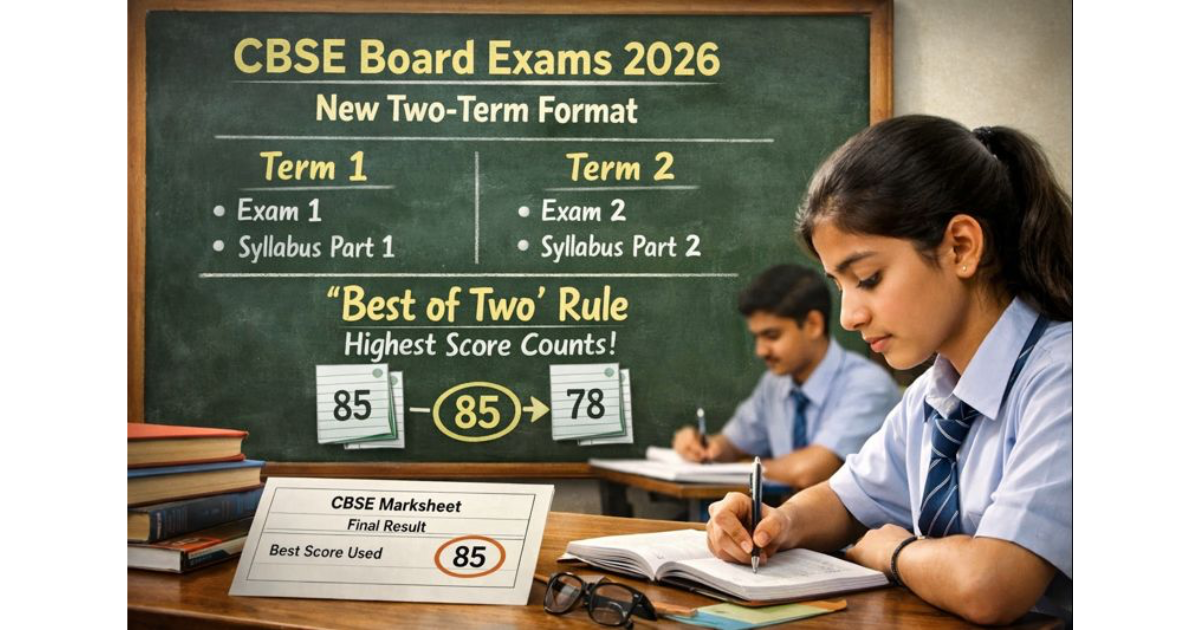
The Central Board of Secondary Education is set to introduce one of the most consequential examination reforms in recent years with the rollout of a revised board exam structure for 2026. After years of debate around high-stakes testing, student stress, and learning outcomes, CBSE’s move toward a two-term examination format combined with a ‘Best of Two’ scoring rule signals a structural shift in how academic performance is measured at the secondary level.
The reform aligns closely with the spirit of the National Education Policy, which calls for continuous evaluation, reduced exam anxiety, and a stronger focus on conceptual understanding rather than rote memorisation. For students appearing in Classes 10 and 12 in 2026, the changes are not cosmetic. They redefine preparation strategies, school calendars, and even the role of coaching.
Why CBSE Is Moving Away From a Single High-Stakes Exam
For decades, CBSE board exams have revolved around a single final examination held at the end of the academic year. While the system produced standardised outcomes, it also placed enormous pressure on students, making one exam the sole determinant of academic success.
The two-term format seeks to correct this imbalance. By splitting the assessment into two separate board-level examinations conducted at different points in the academic year, CBSE aims to distribute academic pressure and offer students more than one opportunity to demonstrate learning. This approach reflects global assessment practices where cumulative performance matters more than one-time testing.
Understanding the Two-Term Board Exam Structure
Under the new format, the academic year will be divided into two assessment cycles, commonly referred to as Term 1 and Term 2. Each term will culminate in a board-conducted examination covering the syllabus taught during that period.
Term 1 exams are expected to assess foundational concepts and early-year learning, while Term 2 exams will focus on advanced topics and application-based understanding. Both exams will be conducted at the board level, following uniform question paper patterns and evaluation standards across the country.
Importantly, internal assessments and practical examinations will continue to play a supporting role, but the two board exams will form the core of the final result.
What the ‘Best of Two’ Rule Really Means for Students
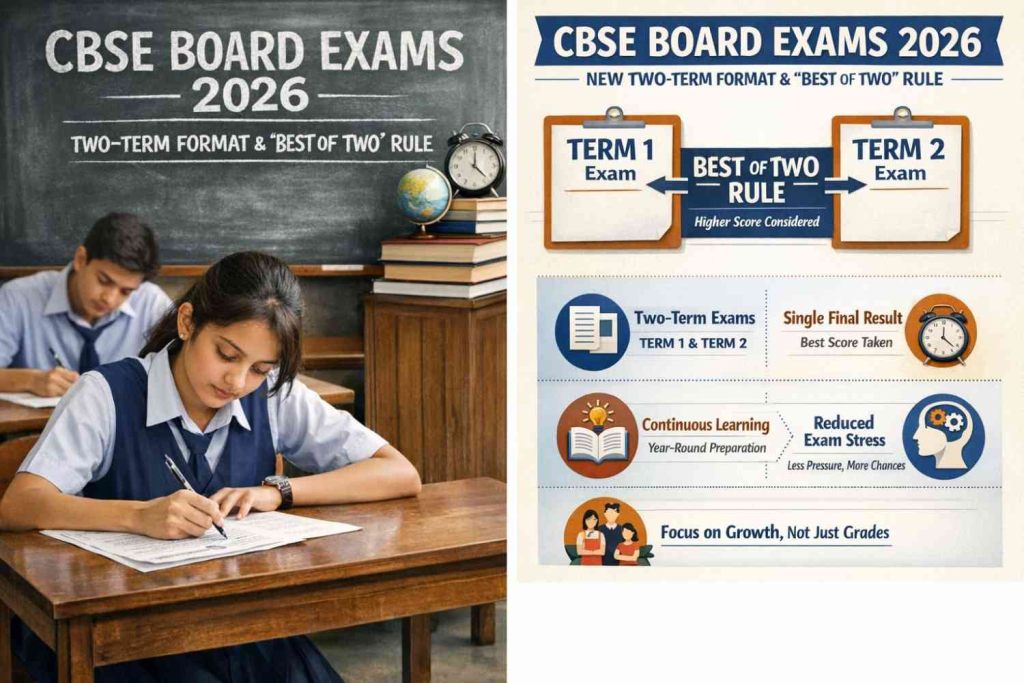
The most student-friendly element of the reform is the introduction of the ‘Best of Two’ rule. Under this system, if a student appears for both Term 1 and Term 2 exams in a subject, the higher score of the two will be considered for the final board result.
This does not mean that one term can be ignored. Students must appear for both examinations, but the safety net ensures that underperformance in one term due to illness, stress, or other factors does not irreversibly damage their academic record.
For high-pressure subjects like Mathematics, Science, and Accountancy, the rule offers psychological relief while still encouraging consistent preparation throughout the year.
How Final Results Will Be Calculated
While CBSE will conduct two separate exams, students will receive a single consolidated marksheet at the end of the academic cycle. The final score for each subject will be derived by selecting the better performance between the two terms, along with applicable internal or practical components where required.
This method balances accountability with flexibility. Students who improve significantly over the year are rewarded, while those who perform strongly early on are not penalised if they face challenges later.
Impact on Student Preparation and Learning Habits
The new format fundamentally changes how students prepare for board exams. The traditional approach of intensive last-minute preparation concentrated in the final months of the academic year becomes far less effective.
Instead, students will need to adopt a continuous learning mindset. Consistent revision, conceptual clarity, and regular practice across both terms will be critical. Schools are also expected to recalibrate teaching plans, ensuring that syllabi are paced realistically and assessments are integrated into everyday learning.
The role of coaching centres may also evolve, shifting from crash-course models to longer, concept-driven preparation cycles aligned with school teaching.
What Schools and Teachers Need to Adapt To
For schools, the two-term system introduces logistical and academic changes. Teachers will need to plan lessons more strategically, ensuring syllabus completion aligns with board exam timelines. Assessment literacy will become increasingly important, as classroom teaching must now prepare students for two high-stakes evaluations instead of one.
Schools will also need to strengthen academic counselling and student support systems, helping learners manage stress, plan revisions, and understand how the ‘Best of Two’ rule works in practice.
Concerns and Criticisms Around the New System
Despite its student-centric intent, the reform has sparked debate. Some educators worry that two board exams may actually increase stress if not implemented thoughtfully. Others point out that syllabus fragmentation could disrupt holistic learning if not carefully designed.
There are also operational challenges. Conducting two nationwide board examinations requires significant coordination, resources, and examiner capacity. CBSE will need to ensure consistency in difficulty levels and evaluation standards across both terms to maintain credibility.
What Parents Should Know Ahead of 2026
For parents, the shift demands a change in mindset. Academic success will no longer hinge on one exam season alone. Monitoring steady progress, encouraging balanced routines, and supporting mental well-being throughout the year will be more important than ever.
Understanding the mechanics of the ‘Best of Two’ rule can also help parents guide students realistically, avoiding unnecessary panic after a weaker performance in one term.
A Step Toward a Less Punitive Exam Culture
CBSE’s two-term format with the ‘Best of Two’ rule represents a broader philosophical shift in India’s education system. It acknowledges that learning is not linear and that students perform differently under varying circumstances.
If implemented carefully, the reform has the potential to reduce exam fear, reward genuine learning, and bring India’s board assessment framework closer to international best practices. For the Class of 2026, it marks the beginning of a new chapter—one where opportunity, not just outcome, defines success.
Add outlooknews.in as a preferred source on google – click here
Last Updated on: Wednesday, January 28, 2026 12:22 pm by Outlook News Team | Published by: Outlook News Team on Wednesday, January 28, 2026 12:22 pm | News Categories: News
About The Author