

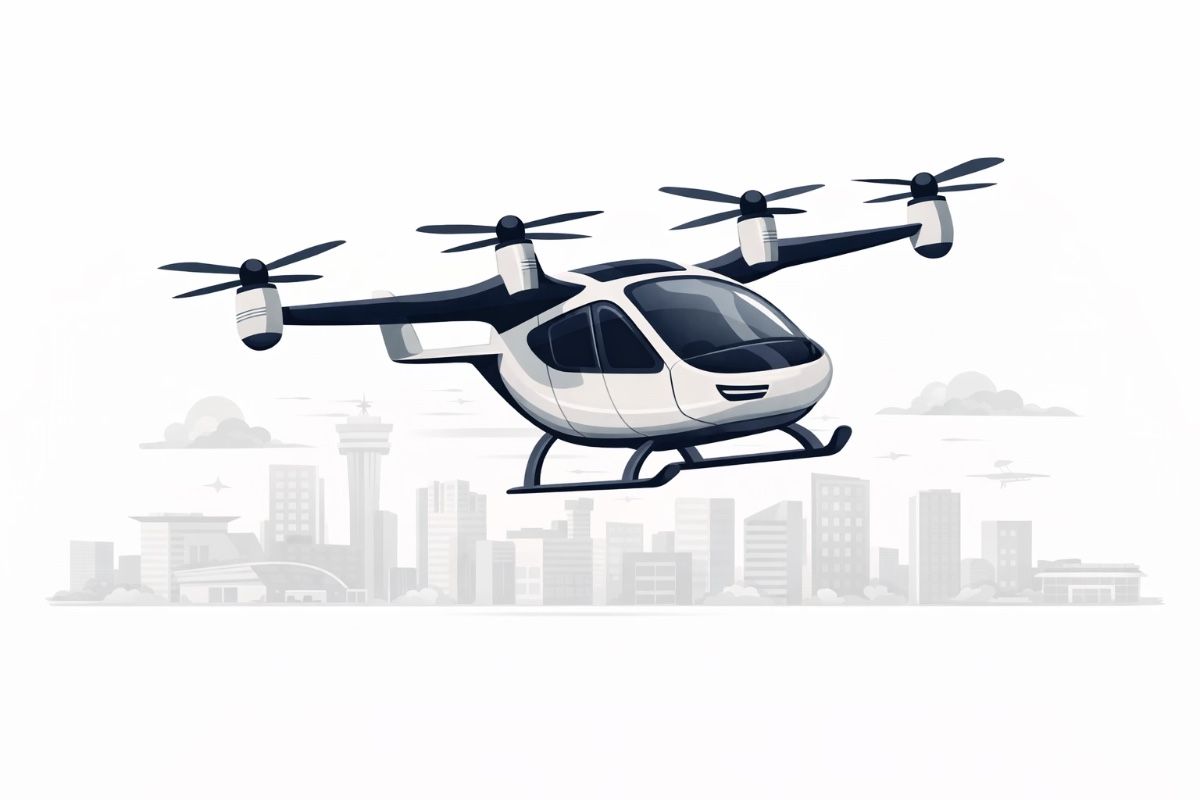
Air taxis are moving from concept to policy discussion in India, as industry and government begin laying the groundwork for urban air mobility.
A recent report by the Confederation of Indian Industry (CII) has outlined how electric air taxis could operate in Indian cities, what rules will govern them, and what needs to be done before commercial launch.
With traffic congestion worsening across metros and demand for faster urban travel rising, air taxis are now being seen as a serious future transport option, not science fiction.
Why Air Taxis Matter for India Right Now
India’s cities are struggling with road congestion, pollution, and long commute times.
In metros such as Delhi, Mumbai, Bengaluru, and Hyderabad, daily travel delays cost time, fuel, and productivity.
Air taxis offer a possible solution by reducing pressure on roads, sharply cutting travel time, using electric low-emission aircraft, and supporting smart city and clean mobility goals.
The CII report suggests that urban air mobility could become viable in India within the next few years if regulations, safety systems, and infrastructure are aligned early.
What Are Air Taxis and How Do They Work
Air taxis are small electric aircraft designed for short-distance urban travel.
Most models fall under the category of eVTOL aircraft, which stands for electric vertical take-off and landing.
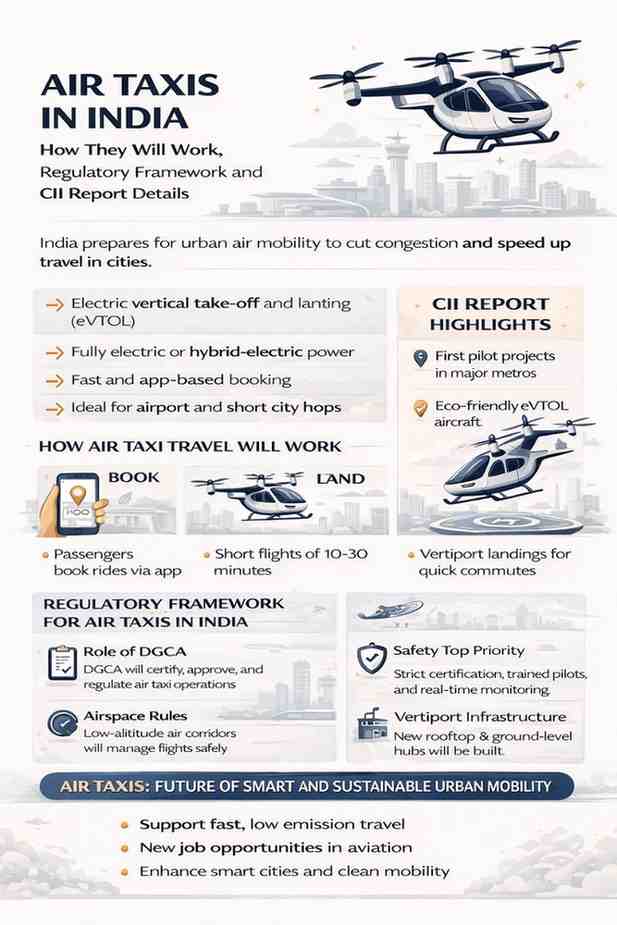
Key features of air taxis include vertical take-off and landing similar to helicopters, fully electric or hybrid-electric power systems, quieter operation compared to traditional helicopters, and short-range city and inter-city travel capability.
These aircraft do not require long runways and can operate from vertiports, which are compact landing hubs planned on rooftops, parking structures, or dedicated open spaces.
How Air Taxi Travel Will Work for Passengers
According to the CII framework, the passenger journey is expected to be digital, simple, and time-efficient.
Passengers will book rides through mobile apps, similar to cab-hailing platforms. Identity verification and safety checks will be completed digitally, and boarding will take place at designated vertiports.
Typical flights are expected to last 10 to 30 minutes, making air taxis ideal for airport transfers, business travel, and high-traffic urban routes.
Aircraft will land at vertiports located close to key destinations, with planned integration into last-mile transport systems.
The aim is to make air taxis as easy to use as app-based cabs, but significantly faster.
What the CII Report Says
The CII report provides a clear roadmap for introducing air taxis in India through a phased approach.
Initial operations will begin with pilot projects in select cities, operating on limited routes under strict safety supervision. Expansion will be gradual and linked directly to operational performance and safety records.
The report strongly emphasises that public trust will depend on safety, not speed. It calls for strict aircraft certification, trained pilots or certified autonomous systems, and real-time flight monitoring.
Regulatory Framework: Who Will Control Air Taxis
The Directorate General of Civil Aviation (DGCA) will be the primary authority regulating air taxi operations in India.
Its responsibilities will include aircraft certification, pilot licensing, airworthiness standards, and operational approvals.
Low-altitude urban airspace will require an entirely new management system. The report recommends dedicated air corridors, integration with existing air traffic control systems, and clear separation from drones and helicopters.
New urban airspace rules will be required, as current regulations are designed mainly for commercial airplanes and conventional helicopters.
Infrastructure Needs: Vertiports and Charging
Vertiports will form the backbone of air taxi operations. These are planned on rooftops of malls, office complexes, hospitals, and transport hubs, as well as at dedicated ground-level locations.
Each vertiport will need safety zones, emergency systems, passenger handling facilities, and digital monitoring infrastructure.
Since most air taxis are electric, fast-charging stations will be critical. The report highlights the importance of grid stability, backup power, and increased use of renewable energy sources.
Close coordination between aviation regulators, power utilities, urban planners, and state governments will be essential.
Cost and Affordability: Will Air Taxis Be Expensive
In the initial years, air taxis are expected to be positioned as premium transport services. Costs will be higher due to advanced technology, limited fleet sizes, and infrastructure investment.
However, the CII report expects fares to decline over time as operations scale up, battery costs fall, and competition increases.
In the long run, air taxi fares could become only slightly higher than premium road-based cab services, particularly for airport and high-demand routes.
Electric Air Taxis and Sustainability
One of the biggest advantages of air taxis is their lower environmental impact.
Electric air taxis produce zero direct emissions, generate significantly less noise than helicopters, and reduce dependence on fossil fuels.
This aligns with India’s broader push towards electric mobility, cleaner urban transport, and long-term net-zero targets.
The report stresses that strong policy support will be needed to ensure clean energy integration across the ecosystem.
Job Creation and Economic Impact
The air taxi ecosystem is expected to generate new employment opportunities across multiple sectors.
These include pilots, flight supervisors, maintenance engineers, vertiport operations staff, safety monitoring teams, and software specialists.
It could also boost domestic aerospace manufacturing, battery technology development, and urban infrastructure investment.
Key Challenges Highlighted in the Report
Despite strong potential, the report flags several challenges that need careful handling.
Public acceptance remains a key concern, particularly around safety, noise, and flying over densely populated areas.
Regulatory complexity is another issue, with coordination required between central ministries, state governments, and urban local bodies.
High initial investment costs for aircraft, infrastructure, and skilled workforce training could also slow early adoption.
The report recommends clear timelines, pilot programmes, and public communication to address these challenges.
Which Indian Cities Could See Air Taxis First
Based on congestion levels and infrastructure readiness, early candidate regions include Delhi NCR, Mumbai Metropolitan Region, Bengaluru, and Hyderabad.
Airport connectivity is expected to be the first major use case, followed by high-demand business corridors.
Global Context: Where India Stands
Globally, air taxi trials are already underway in the United States, Europe, and the Middle East.
India is currently at the policy and planning stage, but the CII report indicates a clear intent to move quickly and close the gap.
What Happens Next
Industry sources indicate that government consultations may follow the report, with draft rules released for public feedback.
Pilot projects are likely to be announced in phases, although no official commercial launch timeline has been confirmed yet.
Why This Is a Big Policy Moment
Air taxis signal a major shift in how India approaches urban transport.
Beyond roads and metro systems, policymakers are now seriously considering vertical mobility.
If implemented carefully, air taxis could become a practical solution for time-sensitive travel, a symbol of advanced urban planning, and a new chapter in Indian aviation.
Bottom Line
Air taxis in India are no longer just futuristic ideas.
With the CII report laying out operations, regulations, and infrastructure needs, the discussion has moved firmly into the policy execution phase.
The future of air taxis will depend on safety, affordability, and smart regulation.
If these elements fall into place, India’s urban skyline may soon witness a new mode of transport taking flight.
Disclaimer: The information presented in this article is intended for general informational purposes only. While every effort is made to ensure accuracy, completeness, and timeliness, data such as prices, market figures, government notifications, weather updates, holiday announcements, and public advisories are subject to change and may vary based on location and official revisions. Readers are strongly encouraged to verify details from relevant official sources before making financial, investment, career, travel, or personal decisions. This publication does not provide financial, investment, legal, or professional advice and shall not be held liable for any losses, damages, or actions taken in reliance on the information provided.
Last Updated on: Tuesday, February 10, 2026 11:40 am by Outlook News Team | Published by: Outlook News Team on Tuesday, February 10, 2026 11:40 am | News Categories: Tech
About The Author