
From hyper-realistic fake screenshots to celebrity selfies, AI-generated humour is redefining how harmless mischief plays out online.
April 1 has long been associated with playful deception, but this year the scale and sophistication of pranks have noticeably evolved. Users across platforms are increasingly turning to Google Gemini to generate convincing visual content within seconds, using simple text instructions.
AI meets April Fools’ Day: A viral trend takes shape
As April 1 unfolds globally, users are leveraging Gemini’s image-generation capabilities to create prank content that is both creative and highly realistic. At the centre of this trend is the so-called “Nano Banana” model, a nickname commonly used online to refer to Gemini’s fast and lightweight image-generation system.
Originally introduced as part of Google’s multimodal AI expansion, the image model—often associated with Gemini 2.5 Flash Image—gained rapid traction due to its ability to produce context-aware visuals with minimal effort. By 2026, improved versions have enhanced speed, realism, and prompt accuracy, making AI-generated pranks more accessible to everyday users.
What is “Nano Banana” and why is it trending?
Despite its quirky nickname, “Nano Banana” is not a standalone application. It is a powerful image-generation capability integrated into Gemini and related Google AI services.
The tool enables users to edit and generate images using natural language prompts. This includes combining multiple images, adjusting lighting and expressions, and producing outputs that closely resemble real photographs. Its ability to maintain subject consistency across edits makes it particularly effective for prank content.
The viral appeal also lies in its simplicity. Users can upload an image, type a short instruction, and receive a polished visual that is ready to share on messaging platforms or social media.
The “Nano Banana” prank culture: What’s going viral
This April Fools’ Day, a range of AI-generated prank formats are trending across digital platforms. These are typically created using prompt templates that users customise.
Fake celebrity selfies are among the most popular, where individuals appear to be casually posing with well-known public figures. The realism of lighting and facial expressions often makes these images briefly convincing.
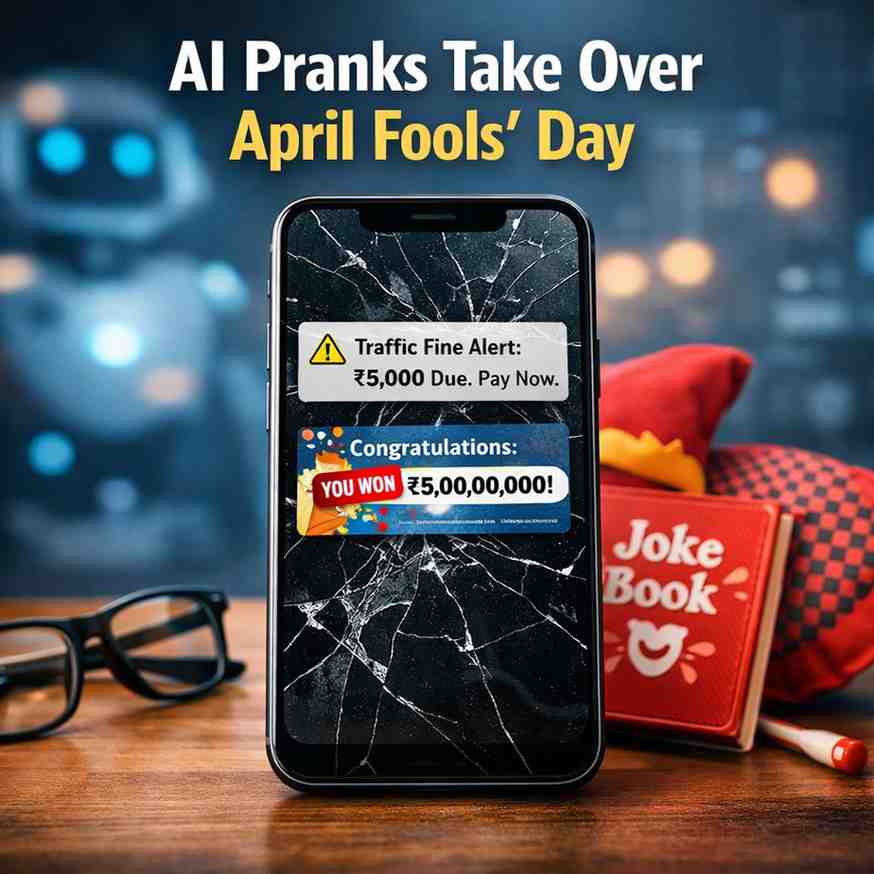
Another widely shared format is the broken phone screen illusion. Here, users edit images to make it look like their phone display has cracked, often surprising friends before revealing the prank.
Some users are also creating fake official notices or challans designed to resemble government alerts. While these are intended as jokes, experts caution that such content should be used responsibly to avoid unnecessary panic.
Lottery or jackpot announcements are also circulating, with images styled like news graphics showing users winning large sums of money. Cinematic transformations, where photos are turned into dramatic movie posters or superhero visuals, round out the trend.
How the technology works
The underlying system relies on multimodal artificial intelligence, which combines text understanding with visual generation. When a user inputs a prompt, the model interprets the instruction and modifies or generates images accordingly.
A notable feature is its ability to preserve identity across edits. This ensures that the subject in the image remains consistent even after multiple transformations, contributing to the realism of the final output.
To address concerns about misuse, Google has implemented safeguards such as SynthID, a watermarking system that embeds invisible markers in AI-generated images. This helps identify content as AI-created without affecting its visual quality.
Ethical concerns and safety warnings
While most of these pranks are intended to be harmless, the growing realism of AI-generated content raises important ethical questions.
Images that mimic official documents or legal notices could cause confusion if shared without context. Similarly, AI-generated celebrity images may blur the line between parody and misrepresentation.
Experts emphasise that the spirit of April Fools’ Day lies in humour that is quickly revealed and does not cause distress. As AI tools become more powerful, responsible use becomes increasingly important.
Why this trend matters
The popularity of “Nano Banana” pranks reflects a broader shift in how people interact with technology. Artificial intelligence is no longer confined to specialised fields; it is becoming part of everyday communication and entertainment.
Creative tools that once required technical expertise are now accessible to a wide audience. As a result, social media trends are increasingly shaped by AI-driven content.
The rapid adoption of such tools also highlights how quickly digital culture evolves when new technologies become widely available.
The bottom line
April Fools’ Day in 2026 marks a turning point where traditional pranks meet advanced AI capabilities. With tools like Google Gemini, users can create content that is more imaginative and convincing than ever before.
However, the essence of a good prank remains unchanged. In an era of hyper-realistic AI, the most successful jokes are still those that entertain without misleading or harming others.
Add outlooknews.in as preferred source on google – click here
Also read – Adani Green Energy delivers 5 GW milestone in FY26: A global benchmark in renewable expansion
Last Updated on: Wednesday, April 1, 2026 11:58 am by Monisha Angara | Published by: Monisha Angara on Wednesday, April 1, 2026 11:57 am | News Categories: Tech
About The Author