

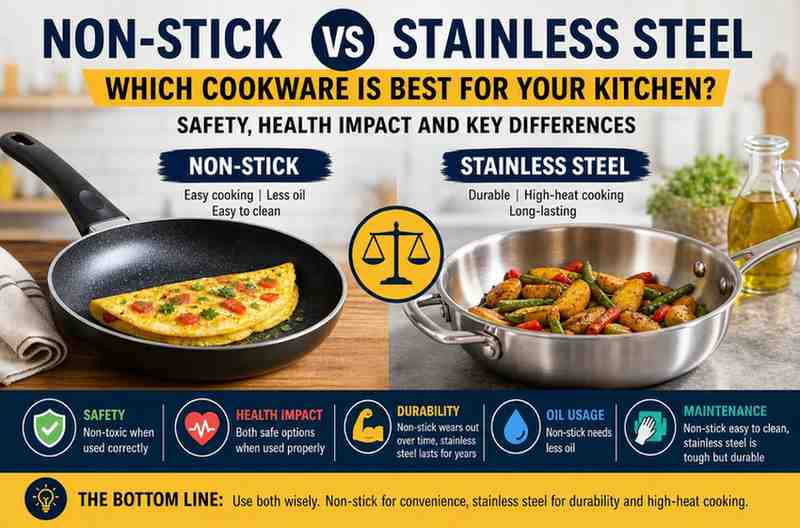
Choosing the right cookware today goes beyond convenience. It directly affects how you cook, how healthy your meals are, and how long your kitchen tools last. Among the most commonly used materials are Non-stick cookware and Stainless steel cookware, each offering distinct advantages and limitations.
Here’s a detailed, fact-based comparison to help you make an informed decision.
What is non-stick cookware?
Non-stick cookware is coated with a synthetic layer, most commonly polytetrafluoroethylene (PTFE), which prevents food from sticking to the surface. This allows cooking with very little oil and makes cleaning significantly easier.
It is especially useful for dishes like eggs, pancakes, and other delicate foods that tend to stick easily.
What is stainless steel cookware?
Stainless steel cookware is made from an iron-based alloy combined with chromium, making it resistant to rust and corrosion. Many stainless steel utensils also include layers of aluminium or copper to improve heat distribution.
It is widely used for everyday cooking, including curries, sautéing, frying, and high-heat preparations.
Safety and health impact
Non-stick cookware safety
Modern non-stick cookware is considered safe when used properly. It performs well under normal cooking conditions, but there are important guidelines to follow.
It should not be overheated beyond high temperatures, as excessive heat can degrade the coating. Scratched or damaged surfaces should also be replaced, as the coating may wear off over time.
Earlier concerns around harmful chemicals have largely been addressed, as most modern non-stick cookware is now manufactured without those substances.
Stainless steel safety
Stainless steel is widely regarded as one of the safest cookware materials available. It does not have a chemical coating and remains stable even at high temperatures.
In some cases, very small amounts of metals such as nickel and chromium may transfer into food, particularly when cooking acidic dishes. However, for most people, this is not considered harmful.
Key differences between non-stick and stainless steel
Cooking performance is one of the biggest differences. Non-stick cookware works best at low to medium heat and is ideal for foods that require gentle handling. Stainless steel, on the other hand, performs better at high heat and is excellent for browning, searing, and cooking heavier dishes.
Oil usage is another factor. Non-stick cookware requires very little oil, making it suitable for low-fat cooking. Stainless steel usually needs more oil to prevent food from sticking.
Durability varies significantly. Non-stick coatings tend to wear out over time, typically within a few years depending on usage. Stainless steel cookware can last for decades if properly maintained.
Maintenance also differs. Non-stick cookware is easy to clean but requires careful handling to avoid scratches. Stainless steel is tougher and more resistant to damage, though it may require more effort to clean after cooking.
Heat tolerance is another key point. Non-stick cookware is not designed for very high temperatures, while stainless steel can handle high heat and is often oven-safe.
Health comparison
From a health perspective, stainless steel has a slight advantage because it does not rely on a coating and remains stable across a wider temperature range.
Non-stick cookware is still safe for everyday use when handled correctly, but misuse such as overheating or using damaged pans can reduce its safety over time.
When should you use each?
Non-stick cookware is best suited for cooking items like eggs, dosa, pancakes, and other delicate foods where sticking is a concern. It is also ideal when you want to minimise oil usage and simplify cleanup.
Stainless steel cookware is better for preparing curries, stir-fries, meats, and dishes that require high heat or longer cooking times. It is also a better long-term investment due to its durability.
Common misconceptions
It is often assumed that non-stick cookware is unsafe, but modern versions are designed to be safe under normal use. Similarly, while stainless steel is highly stable, it is not entirely free from minor metal interaction with food.
Another common misunderstanding is that one type is universally better than the other. In reality, both serve different purposes in the kitchen.
What should you choose?
Most experts recommend using both types of cookware rather than choosing one exclusively.
Stainless steel provides durability, versatility, and high-heat performance, making it suitable for most cooking tasks. Non-stick cookware adds convenience, especially for quick meals and low-oil cooking.
The bottom line
There is no single winner in the comparison between Non-stick cookware and Stainless steel cookware.
If your priority is long-term durability, high-heat cooking, and overall safety, stainless steel is the better choice. If you value ease of use, minimal oil, and quick cleanup, non-stick cookware is more suitable.
For most households, the ideal approach is to combine both, using each where it performs best.
Input & Images : Hindusthan Samachar
Add outlooknews.in as preferred source on google – click here
Last Updated on: Friday, May 1, 2026 4:45 pm by Monisha Angara | Published by: Monisha Angara on Friday, May 1, 2026 4:45 pm | News Categories: Lifestyle
About The Author