

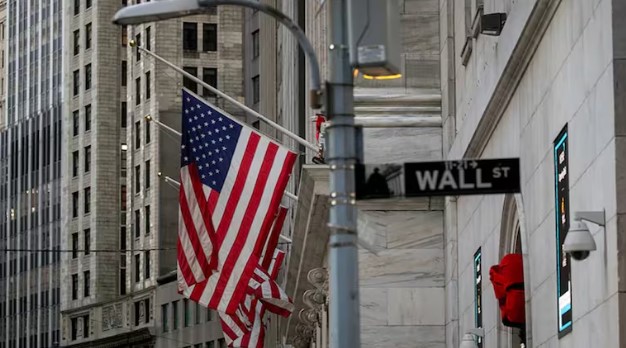
Asian indices fall sharply and Dow futures drop over 300 points after failed diplomatic efforts raise fresh geopolitical concerns.
Global financial markets opened the week on a cautious note after reported breakdown in diplomatic talks between the United States and Iran heightened geopolitical tensions. The development, linked to discussions held in Pakistan, has unsettled investor sentiment worldwide, leading to a broad-based sell-off across Asian markets and declines in US futures.
Key Market Movements
US futures indicated weakness, with Dow Jones futures falling 344.57 points (0.72%) to 47,570, signaling a subdued start.
On Friday, US markets had closed on a mixed note. The S&P 500 edged down 0.11% to 6,816.89, while the Nasdaq gained 0.35% to settle at 22,902.89.
European markets also reflected caution. The FTSE 100 slipped 0.03%, Germany’s DAX remained nearly unchanged, and France’s CAC 40 rose 0.17%.
Asian Markets React Sharply
Most Asian markets traded lower on Monday, reflecting heightened uncertainty among investors.
GIFT Nifty declined sharply by 442.50 points (1.84%), indicating potential weakness in Indian equities. Japan’s Nikkei fell 1.04%, South Korea’s Kospi dropped 1.27%, and Hong Kong’s Hang Seng declined 1.01%.
China’s Shanghai Composite slipped 0.17%, while Singapore’s Straits Times and Indonesia’s Jakarta Composite also registered modest losses. Taiwan’s weighted index was the only major market to post a marginal gain of 0.03%. Thailand’s SET index remained closed due to a holiday.
What Triggered the Sell-Off?
The downturn follows reports that US–Iran negotiations aimed at easing tensions in West Asia failed to produce an agreement. The talks, reportedly held in Pakistan, had initially raised hopes of diplomatic progress.
However, their collapse has renewed concerns about prolonged instability in a region crucial to global energy supplies, prompting investors to reduce exposure to riskier assets.
Official and Market Interpretation
Although no detailed official statement has clarified the outcome of the talks, market sentiment suggests disappointment over the lack of progress. Analysts say that uncertainty surrounding geopolitical developments often leads to cautious trading and market volatility.
Broader Context
West Asia remains a key region for global markets due to its role in oil production and strategic trade routes. Any escalation in tensions can influence crude oil prices, disrupt supply chains, and impact inflation expectations worldwide.
Historically, geopolitical uncertainty in the region has led to short-term volatility in equity markets and shifts toward safer investment options.
Impact on India and Investors
For India, the decline in GIFT Nifty suggests a weak opening for domestic stock markets. Investors may see increased volatility in benchmark indices.
Sectors linked to global trade and energy could face pressure, while safer assets such as gold may see increased demand. Despite short-term fluctuations, domestic economic factors will continue to shape long-term market direction.
Conclusion and Outlook
Global markets are likely to remain sensitive to further geopolitical developments in the coming days. Investors will closely monitor any updates on diplomatic efforts, along with movements in oil prices and global cues.
Until clearer signals emerge, cautious sentiment and volatility are expected to dominate trading across major markets.
Input & Images : Hindusthan Samachar
Add outlooknews.in as preferred source on google – click here
Also read – CAIT, Shriram Finance Launch Fintech Portal to Expand Credit Access for Small Businesses
Last Updated on: Sunday, April 12, 2026 6:57 am by Monisha Angara | Published by: Monisha Angara on Sunday, April 12, 2026 6:57 am | News Categories: Business
About The Author